




Climbing Carabiner UIAA Certification Meaning: The Global Gold Standard for Safety
When you're hanging off a rock face hundreds of feet in the air, the small metal clip connecting you to your safety rope is more than just a piece of gear—it's a lifeline. This is where the UIAA certification stamp on a climbing carabiner transforms from a simple logo into a critical promise of safety. Understanding what this certification means is not just for gear nerds; it is fundamental knowledge for every climber who trusts their life to their equipment.
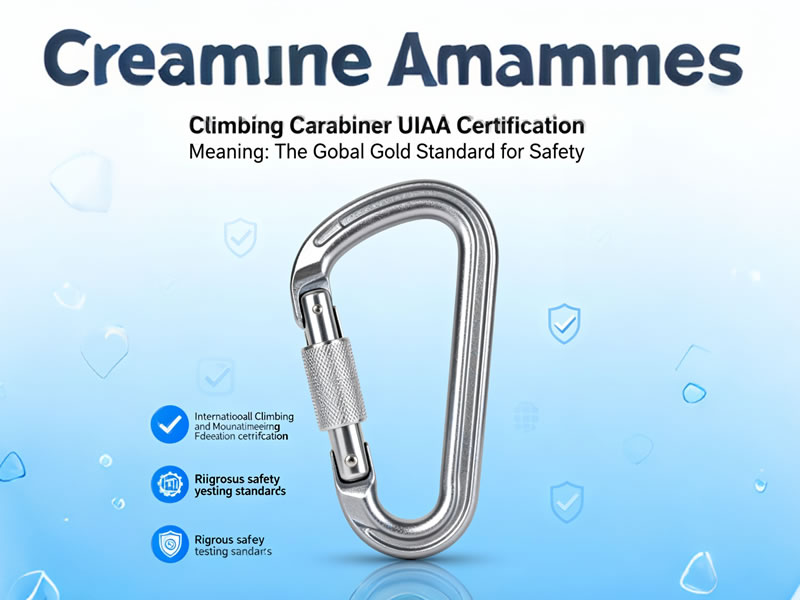
The UIAA (Union Internationale des Associations d'Alpinisme), or the International Climbing and Mountaineering Federation, is the global governing body that sets the voluntary safety standards for climbing equipment. A UIAA certification on a carabiner is your guarantee that it has passed a series of brutal, independent tests that go far beyond what a manufacturer might do on its own. It is a universally recognized seal of approval, signifying that the carabiner meets the highest and most rigorous international benchmarks for strength, durability, and reliability.
The Rigorous Testing Behind the Stamp
The UIAA doesn't just take a manufacturer's word for it. To earn the certification, carabiner models are subjected to a battery of destructive tests that simulate extreme and worst-case scenarios. Here’s what that process entails:
1. Strength Under Load: The Three Critical Tests
A carabiner's strength is tested in the three ways it could potentially fail in the real world, with all ratings measured in kilonewtons (kN):
- Major Axis Strength (Closed Gate): The carabiner is pulled apart along its spine. The UIAA minimum requirement is 20 kN. Most modern carabiners far exceed this, often rating between 22-28 kN. This test verifies its strength in the ideal, intended loading configuration.
- Minor Axis Strength (Cross-Loaded): The carabiner is loaded across its weakest dimension—from the gate to the spine. The UIAA requires it to withstand a minimum of 7 kN. This test is crucial because it validates the carabiner's resilience in a common misuse scenario, highlighting why proper orientation is so important.
- Open Gate Strength: The carabiner is loaded along its major axis with the gate open. The minimum requirement is also 7 kN. This test ensures that even in its most vulnerable state (which a locking carabiner is designed to prevent), the carabiner retains a baseline level of strength.
2. Gate Function Test: Ensuring Reliability
Strength is meaningless if the gate fails. The UIAA tests the gate mechanism by opening and closing it 10,000 times. After this cycle, the gate must still function correctly—opening smoothly, closing crisply, and not showing significant wear that could lead to failure. This ensures the spring and hinge will last through years of use.
3. Durability and Impact Tests
Additional tests may include impact testing and checks for sharp edges that could damage a rope. The certification process looks at the entire design and construction, not just a single attribute.
UIAA vs. CE: A Complementary Partnership
You will often see the CE mark alongside the UIAA Safety Label. While related, they have different purposes:
- CE Mark (Conformité Européenne): This is a legal requirement for selling climbing equipment in the European Economic Area. It indicates the product meets the essential health and safety requirements of the European Personal Protective Equipment (PPE) Regulation. In practice, for climbing gear, manufacturers typically use the UIAA standards to demonstrate conformity with CE requirements.
- UIAA Certification: This is a voluntary, international safety benchmark that often exceeds the basic CE requirements. It is a mark created by climbers, for climbers, and is recognized globally as the symbol of top-tier quality and safety.
Think of it this way: CE is the legal "driver's license" for the gear to be sold in Europe, while the UIAA certification is the "honors degree" that shows it excels in safety.
Why This Certification Matters to You
For the climber, the UIAA certification provides three invaluable things:
- Peace of Mind: It means an independent body has verified the gear's performance. You are not relying solely on the manufacturer's marketing claims.
- Standardization: It creates a level playing field. Whether you buy a carabiner from a German, American, or Korean company, if it has the UIAA label, it has passed the same rigorous tests.
- A History of Safety: The UIAA has been setting these standards for decades. Their protocols are continuously updated based on technological advances, material science, and—tragically—accident analysis, making modern certified gear safer than ever before.
Conclusion: Don't Just Clip In—Look First
The UIAA certification on a climbing carabiner is the culmination of decades of engineering, testing, and a deep-seated commitment to the safety of the climbing community. It is a non-negotiable feature for any serious climber.
Before you purchase your next carabiner, or any piece of critical safety gear, make a habit of looking for the UIAA Safety Label. It is a small stamp that carries the weight of a global community's dedication to preserving life. In a sport where margins for error are slim, this certification is your first and most important line of defense. Trust it, and climb with confidence.




