




What is the Gate Strength of a Climbing Carabiner?
When evaluating the safety of a climbing carabiner, many climbers understandably focus on the prominent major axis strength rating—the impressive 22-28 kN figure stamped on the spine. However, a far more critical number, often overlooked, reveals the carabiner's greatest vulnerability: the gate strength, officially known as the open-gate strength. This rating isn't just another specification; it is a crucial safety warning that defines the carabiner's performance in its weakest possible state and fundamentally dictates how it must be used in life-supporting systems.
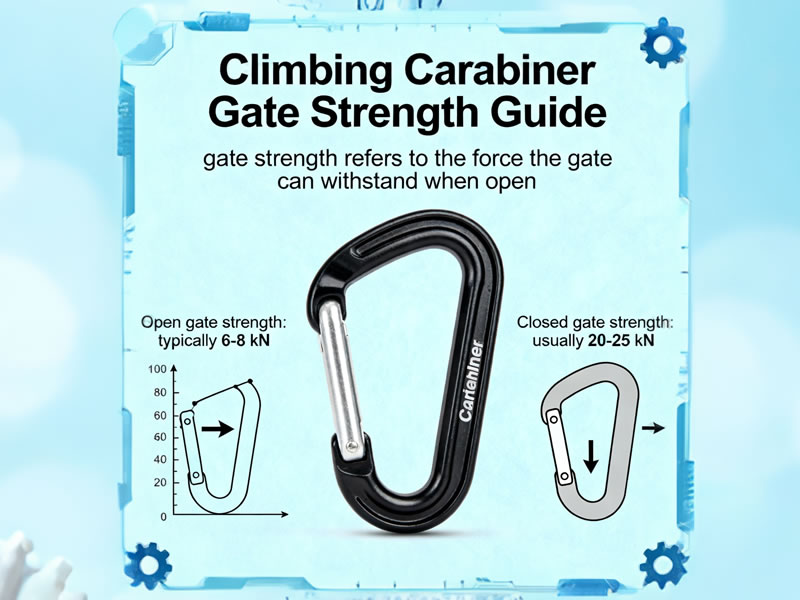
This article will delve into what gate strength truly means, why it is intentionally the lowest rating, and how this single number underpins the most important safety practices in climbing.
Defining Gate Strength: The Achilles' Heel
The gate strength of a climbing carabiner is the maximum force it can withstand when pulled along its major axis (from spine to base) with the gate fully open. For the vast majority of UIAA and CE-certified carabiners, this rating falls within a narrow and critical range of 7 kN to 10 kN.
To put this in perspective, 1 kN is approximately 225 pounds of force. Therefore, a gate strength of 8 kN translates to about 1,800 pounds. While this may still sound like a lot, it represents a drastic reduction from the carabiner's full potential.
The Dramatic Strength Reduction: A Tale of Two Numbers
The true significance of gate strength becomes clear only when compared to the carabiner's closed-gate strength:
- Closed-Gate Strength (Major Axis): 22-28 kN (approx. 4,950 - 6,300 lbs)
- Open-Gate Strength (Major Axis): 7-10 kN (approx. 1,575 - 2,250 lbs)
This comparison reveals a staggering 60-75% reduction in strength when the gate is open. The reason for this is fundamental engineering: an open gate creates a massive structural flaw. The carabiner is no longer a continuous, load-bearing oval or D-shape; it becomes a broken, "C"-shaped piece of metal. The open end cannot effectively distribute stress, causing forces to concentrate at the tip of the gate and the opposing nose of the carabiner body, which are the weakest points in the entire structure.
Why the UIAA/CE Standard is a Lifesaver
The existence of a standardized and tested open-gate rating is a cornerstone of climbing safety. The UIAA and CE require this test precisely to quantify this vulnerability and to ensure that even in this compromised state, the carabiner maintains a minimum baseline strength.
The test itself is brutal: a hydraulic machine pulls the carabiner apart while a fixture holds the gate open. The carabiner must not fail below the 7 kN threshold. This mandatory test forces manufacturers to design carabiners with robust nose profiles and gate interfaces, ensuring that this "weakest link" is still strong enough to provide a margin of safety in a catastrophic scenario.
The Real-World Implications: From Theory to Practice
Understanding gate strength is not an academic exercise; it directly informs the most critical safety protocols in climbing:
- The Necessity of Locking Carabiners: This is the most important practical application. The drastic strength reduction when open is the entire reason we use locking carabiners for belaying, anchors, and rappelling. A non-locking carabiner's gate can be accidentally opened by the rope, the rock, or another piece of gear. A locking carabiner, whether screw-gate or auto-locking, is designed with a single purpose: to prevent the gate from opening and thus preserve the carabiner's full strength.
- The Danger of "Gate Lash": During a fall, a non-locking carabiner on a quickdraw can experience "gate lash," where the rope whips against the gate, causing it to open and close rapidly. While the system is designed to minimize the chance of the gate being open at the exact moment of peak load, the low gate strength rating acknowledges this real-world risk and ensures the carabiner can still handle it.
- Inspection and Retirement: A carabiner with a damaged gate—such as a bent or notched nose, or a worn-down catch—may see its effective gate strength fall even further. This makes a thorough gate inspection a vital part of any pre-climb check.
Conclusion: The Most Important Number for Safety-Conscious Climbers
While the major axis strength rating inspires confidence, the gate strength rating teaches a vital lesson in humility and vigilance. It is a constant reminder that a carabiner's safety is conditional on the integrity of its gate.
For the informed climber, the gate strength rating is a guide that dictates behavior:
- It mandates the use of a locking carabiner anywhere a failure would be catastrophic.
- It justifies the extra second it takes to visually and physically confirm that a screw-gate is fully locked.
- It reinforces why we avoid situations where a carabiner could be twisted or leveraged into a gate-open position.
In the end, knowing that a carabiner's strength can plummet from over 5,000 pounds to under 2,000 pounds by simply opening the gate is the most powerful argument for meticulous, knowledgeable gear management. It underscores that safety in climbing is not just about the strength of your equipment, but about your understanding of its limitations.




