




Oval vs. D-Shaped vs. Asymmetric Climbing Carabiner
For climbers, the humble carabiner is a fundamental tool. But not all biners are created equal. One of the most critical distinctions lies in their shape, which directly influences their strength, weight, and best-use scenarios. Understanding the difference between oval, D-shaped, and asymmetric designs is key to building a safe and efficient rack. Let's break down the pros, cons, and primary applications of each.
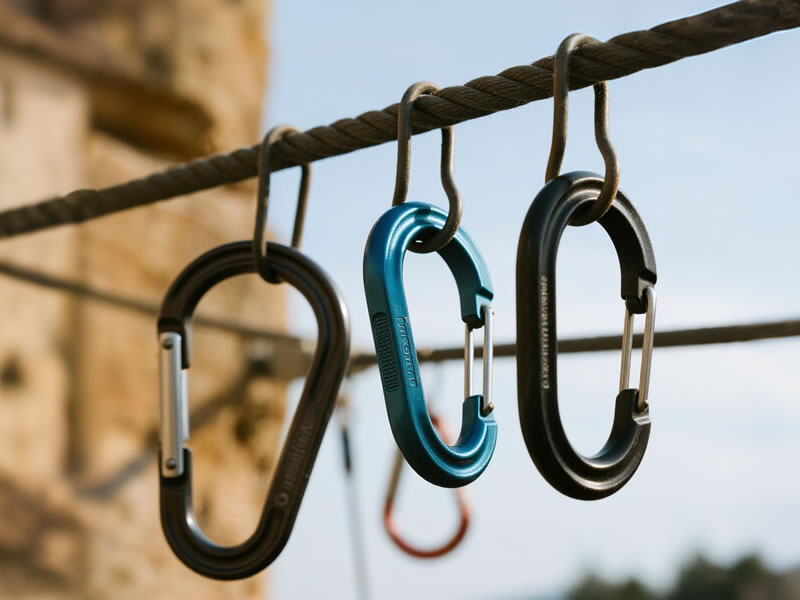
The Versatile Workhorse: Oval Carabiners
Design & Characteristics:
The oval carabiner features a symmetrical, rounded shape. This classic design was one of the first used in climbing and offers a balanced, uniform profile.
Strengths:
- Versatility: Their symmetry makes them excellent for use with multiple pieces of gear, such as in a pulley system or when racking hexcentrics, as they don't twist or sit awkwardly.
- Gate Opening: They typically have a wide, unobstructed gate opening, making it easy to clip bulky items like multiple slings or a knotted cordelette.
- Cost: Ovals are often among the most affordable carabiner types.
Weaknesses:
- Strength-to-Weight Ratio: This is their biggest drawback. Because the load is distributed equally across both sides, the oval is the weakest shape for its weight. Under load, the force is shared by both the spine and the gate side, which is inherently weaker.
- Less Specialized: Their "jack-of-all-trades" nature makes them a master of none in the modern age of specialized gear.
Best For:
- Anchor Building: Clipping multiple rope strands or gear at an anchor master point.
- Racking Gear: Organizing nuts and hexes on your harness.
- Pulley Systems: Their symmetrical shape is ideal for use with rescue or hauling pulleys.
The Strength Champion: D-Shaped Carabiners
Design & Characteristics:
As the name implies, the D-shape features a straight spine and a curved gate side. This design intentionally shifts the load away from the weaker gate and onto the stronger spine.
Strengths:
- Superior Strength: The D-shape is the strongest standard carabiner design. By channeling force onto the spine, it achieves a higher load-bearing capacity (measured in kN) than an oval of similar size and weight.
- Durability: The robust spine can withstand more abuse over time.
Weaknesses:
- Smaller Gate Opening: The curved gate can result in a slightly smaller internal space and gate opening compared to an oval, which can sometimes make clipping feel more fiddly.
Best For:
- Belaying and Rappelling: The high strength and security make D-shaped lockers the preferred choice for attaching a belay device.
- Critical Anchor Points: Ideal for any life-critical connection where maximum strength is paramount.
The Sport Climbing Specialist: Asymmetric D Carabiners
Design & Characteristics:
The asymmetric D (or bent-gate carabiner) is a specialized evolution of the D-shape. It features a deeply curved, often "banana-shaped" profile, with a gate that is frequently slightly bent.
Strengths:
- Optimum Rope Clipability: This is their raison d'être. The asymmetric shape creates a large, funnel-like opening that guides the rope in effortlessly. The bent gate aids in the rope's smooth entry during one-handed clips. They are famously easy and fast to use.
- Light Weight: Designed for speed and efficiency on sport routes, they are typically the lightest of the three shapes.
- Reduced Gate Flutter: The design can help stabilize the gate during a fall, reducing the chance of it bouncing open.
Weaknesses:
- Reduced Strength: While still very strong (meeting all UIAA safety standards), they are slightly weaker than a standard D-shape due to the more extreme shape and focus on weight reduction.
- Specialized Use: They are almost exclusively designed for one job: being the rope-end carabiner on a quickdraw.
Best For:
- Quickdraws (Rope-End): Their primary and essential function is on the rope-end of a sport climbing quickdraw, facilitating smooth, rapid clipping.
- Competition Climbing: Where every gram and split-second counts.
Head-to-Head Comparison
| Feature | Oval | D-Shaped | Asymmetric D |
|---|---|---|---|
| Primary Strength | Lowest | Highest | Moderate (but sufficient) |
| Weight | Moderate | Moderate | Lightest |
| Gate Opening | Large | Smaller | Largest & easiest for ropes |
| Best Use Case | Anchors, racking | Belaying, critical anchors | Sport climbing quickdraws |
Conclusion: Matching the Shape to the Task
Choosing the right carabiner shape is about applying the right tool for the job.
- For all-purpose safety and belaying, choose a D-shaped locker. Its strength is unmatched for critical systems.
- For building anchors and organizing gear, an oval is a versatile and cost-effective choice.
- For sport climbing performance, an asymmetric D on your quickdraws is non-negotiable for its clipping ease and light weight.
By understanding these core designs, you can build a rack that is not only safe but also optimized for your chosen climbing discipline. Always remember to use locking carabiners for all critical connections and regularly inspect all gear for signs of wear.




