




How does a carabiner hook work?
At first glance, a carabiner seems like a simple metal loop with a gate. But this deceptively basic design is the product of over a century of refinement, resulting in a device that is both incredibly strong and functionally elegant. Understanding how a carabiner works isn't just about mechanics; it's about appreciating the engineering that makes it a reliable lifeline for climbers, rescuers, and industrial workers. Its operation can be broken down into a few core components and principles working in perfect harmony.
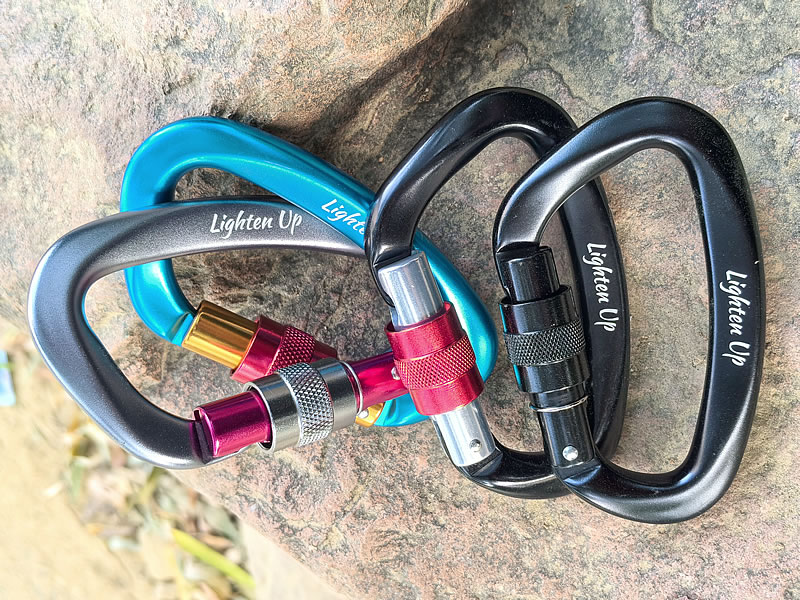
The Core Components: A Team Effort
To understand how a carabiner works, you must first know its parts:
- The Spine: The solid, un-moving arc of the carabiner. This is the primary load-bearing member, designed to withstand immense force.
- The Gate: The movable section that opens and closes. It's the "door" that allows you to insert a rope, sling, or other gear.
- The Spring: A small but vital component housed inside the gate. It provides the constant tension that keeps the gate shut.
- The Nose: The end of the gate, which features a notch or pin that engages with the carabiner's body to hold it closed.
- The Locking Mechanism (on Locking Carabiners): An additional feature that secures the gate to prevent accidental opening.
The Basic Operation: The Snap-Gate
The fundamental operation of a non-locking, or "snap-gate," carabiner is a two-step process:
- Opening the Gate: When you apply pressure to the gate, you overcome the force of the internal spring. The gate pivots on its axle, swinging open and creating an entry point. The spring is compressed, storing energy to close the gate again.
- Closing and Locking: Once the object is inside the "basket" (the open area of the carabiner), you release the gate. The stored energy in the spring is released, forcing the gate to snap shut. The nose of the gate engages with a corresponding notch or pin on the carabiner's body, holding it securely in place.
In this state, any load applied to the carabiner is borne almost entirely by the spine. The gate's primary job is to keep the load inside the carabiner; it is not designed to bear significant weight itself.
The Evolution: Locking Mechanisms
The snap-gate is fast and convenient, but it has a critical vulnerability: the gate can be bumped open by the rock, another carabiner, or the rope itself. To solve this, locking carabiners were invented. They add a crucial layer of security:
- Screw-Gate: This is the most common type. After the gate is closed, a threaded sleeve is manually screwed down over the gate's nose, physically blocking it from opening. The user must consciously unscrew the sleeve to open the carabiner.
- Auto-Locking Carabiners: These use more complex mechanisms that engage automatically when the gate closes.Twist-Lock (e.g., Petzl Ball-Lock): Require a specific twisting motion (often a half-turn) of a collar to disengage the lock before the gate can be opened.Push-Lock (e.g., Black Diamond Magnetron): Require the user to push the gate in a specific, non-intuitive direction to unlock it, making accidental opening highly unlikely.
The Physics of Strength and Weakness
A carabiner's strength is not uniform. It is engineered to be strongest when loaded along its major axis (from spine to gate). In this "in-line" configuration, the force is efficiently channeled through the robust spine.
However, its operation introduces inherent weaknesses:
- Open-Gate Strength: If the gate is open when loaded, the carabiner's strength can be reduced by 50-70% or more. The open gate cannot effectively transfer force to the spine, creating a massive weak point.
- Cross-Loading: If the carabiner is loaded across its minor axis (sideways on the gate), its strength is also drastically reduced, typically to around 7 kN. This is why proper orientation is critical.
The spring mechanism, while essential for function, also has a minor physical effect. In a high-load situation, the "gate flutter" caused by the rope's vibration can theoretically contribute to the rope unclipping, which is why modern designs focus on low-mass wire gates to minimize this risk.
Materials and Manufacturing: Enabling the Mechanism
The functionality of a carabiner depends on its material properties. They are typically hot-forged from aluminum alloys, a process that aligns the metal's grain structure for maximum strength and ductility. This allows the carabiner to be both incredibly strong and lightweight, and for the gate to be springy and resilient through thousands of open-close cycles without failing. The precision of the manufacturing ensures that the gate nose and its corresponding notch engage perfectly every time.
Conclusion: A Symphony of Simple Parts
A carabiner hook works through the elegant interplay of simple components: a strong spine to bear the load, a spring-loaded gate for access, and, for critical applications, a locking mechanism for security. Its genius lies in its specialization—it is designed to perform one task perfectly: to be a strong, secure, and reversible connector. Understanding this mechanism—how the gate opens, how the spring closes it, and how a locker secures it—is the first step in using this vital tool correctly. It transforms the carabiner from a mysterious metal loop into a knowable and trustworthy piece of equipment, reminding us that its reliable "snap" is the sound of sophisticated engineering at work.




