




How much weight can a carabiner hook hold?
It’s one of the most common and crucial questions for anyone involved in climbing, rigging, or any activity where safety is paramount. The seemingly simple answer is stamped directly on the side of every carabiner: a number like "22 kN" or "30 kN." However, the real answer is more complex and understanding it is the key to using this essential piece of gear safely.
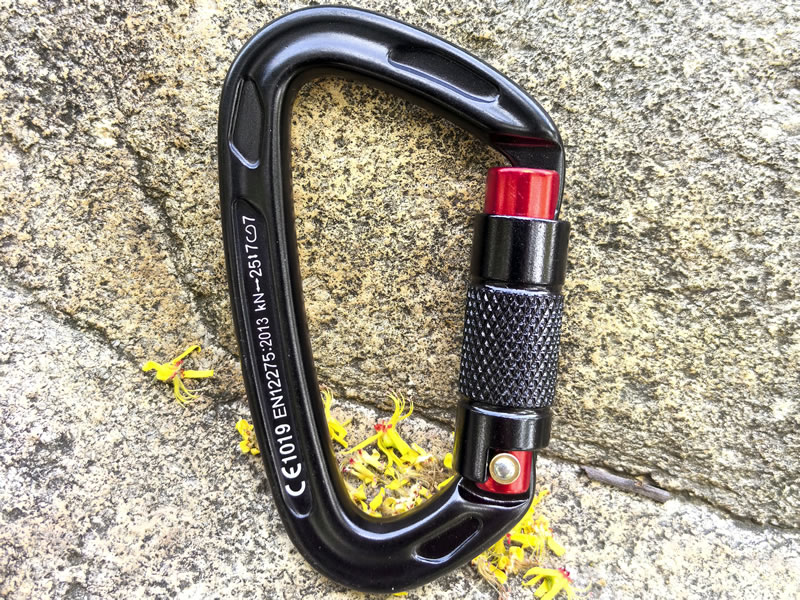
To put it directly, asking for a "weight" limit is the wrong question. The correct question is: "How much force can it withstand?" This distinction between static weight and dynamic force is the most critical concept to grasp.
kN: The Language of Force
The "kN" on your carabiner stands for kilonewton, a unit of force. One kilonewton (1 kN) is approximately equal to 225 pounds (102 kg) of force. This measurement reflects the immense, instantaneous shock load a carabiner must survive in a fall, not just the passive weight of a person or object.
For example, a carabiner rated for 22 kN does not mean it's designed to hold a 4,945-pound (2,243 kg) static weight. Instead, it means it has been tested to withstand a force equivalent to that weight before deforming or breaking. This high rating exists to absorb the extreme forces generated during a fall.
The Three Strength Ratings: It's All About Direction
A carabiner is not equally strong in every direction. Its strength rating is always given for three specific, standardized scenarios:
- Major Axis (Spine Loaded - Strongest): This is the carabiner's intended loading configuration, with the force applied along its long, straight spine and the gate closed. This is where you see the highest rating, typically 22-28 kN for climbing gear. This is the number most people first notice.
- Minor Axis (Cross-Loaded - Weaker): This occurs when force is applied across the carabiner's narrow width, often because it has been twisted incorrectly. This is a dangerously weak position. A carabiner with a 22 kN spine rating might only be rated 7 kN (approx. 1,575 lbs) in this orientation—a reduction of over two-thirds!
- Open Gate (Weakest): This tests the carabiner with the gate open. The strength plummets, often to just 7-10 kN. This starkly illustrates why it is absolutely critical to ensure the gate is fully closed and locked before loading the carabiner.
Force vs. Weight: The Fall Factor
Why are the ratings so high? Imagine a 176-pound (80 kg) climber. Why would they need a piece of gear rated for 5,000 pounds?
The answer lies in physics. In a fall, you are not just applying your body weight to the carabiner. You are creating a dynamic force. The severity of a fall is measured by the fall factor (the length of the fall divided by the amount of rope out). A longer fall on a shorter rope generates a higher force. This force, multiplied by your mass and deceleration, can easily exceed 5 kN or more on a single piece of gear. The high kN rating is your safety buffer against these real-world dynamic loads.
So, What is the "Safe Working Load"?
In industrial settings, a "Safe Working Load" (SWL) is often calculated by applying a safety factor to the breaking strength (e.g., dividing the breaking strength by 10). In recreational climbing, this concept is managed differently. The entire safety system—rope, harness, anchor, and carabiner—is designed to work together. The dynamic rope is the primary shock absorber, stretching to decelerate a fall and drastically reduce the peak force on both the climber and the gear.
Conclusion: Strength is a System
You cannot assign a simple "weight limit" to a carabiner. Its capacity is a function of force and direction. When choosing and using a carabiner:
- Always check the kN rating on the major axis and understand its dramatic weakness when cross-loaded or open-gated.
- Trust the system. Your gear is part of an integrated safety system where each component has a specific role.
- Inspect your gear regularly. Look for cracks, sharp edges, and gate wear.
- Use it correctly. Always load it on the spine and ensure the gate is fully closed.
Ultimately, the high kN number is not an invitation to test its limits, but a carefully engineered guarantee of safety for when you need it most.




