




What is the Breaking Strength of a Heavy-Duty Carabiner Hook?
When you're trusting your safety to a piece of gear, understanding its limits is non-negotiable. For a heavy-duty carabiner hook, the term "breaking strength" is your most critical metric. However, the answer is more nuanced than a single number; it's a story told through standardized ratings, material science, and proper usage.
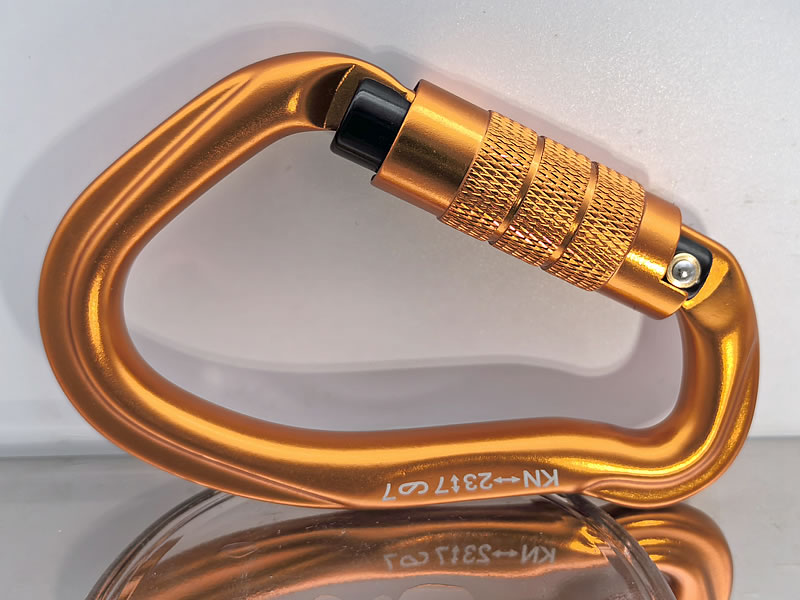
It's All About the kN Rating
The breaking strength of a carabiner is measured in kiloNewtons (kN). One kiloNewton is approximately 225 pounds of force. For a carabiner to be considered "heavy-duty" in applications like rock climbing, industrial rigging, or rescue work, you should look for a major axis strength of at least 22 kN to 28 kN (approximately 4,900 to 6,300 lbf). Some ultra-heavy-duty models, especially locking carabiners, can exceed 40 kN.
The Critical Factor: Direction of Load
This is the most important safety concept. A carabiner's strength is not uniform and changes drastically based on how force is applied.
- Major Axis Strength (Spine to Gate): This is the carabiner's designed loading direction and where it achieves its maximum strength (e.g., 28 kN). The force is applied along the spine, and the gate is closed, creating a stable, closed system.
- Minor Axis Strength (Across the Gate): If force is applied across the width of the carabiner, pushing against the gate, its strength plummets—often by 60-70%. A carabiner rated for 28 kN on the major axis might fail at just 7-10 kN on the minor axis. This is a primary cause of gear failure in misuse scenarios.
- Open Gate Strength: Perhaps the most startling figure is the open-gate strength. With the gate open, the same 28 kN carabiner might withstand only 7-10 kN of force. This highlights the vital importance of ensuring the gate is fully closed and locked before loading.
What Dictates This Strength?
Several factors determine a carabiner's breaking strength:
- Material: Most heavy-duty carabiners are made from aluminum alloy (lightweight and strong) or steel (significantly stronger and more durable, but heavier). Steel carabiners are common in industrial settings where abrasion resistance is key.
- Design & Engineering: The spine's cross-sectional shape (I-beam, T-beam), the gate mechanism, and the overall geometry are all engineered to maximize strength while minimizing weight.
- Manufacturing Standards: Reputable manufacturers test their carabiners to rigorous international standards (like UIAA for climbing or CE for European equipment), which dictate the Minimum Breaking Strength (MBS).
Conclusion: Look for the Stamp
Never guess a carabiner's strength. The breaking strength is permanently stamped on its spine. Look for three ratings: along the spine (major axis), across the spine (minor axis), and with the gate open. A true heavy-duty carabiner is not just about a high number on its spine, but about understanding its vulnerabilities and using it correctly every single time. Your safety depends on this knowledge.




