




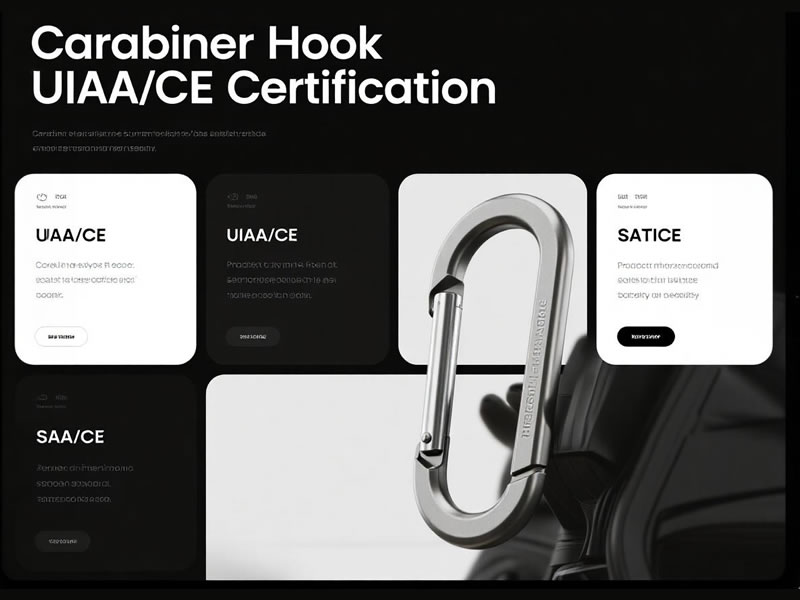
Carabiner Hook UIAA/CE Certification Meaning: Your Guarantee of Safety
When your life depends on a piece of gear, a simple price tag or brand name isn't enough. This is where the UIAA and CE certifications become non-negotiable. These stamps on a carabiner's spine are not mere suggestions; they are your objective, third-party guarantee that the device has passed the most rigorous safety tests in the world. Understanding their meaning is fundamental to safe participation in climbing and other high-risk activities.
Buy Link: https://www.aliexpress.com/item/1005009247748751.html
What are UIAA and CE?
While often seen together, these two certifications have distinct roles:
- UIAA (Union Internationale des Associations d'Alpinisme): The International Climbing and Mountaineering Federation. This is a global, non-profit organization made up of national climbing clubs. Its standards are developed by experts and are often more stringent than the legal minimums. The UIAA focuses specifically on the unique demands and worst-case scenarios of mountaineering and rock climbing.
- CE (Conformité Européenne): This is a mandatory legal mark for products sold within the European Economic Area. It indicates that the manufacturer declares the product conforms to the essential health, safety, and environmental requirements of the relevant European Directives. For personal protective equipment (PPE) like carabiners, this falls under the EN 12275:2013 standard.
In practice, most reputable manufacturers test their gear to satisfy both standards simultaneously, as they share many overlapping requirements.
The Rigorous Tests Behind the Stamp
A carabiner bearing the UIAA and CE marks has successfully passed a battery of destructive tests on a sample basis. Key tests include:
- Strength Test (Major Axis): The carabiner is pulled along its spine until it fails. The minimum breaking strength must be at least 20 kN (approx. 4,500 lbf) for a basic carabiner, with many models far exceeding this. For a sense of scale, a severe climbing fall might generate 5-8 kN of force.
- Strength Test (Minor Axis): The carabiner is loaded across its gate. The standard requires it to withstand a minimum of 7 kN, highlighting the severe strength reduction when loaded incorrectly.
- Open Gate Test: This simulates a worst-case scenario where the gate is accidentally open during a fall. The carabiner must still withstand a minimum of 7 kN, a test that has driven significant design improvements over the years.
- Gate Function Test: The gate must open and close smoothly under a specified load, ensuring it can be operated easily with one hand, even when under tension.
- Durability Test: The gate mechanism is opened and closed tens of thousands of times to ensure it won't fail prematurely due to wear.
Why You Should Never Compromise
Choosing a certified carabiner is the most basic and critical safety decision you can make. An uncertified carabiner from a hardware store is designed for static loads like holding keys, not for the dynamic, high-impact forces of a fall. There is no way to verify its strength, metallurgy, or manufacturing consistency.
The UIAA and CE certifications are your assurance that the gear has been designed, tested, and proven for the life-or-death situations you may encounter. They represent a global consensus on safety, born from decades of experience and engineering. When you see these marks, you are not just looking at a carabiner; you are holding a promise of reliability. Always look for them, and never trust your life to anything less.




