




Carabiner Hook Weight Capacity for Industrial Rigging: Understanding WLL and Safety
In the world of industrial rigging, where the stakes involve lifting heavy loads over people and critical infrastructure, the term "weight capacity" takes on a profoundly different and more critical meaning than in recreational contexts. Using a carabiner hook safely here is not about a single number, but about understanding a comprehensive system of ratings, safety factors, and rigorous protocols designed to prevent catastrophic failure.
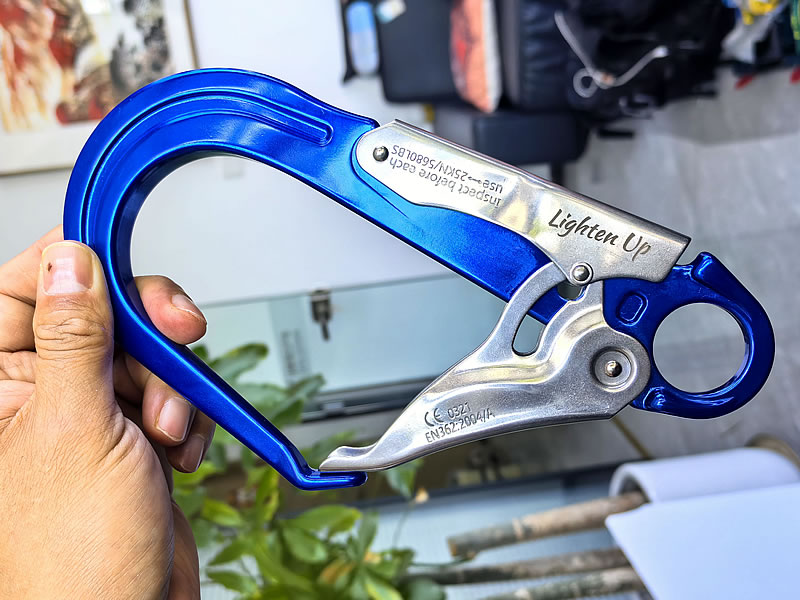
From Breaking Strength to Working Load Limit (WLL)
The most crucial concept to grasp is the difference between breaking strength and Working Load Limit (WLL).
- Breaking Strength (or Minimum Breaking Strength - MBS): This is the ultimate load at which the carabiner will physically deform and fail. For a heavy-duty steel rigging carabiner, this can be 50 kN (approx. 11,240 lbf) or much higher.
- Working Load Limit (WLL): This is the maximum allowable load that can be applied to the carabiner during routine, normal service. This is the true "weight capacity" you must never exceed.
The WLL is not arbitrary; it is derived by dividing the carabiner's minimum breaking strength by a designated safety factor.
The Critical Role of the Safety Factor
Industrial rigging operates with high safety factors to account for dynamic forces, wear, material imperfections, and human error. A common safety factor for overhead lifting is 4:1 or 5:1.
- Example Calculation: If a steel carabiner has a minimum breaking strength of 50 kN (11,240 lbf), its WLL with a 5:1 safety factor would be 50 kN / 5 = 10 kN (approx. 2,250 lbf).
This means that while the carabiner could hold 11,240 lbs before breaking, it is only rated to safely lift 2,250 lbs in a controlled, dynamic lifting environment. Exceeding the WLL is extremely dangerous and compromises the entire safety system.
Key Distinctions from Recreational Carabiners
Industrial rigging carabiners differ significantly from their climbing cousins:
- Material: They are almost exclusively made of steel, chosen for its high strength and superior resistance to abrasion and damage from sharp edges.
- Standards: They are manufactured and certified to different standards, such as ASME B30.26 (Rigging Hardware) in the US, which governs their design, inspection, and use.
- Markings: A properly rated industrial carabiner will be clearly stamped with its WLL (often in tons or kgs), a unique serial number, and the manufacturer's name. The absence of these markings should immediately disqualify it from service.
Choosing the Right Carabiner for the Job
Selecting a carabiner for industrial rigging requires a thorough plan:
- Calculate the Total Load: This includes the weight of the object, all rigging hardware (slings, shackles), and environmental factors like wind.
- Apply the Safety Factor: Ensure the carabiner's WLL is suitable for the calculated load within the required safety margin.
- Consider the Configuration: Like all carabiners, they are strongest when loaded along the spine. Side-loading (minor axis) dramatically reduces their effective strength and must be avoided.
- Inspect Relentlessly: Industrial carabiners require regular, formal inspection by a competent person for signs of wear, cracks, gate distortion, or thread damage. Any compromised gear must be immediately taken out of service.
In conclusion, the "weight capacity" for an industrial rigging carabiner is its Working Load Limit—a conservative, safety-focused rating designed to protect life and property. Never mistake it for a breaking strength. Always refer to the manufacturer's specifications, adhere to relevant safety standards, and when in doubt, consult with a qualified and certified rigger. There is no room for approximation when lives are on the line.




