




Best Threadlock Mechanism for a Safety Carabiner Hook
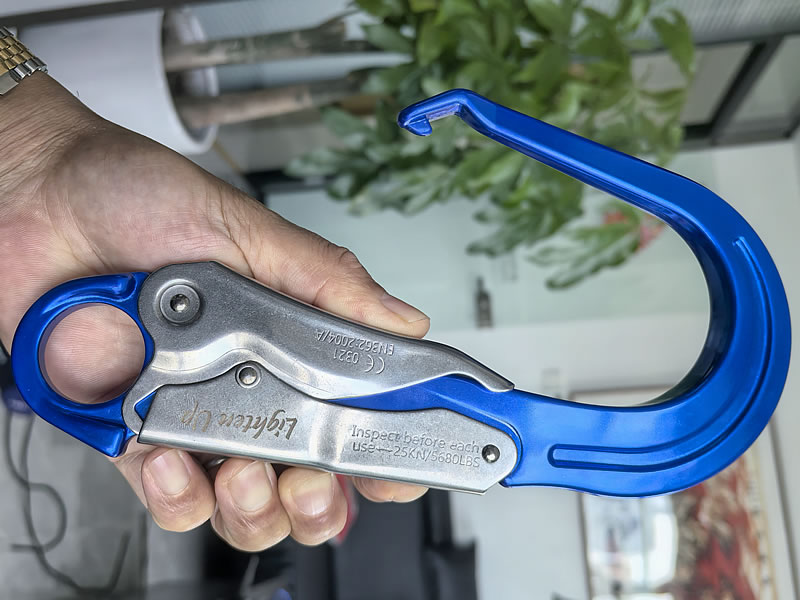
When your safety depends on a carabiner staying securely locked, understanding the gate mechanism is paramount. While the term "threadlock" often refers to a chemical adhesive for bolts, in the carabiner world, we discuss positive-locking gates. For the highest level of security, the undisputed best mechanism is the triple-action lock (also known as a triple-locker). This system offers redundant security that far surpasses simpler designs, making it the gold standard for life-critical applications.
Beyond the Basic Screw-Lock
Many users are familiar with the standard screw-lock carabiner, where you manually twist a collar to open or close the gate. While a significant step up from a non-locking carabiner, this design has vulnerabilities. It can be cross-threaded, accidentally unscrewed by rubbing against rock or gear, and its status (locked or unlocked) can be difficult to verify visually in stressful situations.
The triple-action lock addresses these weaknesses through a deliberate, multi-step process.
The Anatomy of a Triple-Action Lock
A triple-action locking gate requires three distinct, sequential motions to open, creating a formidable barrier against accidental opening. The steps are:
- Unscrew the Collar: The first action is identical to a standard screw-lock. You must rotate the outer locking collar counter-clockwise until it stops. This disengages the first mechanical barrier.
- Depress the Locking Sleeve: With the collar unscrewed, you must then press down a secondary spring-loaded sleeve. This sleeve is physically impossible to depress unless the collar is fully unscrewed. This action disengages an internal plunger or cam mechanism.
- Pivot the Gate Open: Only after successfully completing the first two steps can the gate itself be swung open.
This "screw, push, then open" sequence is intentionally complex. It cannot be undone by a simple impact, a casual brush against a surface, or user error in a moment of panic.
Why the Triple-Action Lock is Superior for Safety
The advantages of this mechanism are clear:
- Redundancy: It incorporates three separate locking features. The failure of one component does not immediately lead to a complete failure of the system.
- Resistance to Snagging: Its smooth, collar-based exterior is far less likely to catch on ropes, wires, or vegetation compared to gate-based auto-locking systems.
- Positive User Confirmation: The physical actions required provide tactile and often auditory (a distinct "click") feedback that the gate is being correctly manipulated. The brightly colored locking sleeve also offers a clear visual indicator of its status.
- UIAA/CE Certification: Carabiners with triple-action locks are rigorously tested and certified to the highest standards, including the critical open-gate strength test, proving their reliability under load.
Applications for the Ultimate Security
While a triple-action lock may be overkill for a simple dogbone quickdraw in sport climbing, it is the mandatory choice for:
- The central point in a climbing harness belay loop.
- Connecting a rope to an anchor system.
- High-stakes industrial, rescue, and via ferrata scenarios where an accidental gate opening would be catastrophic.
In conclusion, when the question is about the best locking mechanism for a safety carabiner, the answer is unequivocally the triple-action lock. Its deliberate, multi-stage operation provides a level of security and peace of mind that simpler mechanisms cannot match. For any situation where failure is not an option, this is the mechanism you must trust. Always ensure any locking carabiner you use bears the relevant UIAA or CE safety certification.




