




Automatic locking vs. manual locking carabiner hooks.
In the world of climbing, rescue, and industrial safety, the locking carabiner is a non-negotiable piece of equipment for critical connections. The primary division within this category lies between automatic and manual locking mechanisms. Understanding the fundamental differences, advantages, and drawbacks of each is not just a matter of preference—it's a critical decision that impacts safety, speed, and reliability in high-stakes environments.
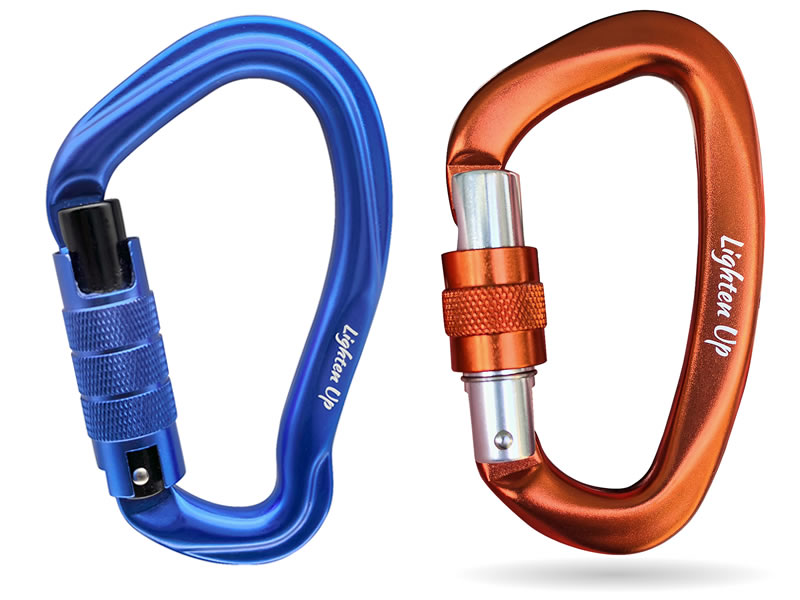
Manual Locking Carabiners: The Deliberate Classic
Manual locking carabiners, most commonly screw-gate models, require the user to physically thread a sleeve over the gate to lock it.
- How They Work: After the gate is closed, the user must consciously rotate the outer collar several times until it is fully seated and finger-tight. This action physically prevents the gate from opening accidentally.
- Pros:Simplicity and Reliability: The screw-gate mechanism is mechanically simple with few moving parts, making it highly reliable and easy to inspect for wear or damage.Tactile and Visual Confirmation: The user receives clear tactile feedback and can easily see when the gate is fully locked. The collar's position provides a distinct visual indicator.Cost-Effective: They are generally less expensive than their automatic counterparts, making them a budget-friendly option for building extensive anchor systems.
- Cons:Human Error: This is the single greatest risk. A user can forget to screw the gate closed, or it may not be fully tightened, leaving the mechanism vulnerable to being knocked open.Slower Operation: In situations requiring rapid clipping and unclipping, the need to manually screw and unscrew the collar can be a significant disadvantage.Two-Handed Operation: While experienced users can operate them one-handed, it typically requires two hands for safe and sure manipulation.
Automatic Locking Carabiners: The Fail-Safe Innovators
Automatic locking carabiners, which include twist-lock and ball-lock systems, are designed to engage the lock automatically once the gate is released.
- How They Work: Upon closing, an internal spring mechanism immediately drives a locking sleeve or a series of balls into position, blocking the gate from reopening. To open it, the user must first disengage this lock (by twisting or pushing the sleeve), and then press the gate.
- Pros:Reduced Human Error: The automatic engagement is a crucial safety feature. It ensures the lock is engaged every time the gate closes, protecting against forgetfulness in stressful situations.Faster and Easier: Once the opening motion is mastered, they can be faster to re-lock than a screw-gate, as the locking action requires no additional steps from the user.Often Easier One-Handed: The push-and-twist or push-and-pull motion is often more conducive to one-handed operation compared to the fine motor skills needed for a screw-gate.
- Cons:Mechanical Complexity: The internal spring and locking mechanism have more parts that can, in rare cases, fail or become clogged with dirt, ice, or sand.Higher Cost: The more complex engineering typically makes them more expensive.False Sense of Security: A malfunctioning auto-locker may appear locked but not be fully engaged. Users must always perform a visual check to confirm the locking sleeve is in the correct position.
Making the Critical Choice: Application is Key
The choice between automatic and manual locking is not about which is universally "better," but which is most appropriate for the specific task.
- Choose Automatic Locking (Twist/Ball-Lock) For:Belay Devices: This is the most common and critical application. The auto-lock provides a vital safety backup when a climber is being lowered or belayed.Rescue Operations: Where speed, reliability, and reduced error under stress are paramount.Via Ferrata and Industrial Work: Where a user may be fatigued and less likely to consistently manually lock a screw-gate.
- Choose Manual Locking (Screw-Gate) For:Anchor Building: Where multiple carabiners are used in a static configuration and the user has time to deliberately check each one.General Purpose Use: Where cost is a factor and the user is disciplined about checking their gear.Environments with High Debris: Where the simplicity of a screw-gate is less prone to jamming than a complex auto-locking mechanism.
Conclusion
For the ultimate in safety-critical connections—such as attaching yourself to a belay device or a rescue system—the automatic locking carabiner is the superior choice. Its proactive, "fail-safe" design significantly mitigates the risk of human error. However, the manual screw-gate remains a highly reliable, simple, and cost-effective workhorse for applications where the user can maintain disciplined vigilance. Regardless of your choice, the cardinal rule remains the same: always perform a visual and physical check to confirm the gate is fully closed and locked before committing your weight to it. Your life depends on that single, simple action.




