




Best foldable vs. telescoping trekking poles
The choice between foldable and telescoping trekking poles represents one of the most fundamental decisions in hiking gear selection. While both serve the same essential purpose—providing stability and reducing impact on trails—their design philosophies cater to different priorities, hiking styles, and terrain challenges. Understanding the core differences between these two systems will help you invest in poles that genuinely match your outdoor ambitions, whether you're a weekend warrior or a seasoned thru-hiker.
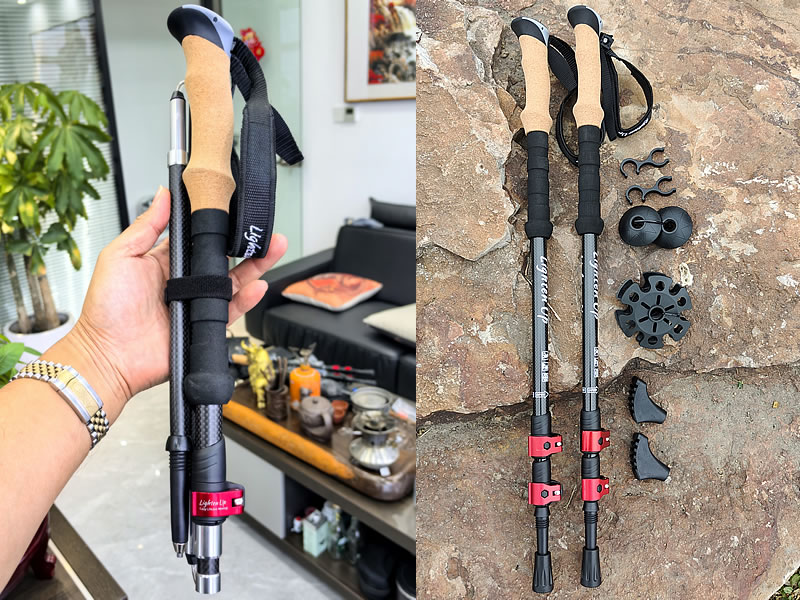
Recommended trekking pole purchase link: https://s.click.aliexpress.com/e/_c4M7OWaN
Telescoping Poles: The Adjustable Workhorses
Telescoping poles, characterized by their multiple sections that extend and lock into place, have long been the standard in the hiking world. Their design features typically include:
- Adjustability and Versatility: This is their greatest strength. With two or three adjustable sections, you can fine-tune the pole's length for uphill climbs, downhill descents, and flat terrain. This optimizes efficiency and reduces strain on your joints. This feature is also invaluable for sharing poles between hikers of different heights.
- Durability and Repairability: The simple, robust design often means fewer failure points in the long run. If one section becomes damaged, it's often possible to replace just that part. The solid, continuous structure when locked is excellent for handling heavy loads and providing confident support on technical, off-trail terrain.
- Locking Mechanisms: They primarily use two systems:Lever Locks (e.g., FlickLock, SpeedLock): An external clamp that provides a secure, visible, and easily adjustable lock, even with cold or wet hands. This is widely considered the most reliable system for demanding use.Twist Locks: An internal mechanism that expands a sleeve against the inner wall of the pole. While sleeker, they can be prone to slipping and are more difficult to operate when muddy or if the mechanism becomes worn.
Ideal Use Cases for Telescoping Poles:
- Backpacking with a heavy load.
- Hiking on highly variable terrain with frequent ascents and descents.
- Winter hiking with snow baskets, where precise length adjustment is crucial.
- Hikers who prioritize versatility and maximum adjustability over minimal pack size.
Foldable (Z-Poles): The Ultralight Speedsters
Foldable poles, often called Z-poles due to their collapsing "Z" pattern, are connected by a strong, internal tension cord. They are defined by:
- Light Weight and Compactness: By eliminating adjustable sections and complex locking mechanisms, Z-poles achieve a remarkably low weight and pack down to a very short, predictable size (often 35-40 cm). This makes them incredibly easy to stow inside or on a pack.
- Speed and Simplicity: Deployment is nearly instantaneous. A simple pull extends all segments simultaneously, and they're secured by the internal cord's tension. There are no levers to adjust or locks to check, making them perfect for fast-paced hiking or trail running where conditions change rapidly.
- Consistent Performance: With no mechanical locks, there are fewer parts that can fail due to dirt, grit, or impact. However, the internal cord can eventually wear out and may need replacement after several seasons of heavy use.
Ideal Use Cases for Foldable Poles:
- Fastpacking, trail running, and ultralight day hiking.
- Travel, where their compact form factor is a major advantage.
- Hikes where you anticipate frequently stowing and deploying your poles (e.g., mixed scrambling and hiking).
- Hikers who know their ideal fixed pole length and prioritize speed and weight above all else.
Head-to-Head Comparison: Key Decision Factors
| Feature | Telescoping Poles | Foldable (Z) Poles |
|---|---|---|
| Weight & Packed Size | Heavier and longer when collapsed. | Lighter and significantly more compact. |
| Adjustability | Highly adjustable for different terrain and users. | Typically fixed-length; some models offer limited adjustment. |
| Deployment Speed | Slower, requires locking each section. | Very fast, often a single motion. |
| Durability/Repairability | Robust; individual sections often replaceable. | Susceptible to cord wear; harder to field-repair. |
| Best For | Versatility, heavy loads, technical terrain. | Speed, ultralight philosophy, and convenience. |
Top Recommendations
- Best Telescoping Pole: The Black Diamond Trail Pro remains a benchmark for its bomb-proof aluminum construction, reliable FlickLock Pro system, and comfortable grip, making it a trusted companion for any demanding hike.
- Best Foldable Pole: The Black Diamond Distance Carbon Z is a favorite among ultralight enthusiasts for its exceptional weight-to-strength ratio, simple and effective design, and incredibly small packed size.
Conclusion
Your choice between foldable and telescoping trekking poles ultimately boils down to a trade-off between versatility and convenience.
If your hiking involves heavy backpacks, constantly changing terrain, and a need for precise control, the telescoping pole's adjustability makes it the clear and more durable choice. If your goal is to move fast and light, covering long distances with minimal gear, and you value the ability to stow your poles in a flash, the foldable Z-pole's compactness and speed are unmatched.
There is no universal "best"—only the best tool for your specific adventure. Consider where and how you hike most often, and let that guide your investment in this fundamental piece of hiking equipment.




