




Best Trekking Poles That Are Lightweight and Strong
The quest for trekking poles that master the delicate balance between minimal weight and uncompromising strength represents the holy grail for serious hikers. Lightweight poles reduce fatigue over long distances, while strong construction provides essential reliability when you're miles from civilization. Fortunately, advances in materials science and engineering have produced several outstanding models that successfully deliver both qualities, though understanding where and how these poles excel requires a deeper look at what "light and strong" truly means in different hiking contexts.
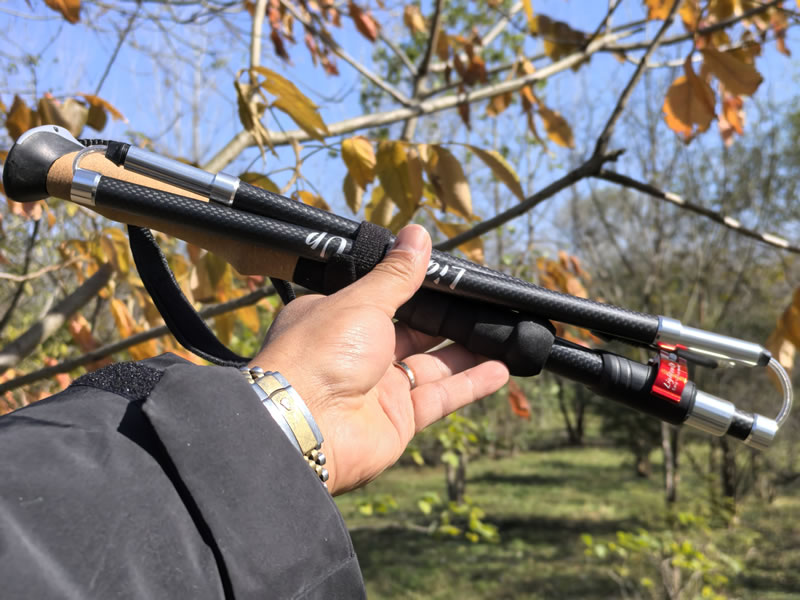
Recommended trekking pole purchase link: https://s.click.aliexpress.com/e/_c4M7OWaN
The Materials Science Behind Lightweight Strength
The fundamental trade-off between weight and strength finds its best resolution in high-quality carbon fiber composites. Unlike aluminum, which derives its strength from uniform metal density, carbon fiber gains its remarkable properties from precisely oriented fibers embedded in resin. This allows engineers to place strength exactly where it's needed most—along the load-bearing axis—while minimizing material elsewhere. The result is a pole that's both incredibly light and exceptionally strong when force is applied as intended (along its length).
However, not all carbon fiber is created equal. The industry uses numbering systems where higher modulus fibers generally indicate greater stiffness and strength-to-weight ratios. While most consumers won't see these specifications, they manifest in real-world performance through poles that feel reassuringly rigid under load yet weigh remarkably little. Brands like LEKI and Black Diamond use these advanced composites in their flagship models to achieve weights under 15 ounces per pair while maintaining strength ratings that exceed international safety standards.
Top Performers in the Lightweight-Strong Category
Several models consistently stand out for their exceptional balance of minimal weight and proven durability:
- Black Diamond Distance Carbon Z: Weighing a remarkable 11-13 ounces per pair, these foldable Z-poles set the standard for ultralight performance without sacrificing critical strength. Their three-section folding design connected by internal tension cords eliminates adjustment mechanisms—the most common failure point in telescoping poles—while maintaining sufficient rigidity for most hiking scenarios. The carbon construction provides excellent vibration damping, though their fixed length makes them best for hikers who don't require frequent adjustments.
- LEKI Micro Vario Carbon: For those who value adjustability without significant weight penalty, these poles offer the perfect solution at approximately 15-17 ounces per pair. The combination of high-modulus carbon fiber with LEKI's reliable external SpeedLock adjustment system creates a pole that's both adaptable to changing terrain and strong enough for demanding use. The quality of construction is immediately apparent in their precise handling and minimal vibration transmission.
- Gossamer Gear LT5: Designed with direct input from thru-hikers, these poles weigh around 14 ounces while incorporating thoughtful features that enhance both strength and usability. The three-section telescoping design offers more length adjustment than foldable models, and the minimalist approach focuses weight and material exactly where it provides the most benefit.
- MSR DynaLock Ascent: While slightly heavier than pure carbon options (around 19 ounces), these poles offer unique strength characteristics through their hybrid construction. The internal lock mechanism distributes stress more evenly than external systems, and the attention to detail in component quality ensures long-term reliability under heavy use.
Key Features That Don't Compromise on Strength
When selecting lightweight poles, certain features are non-negotiable for maintaining strength and safety:
- Quality Locking Mechanisms: Even the strongest pole shafts are useless without reliable locks. External lever systems (like Black Diamond's FlickLock or LEKI's SpeedLock) provide visible security confirmation and maintain tension better than twist mechanisms, especially when cold, wet, or dirty.
- Reinforced Stress Points: Well-designed poles feature additional material at critical stress areas—particularly around locking mechanisms and joint connections. This strategic reinforcement prevents failure at the most vulnerable points without significantly increasing overall weight.
- Optimal Segment Diameters: The relationship between pole segment diameter and wall thickness dramatically affects both weight and strength. The best designs use larger diameters with thinner walls in upper sections (where stress is lower) and thicker walls in lower sections (where impacts occur).
- Quality Tips and Baskets: Durability extends beyond the shafts to include hard-wearing tungsten carbide tips that maintain their grip on rock and ice, and durable but lightweight baskets that withstand repeated impacts with roots and rocks.
Understanding the Real-World Strength Limitations
While these lightweight poles are impressively strong, it's crucial to understand their limitations compared to heavier aluminum alternatives. Carbon fiber's Achilles heel remains its vulnerability to sharp side impacts—the kind that might occur if a pole gets caught between rocks or is accidentally stepped on. Where aluminum might bend under such stress, carbon fiber can crack or break. This doesn't make carbon poles fragile, but it does mean they require more mindful use in extremely rocky terrain or when used by hikers who are particularly hard on their equipment.
Making the Right Choice for Your Needs
The decision ultimately comes down to your specific hiking style and environment. For well-maintained trails, long-distance hiking, and situations where every ounce matters, high-quality carbon fiber poles provide an unmatched combination of light weight and sufficient strength. For more technical terrain involving frequent rock contact, rough handling, or heavy loads, the impact resistance of aluminum might justify its weight penalty.
The most enlightened approach might be owning both—lightweight carbon poles for most trips and durable aluminum poles for particularly demanding expeditions. However, for the single-pole solution that best balances both qualities, today's premium carbon fiber models from reputable manufacturers represent the closest we've come to having it all: poles that barely register on the scale yet provide confident support when the trail turns challenging. As materials technology continues advancing, this balance will only improve, making the dream of perfectly strong, perfectly light trekking poles increasingly a reality.




