




Do Trekking Poles Really Help Save Your Knees?
The question of whether trekking poles genuinely protect our knees is more than just casual hiker curiosity—it's a matter of long-term joint health and hiking sustainability. As knee pain and osteoarthritis remain leading causes of disability among active adults, understanding the scientific evidence behind trekking poles' protective benefits becomes crucial for anyone who regularly ventures onto trails. The short answer, supported by multiple biomechanical studies, is a resounding yes—when used correctly, trekking poles significantly reduce stress on the knee joints, particularly during the demanding descents that cause the most joint damage over time.
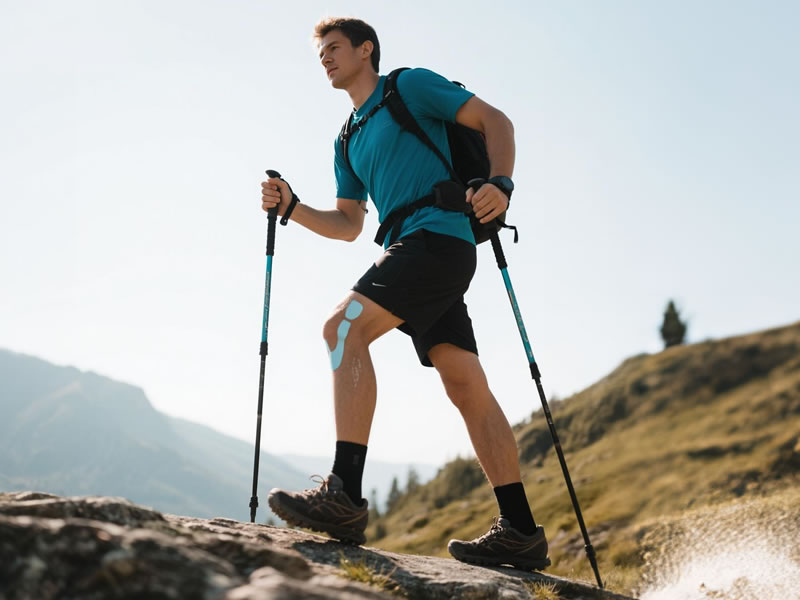
Recommended trekking pole purchase link: https://s.click.aliexpress.com/e/_c4M7OWaN
The Biomechanical Evidence: What Research Reveals
Multiple controlled laboratory studies have quantified exactly how trekking poles affect joint loading. Research published in the Journal of Sports Sciences demonstrated that using trekking poles during downhill walking reduces compressive forces on the knees by approximately 25%. This reduction translates to removing nearly 100 pounds of cumulative force from each knee with every descent step for an average-weight hiker. Another study in the Journal of Biomechanics found that pole use decreases knee joint moments (the rotational forces that contribute to cartilage wear) by up to 28%.
The mechanism behind this protection is straightforward physics: trekking poles allow your upper body to share the workload traditionally borne entirely by your lower limbs. When you plant a pole and transfer weight through your arms and shoulders, you're effectively creating two additional points of contact with the ground, distributing what would otherwise be concentrated impact forces across four limbs instead of two. This distribution is particularly crucial during descents, when knees must act as brakes against both body weight and gravity's acceleration.
Beyond Impact Reduction: The Stability Factor
While impact reduction receives most attention, trekking poles provide another crucial knee-protecting benefit: enhanced stability. Wobbly, unstable movements on uneven terrain create sudden, unexpected stresses on knee ligaments and cartilage. By providing two additional contact points, poles dramatically improve balance, allowing for more controlled, predictable movements that minimize the twisting and shearing forces particularly damaging to knee cartilage. This stability benefit is especially valuable for hikers with existing knee issues or those carrying heavy packs that raise their center of gravity.
Proper Technique: The Difference Between Help and Hindrance
Like any tool, trekking poles only provide these protective benefits when used correctly. Common mistakes can actually increase joint stress:
- Proper Length Adjustment: On descents, lengthen poles by 5-10 cm to allow planting them ahead of your body, creating a stable platform before your weight transfers onto the descending leg.
- Correct Planting Rhythm: The classic "opposite arm to leg" rhythm ensures continuous stability. As your left foot steps forward, your right pole should plant simultaneously, creating a natural tripod of support.
- Strategic Planting Position: Plant poles at a slight rearward angle rather than vertically, leveraging your upper body strength to actively push your body forward and upward rather than merely catching your weight.
- Appropriate Force Application: Use your poles to deliberately reduce loading on each step rather than just maintaining balance. Think about actively pushing down through the poles during weight transfer to your forward foot.
Who Benefits Most from Knee Protection?
While all hikers benefit from reduced joint stress, certain groups experience particularly significant advantages:
- Hikers with Existing Knee Conditions: Those with osteoarthritis, meniscus tears, or patellofemoral pain syndrome often find poles make hiking possible when it would otherwise be too painful.
- Heavy Load Carriers: Backpackers carrying 25% or more of their body weight generate tremendously higher knee forces; poles help redistribute this load.
- Older Hikers: As cartilage naturally thins with age, impact reduction becomes increasingly important for maintaining mobility.
- Recovering from Lower Body Injuries: Poles can help compensate for weak leg muscles during rehabilitation while proper strength returns.
Long-Term Implications for Joint Health
The cumulative effect of regular pole use may extend far beyond immediate comfort. Each hiking descent without poles subjects knee cartilage to repetitive impact forces that can accelerate degenerative changes. While cartilage has limited healing capacity, reducing these damaging forces potentially slows the progression of osteoarthritis. For dedicated hikers who plan to continue their passion for decades, this protective effect represents an investment in long-term joint preservation.
Complementary Strategies for Knee Health
While trekking poles provide significant protection, they work best as part of a comprehensive knee-care strategy:
- Strength Training: Strong quadriceps, hamstrings, and gluteal muscles provide natural knee stabilization that complements pole use.
- Weight Management: Each pound of body weight translates to approximately 4 pounds of pressure on knees during descent.
- Proper Footwear: Shoes with appropriate cushioning and support further reduce impact forces traveling up the kinetic chain.
- Gradual Progression: Suddenly increasing hiking intensity or distance is a common cause of overuse injuries, regardless of pole use.
Conclusion: An Evidence-Based Investment in Joint Longevity
The scientific consensus clearly supports trekking poles as effective tools for reducing knee stress and potentially slowing joint degeneration. While they require an initial investment and technique practice, their benefits extend beyond mere comfort to genuinely protective biomechanical changes. For hikers questioning whether poles are worth the effort, consider this: if you could reduce the wear and tear on your vehicle's suspension system by 25% with a simple, reusable tool, wouldn't you use it? Our knees are the suspension systems of our bodies, and unlike vehicle parts, they can't be replaced when worn out. In this context, trekking poles represent one of the most cost-effective, scientifically-verified investments you can make in your long-term hiking future and joint health.




