




Hiking poles for men vs women
When selecting hiking poles, many adventurers wonder whether gender-specific designs truly matter. While most poles are marketed as unisex, understanding the subtle differences between models tailored for men and women can enhance your comfort, stability, and performance on the trail. This guide breaks down the key distinctions, helping you choose the right poles based on your body mechanics—not just labels.
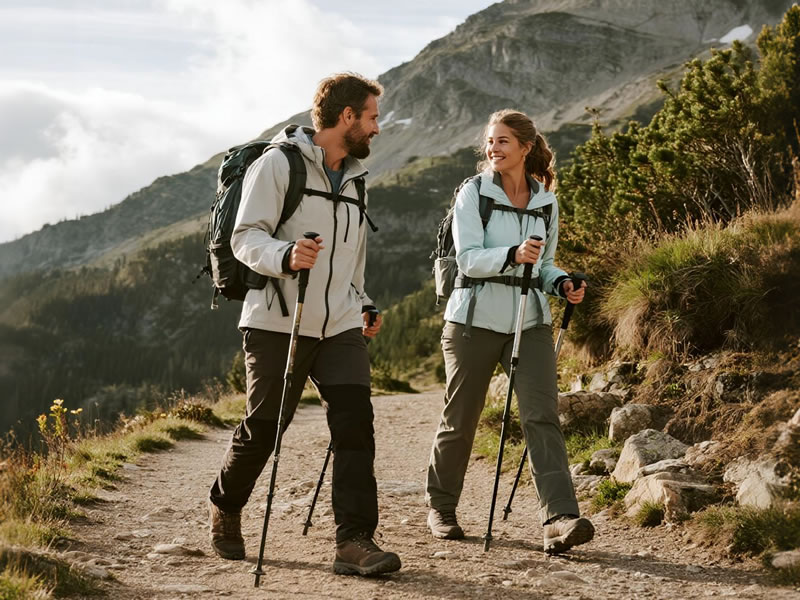
Recommended trekking pole purchase link: https://s.click.aliexpress.com/e/_c4M7OWaN
🔍 Do Gender-Specific Hiking Poles Really Matter?
The short answer is yes, but not for everyone. While men and women share the same basic needs for durability and adjustability, physiological differences can influence design priorities. For example:
- Height and Stride: On average, women tend to be shorter than men, which impacts ideal pole length and adjustability ranges-7.
- Grip Size: Women generally have smaller hands with narrower palms and fingers. A slimmer grip prevents over-gripping and reduces fatigue-7.
- Upper-Body Strength: While this varies individually, women often benefit from lighter poles that prioritize efficient energy transfer-2.
However, the best pole for you depends on your unique body proportions and hiking style. A tall woman with larger hands might prefer a "men’s" model, while a man with a compact build might find a "women’s" pole more comfortable.
🧐 Key Design Differences in Women’s vs. Men’s Poles
Manufacturers like Black Diamond and LEKI often incorporate these features into gender-specific models:
| Feature | Women’s Poles | Men’s Poles |
|---|---|---|
| Grip Design | Narrower, contoured grips for smaller hands-7 | Wider, broader grips for larger hands-7 |
| Shaft Length | Shorter adjustable ranges (e.g., 100–120 cm) to suit shorter stature-7 | Longer ranges (e.g., 115–135 cm) for taller users-7 |
| Weight | Often lighter (e.g., 250–300 g) for reduced arm fatigue-7 | Slightly heavier for added durability-7 |
| Strap Adjustments | Scaled-down straps to fit slender wrists-7 | Wider, padded straps for larger wrists-7 |
Many brands also use distinct colorways for gendered models, though aesthetics should never override functionality.
⚙️ Why Fit Matters More Than Gender Labels
A poorly fitted pole can cause blisters, shoulder strain, or even compromise balance. Focus on these factors when trying poles:
- Forearm Alignment: When holding the pole with your elbow at a 90-degree angle, the tip should rest flat on the ground. Shorten poles for uphill sections; lengthen them for descents-8.
- Grip Comfort: Your fingers should wrap comfortably around the handle without straining. Test cork (moldable), foam (sweat-absorbing), or rubber (durable) materials-8.
- Weight Distribution: Heavier poles (often aluminum) suit rugged terrain, while carbon fiber models excel on light, fast hikes-8.
Pro Tip: Some brands label women’s poles as "compact" or "slim," which can also work for men with smaller hands or shorter heights-7.
🏔️ Scenarios Where Gender-Specific Poles Shine
- For Women: Prioritize models with shorter shafts and ergonomic grips if you experience wrist pain or hike with a lighter pack.
- For Men: Opt for extended-length poles with robust locking mechanisms if you’re taller or carry heavy gear.
- Unisex Alternatives: Many brands (e.g., Trekology) emphasize adjustable features that cater to all body types-10.
✅ Final Recommendations
- Try Before You Buy: Visit a gear shop to test grip thickness and weight.
- Prioritize Adjustability: Look for lever-lock systems (easier to adjust than twist locks) and wide length ranges-8.
- Ignore the Hype: If a "men’s" pole feels better than a "women’s" model (or vice versa), trust your comfort.




