




How to use trekking poles for balance on narrow trails
Navigating a narrow trail—whether it's a rocky ridge, a slippery root-covered path, or a precarious log bridge—tests a hiker's balance and confidence. In these moments, your trekking poles transform from simple walking aids into essential tools for stability. When used correctly, they act as portable anchors, effectively widening your base of support and preventing a misstep from becoming a fall. This guide will walk you through the specific techniques to master balance on the most constricting paths.
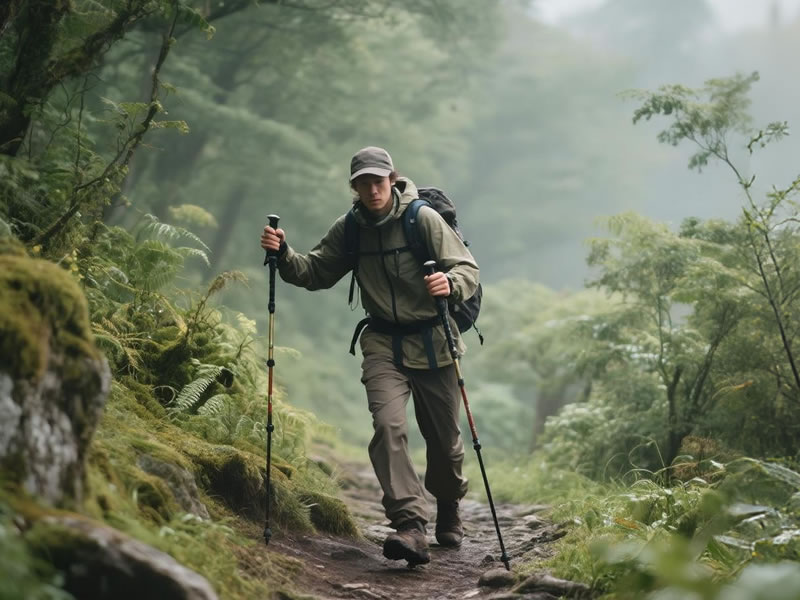
Recommended trekking pole purchase link: https://s.click.aliexpress.com/e/_c4M7OWaN
The Core Principle: Creating a "Portable Anchor"
The fundamental goal on a narrow trail is to use your poles to create a stable, multi-point contact system. Instead of balancing on two feet in a single line, you are creating a temporary, shifting quadrilateral of stability with your two feet and two pole tips. This "outrigger" effect is the key to maintaining your center of gravity over the trail.
The Technique: A Step-by-Step Guide for Narrow Terrain
1. The Wide Base Planting Method
On a wide trail, you might plant your poles directly in front of you. On a narrow trail, you need to plant them slightly wider than your body and slightly ahead. This creates a wider, more stable footprint. As you step forward with your right foot, plant your left pole out to the side and ahead. This cross-body pattern provides counter-balance, much like a tightrope walker's pole.
2. The "Triangle of Stability"
Think of creating a triangle with each step. Your two pole tips and your leading foot form the three points of this stable shape. Before committing your full weight to a step, ensure at least one pole tip is firmly planted and bearing some of your weight. This gives you a stable point to test your footing or recover if a foot slips.
3. Shorten Your Grip for Precision
On technical, narrow sections, consider shortening your poles by 5-10 cm (2-4 inches). A shorter pole allows for a more upright posture and quicker, more precise placements. You have more control over where the tip lands, which is crucial when the only good planting spots are small gaps between rocks or roots.
4. The "Double Plant" for Extreme Obstacles
When facing the most precarious sections—like a narrow log bridge or a steep, rocky step—use the "double plant" technique. As you step forward, plant both poles simultaneously for maximum stability. This provides two solid anchor points, allowing you to move your feet with confidence between them.
5. Master the "Feel and Set"
Don't just tap your poles on the ground. Actively press down on them to ensure the tip is securely set before transferring your weight. On rock or wood, a solid "set" prevents the pole from skittering away. In soft ground or mud, it ensures the pole penetrates to a stable layer.
Terrain-Specific Adjustments
- Slippery Roots and Mud: Use a more aggressive, angled plant behind you to prevent backward slides. Your poles become brakes and anchors.
- Rocky Ridges: Precision is key. Look for cracks or flat spots between rocks for your pole tips. A quick, short planting rhythm is more effective than long strides.
- Stream Crossings on Slippery Logs: The double plant is your best friend. Plant both poles firmly on the downstream side for support, and shuffle your feet across one at a time.
Common Mistakes to Avoid
- The "Death Grip": Clenching the handles tightly wastes energy and reduces reaction time. Keep a relaxed but secure grip, relying on the wrist straps to bear the weight.
- Planting Too Far Ahead: This can pull you off-balance. Keep your plants within a comfortable, controllable range.
- Ignoring the Wrist Straps: As covered in our previous guide, sliding your hand up through the strap creates a platform to push against, which is essential for leveraging your poles for balance without straining your grip.
Conclusion: Walk with Confidence
Using trekking poles for balance on narrow trails is an active skill, not a passive one. It requires forethought, rhythm, and practice. By consciously creating a wide base, using a shortened grip for control, and mastering techniques like the double plant, you can transform your hiking experience. Your poles become extensions of your arms, providing the confidence to tackle trails you might have once avoided, allowing you to focus on the beauty of the journey, not just the precariousness of the path.




