




Trekking Pole Rhythm and Timing for Efficient Walking
Many hikers use trekking poles for stability, but few master the rhythm that transforms them from simple balance aids into powerful engines for efficiency. Proper trekking pole rhythm and timing isn't just about preventing falls; it's about creating a seamless, full-body walking motion that conserves energy, increases speed, and reduces fatigue on every mile. This guide will break down the biomechanics of the perfect stride and help you sync your movements for a fluid, powerful hiking experience.
Recommended trekking pole purchase link: https://s.click.aliexpress.com/e/_c4M7OWaN
The Core Principle: The Natural Gait Cycle
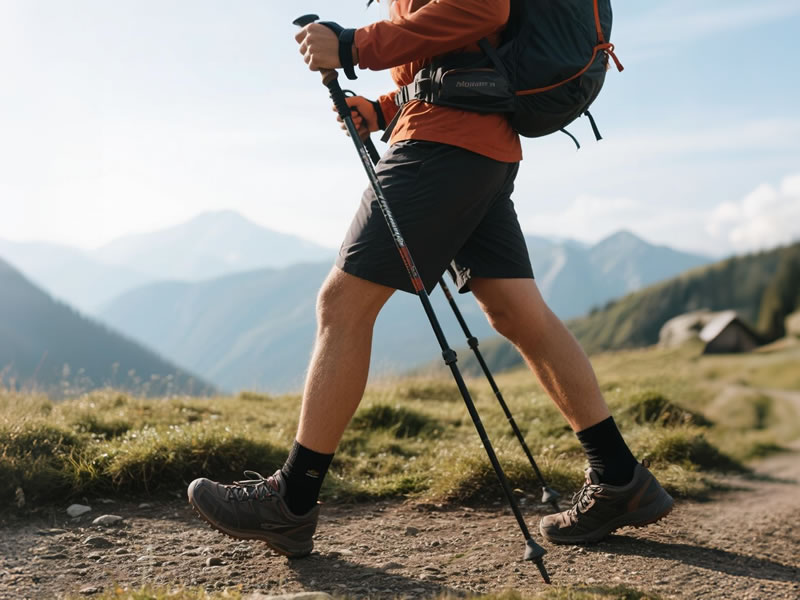
The foundation of efficient pole use is synchronizing with your body's innate walking pattern. Just as you naturally swing your opposite arm forward when you walk or run, you should do the same with your trekking poles.
The Golden Rule: Opposite Arm to Leg.
This means:
- As your right foot steps forward, your left hand plants the pole tip.
- As your left foot steps forward, your right hand plants the pole tip.
This contralateral movement creates a natural counter-balance, stabilizing your torso and engaging your core. It prevents the awkward, "same-side" shuffling that wastes energy and disrupts your balance.
Breaking Down the Efficient Pole Cycle
Think of the pole movement as a continuous, circular motion, much like a train's wheels. Each cycle has four distinct phases:
- The Plant: The pole tip makes contact with the ground. It should land slightly behind your front foot's position, at a point that feels natural for your stride length. Your arm should be relaxed, with a slight bend in the elbow, not fully extended.
- The Load & Drive: This is the power phase. Once the tip is securely planted, you apply pressure through the palm of your hand (via the wrist strap) and push backwards and downwards. You are not pulling yourself forward, but rather pushing the ground behind you, which propels you forward. This is the phase where you actively engage your back, shoulder, and arm muscles to share the workload with your legs.
- The Swing: After the powerful push, you release pressure, and your arm swings forward in a relaxed, pendulum-like motion. The pole tip should skim just above the ground.
- The Recovery: As your arm swings forward, prepare for the next plant. The cycle then repeats seamlessly.
Finding Your Rhythm: The Metronome Effect
A consistent rhythm is key to efficiency. Imagine you have a metronome ticking in your head. Each "tick" is a footfall, and each "tock" is a pole plant. This steady, rhythmic cadence helps you maintain a constant pace, especially on flat or rolling terrain. A rhythmic approach prevents the jerky, sporadic planting that breaks your flow and burns unnecessary energy.
Adapting Rhythm to Terrain
A master hiker adjusts their rhythm and timing just as a driver shifts gears:
- Uphill: Shorten your poles and quicken your rhythm. Your stride shortens, so your pole plants will be more frequent and closer to your body. The focus is on a powerful drive with each step to help "climb" past your feet.
- Downhill: Lengthen your poles and slow your rhythm. The pole plant becomes less about propulsion and more about control and braking. Plant the poles well ahead of you to create a stable anchor before you commit your weight to the descending step.
- Flat & Fast: This is where the classic opposite arm/leg rhythm shines. Use a longer, powerful drive to maintain a brisk, efficient pace. The goal is to make your upper and lower body work in harmony to share the load.
Common Timing Mistakes to Avoid
- The "Parallel Drag": Planting both poles at the same time, then dragging them. This is inefficient and provides no rhythmic propulsion.
- The "Too-Far-Ahead Plant": Planting the pole tip too far in front of you acts as a brake, forcing you to pull yourself forward rather than push off.
- Breaking the Gait: Falling into a same-side arm/leg pattern, which feels unnatural and reduces stability.
Conclusion: Walk in Sync, Walk with Ease
Mastering trekking pole rhythm and timing is the difference between simply carrying poles and truly using them. When your poles become a natural, timed extension of your body, you unlock a new level of hiking efficiency. You'll engage more muscle groups, reduce the percussive impact on your legs, and develop a smooth, sustainable pace that makes long distances feel shorter. Listen to the rhythm of your steps, sync your poles to the beat, and discover how this simple skill can revolutionize your time on the trail.




