




Nordic Walking Technique for Beginners: Your Path to Full-Body Fitness
Nordic walking looks deceptively simple—until you try it yourself. What appears to be just "walking with poles" is actually a sophisticated, technique-driven activity that delivers significantly greater benefits than regular walking. For beginners, learning the proper Nordic walking technique is crucial to unlocking its full potential. This comprehensive guide will break down the fundamental movements step by step, helping you build a solid foundation for this incredibly efficient form of exercise.
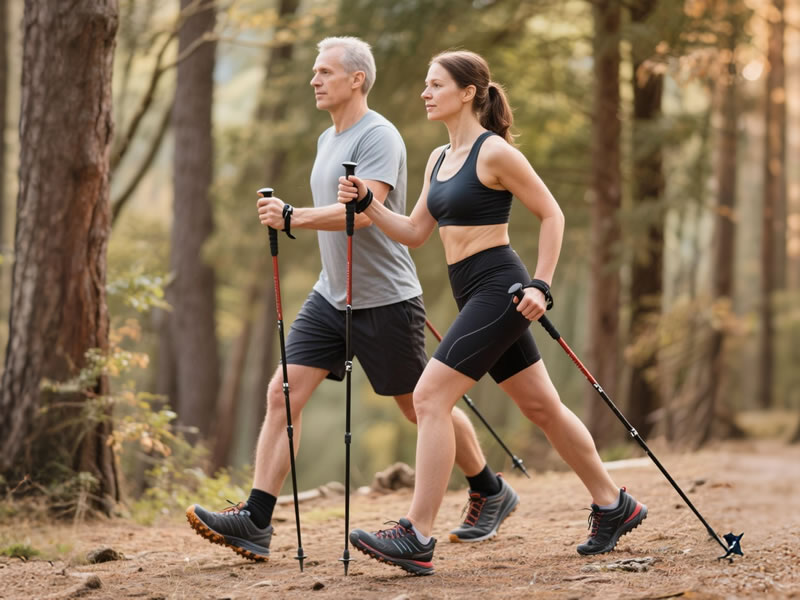
Recommended trekking pole purchase link: https://s.click.aliexpress.com/e/_c4M7OWaN
The Foundation: Understanding the "Why" Behind the Technique
Before we dive into the mechanics, it's important to understand what makes Nordic walking different. Unlike trekking where poles provide stability, Nordic poles are designed for propulsion. The specialized straps allow you to push the pole behind you, engaging your back, shoulder, and arm muscles to actively propel yourself forward. This transforms a lower-body workout into a full-body exercise, increasing calorie burn and cardiovascular benefits by up to 46% compared to regular walking.
Step 1: Mastering the Basic Grip and Posture
- The Grip: Don't clutch the handle. Instead, use the unique Nordic walking strap system. Slide your hand up through the strap from below, then rest the strap across your palm and grip the handle lightly. You should be able to open your hand during the backswing without dropping the pole.
- Posture: Stand tall with your head up, shoulders relaxed and down, and chest open. Imagine a string pulling the crown of your head toward the sky. Keep your gaze forward, not at your feet. Engage your core muscles slightly throughout the walk.
Step 2: The Arm Swing - Your Engine for Power
The arm movement is the heart of the Nordic walking technique. Think of it as a pendulum swinging from your shoulders.
- Forward Swing: As you step forward with your left foot, your right arm swings forward. Your arm should be relatively straight but not locked, extending naturally from the shoulder.
- Pole Plant: Plant the pole at a backward angle, roughly midway between your front and back foot. The tip should land level with your heel on the opposite side.
- The Power Phase: This is the most critical part. As your body moves forward over the planted pole, push down and backward through the strap. Keep your arm extended as you apply force, engaging your latissimus dorsi (the large muscles in your back).
- The Release: At the end of the push, when your hand reaches behind your hip line, open your hand and release the grip completely. The pole will trail behind you, still attached via the strap.
Step 3: Coordinating Arms and Legs
The rhythm is contralateral, just like natural walking: right pole with left foot, left pole with right foot. Avoid the common beginner mistake of moving the arm and leg on the same side together. To find the rhythm, start walking normally without poles, allowing your arms to swing naturally. Then, introduce the poles while maintaining this same, familiar oppositional arm swing.
Step 4: The Perfect Walking Stride
Your stride in Nordic walking is typically longer and more rolling than in regular walking. Focus on a smooth heel-to-toe roll. As your heel strikes the ground, roll through the entire foot, pushing off powerfully from the ball of your foot and toes. The pole push should complement and enhance this powerful stride.
Common Beginner Mistakes to Avoid
- The "Plant and Drag": Simply planting the pole vertically and dragging it behind you. Remember: the power comes from the push.
- The "Death Grip": Clutching the handle tightly throughout the entire motion. This leads to sore hands and shoulders. Keep your grip light and use the strap for power transfer.
- Short, Stiff Arm Movements: Swinging from the elbows instead of the shoulders. Think "long levers" to maximize muscle engagement.
- Poles Pointing Forward: This results in an ineffective, stabbing motion. Always keep the pole tips pointing diagonally backward.
Getting Started: Your First Practice Session
- Find the Right Poles: Your Nordic walking poles should be taller than trekking poles. A good rule of thumb is your height in cm multiplied by 0.68. For a 5'8" (173 cm) person, this would be approximately 118 cm.
- Start Without Poles: Practice the arm swing and contralateral rhythm while walking normally.
- Practice the Pole Plant and Push: Walk slowly, focusing solely on the correct pole planting angle and the powerful push-back motion.
- Put It All Together: Once the individual components feel comfortable, integrate them into a fluid, continuous motion.
The Rewards of Proper Technique
Mastering the Nordic walking technique is well worth the effort. You'll not only enjoy a more effective workout that burns more calories and builds upper-body strength, but you'll also experience reduced impact on your joints and improved posture. Start slowly, be patient with yourself, and focus on one element of the technique at a time. Within a few sessions, the movements will begin to feel natural, and you'll be on your way to reaping the exceptional full-body benefits of Nordic walking.




