




Walking Poles and Weight Distribution: The Science of Sharing the Load
The true magic of walking poles lies not in their simple appearance, but in their profound ability to redistribute weight and forces throughout your body. This isn't just about balance; it's a fundamental biomechanical shift that transforms hiking from a lower-body dominant activity into a full-body, efficient system. Understanding the science of weight distribution with poles unlocks their potential to reduce fatigue, prevent injury, and dramatically enhance your endurance on the trail.
Recommended trekking pole purchase link: https://s.click.aliexpress.com/e/_c4M7OWaN
The Biomechanics: How Poles Redistribute Load
When you walk without poles, nearly 100% of your body weight, plus the impact forces generated with each step, is absorbed by your legs, hips, and spine. The force on your knees during a descent can be three to four times your body weight.
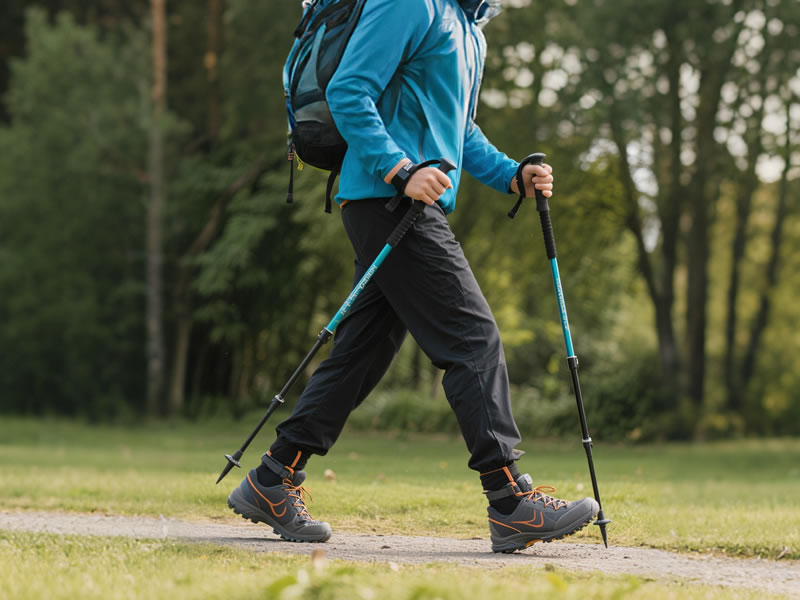
Introducing walking poles changes this equation entirely. With each planted pole, you create a temporary point of support that allows you to transfer load through your arms and shoulders.
- Load Sharing: Studies using force plates have shown that using poles correctly can reduce the load on the knees and hips by 20-30%. This means if you weigh 180 pounds, your knees could be spared up to 54 pounds of force with every single step on a descent.
- Impact Absorption: The poles themselves, especially models with shock absorption, act as primary shock absorbers. They dampen the jarring impact that would otherwise travel up your legs and spine.
- Propulsion Assistance: On flat ground and especially on ascents, the "push-off" phase engages your latissimus dorsi, triceps, and shoulder muscles. This propulsive force helps drive you forward, meaning your leg muscles don't have to work as hard.
The Multifaceted Benefits of Intelligent Weight Distribution
This redistribution of effort and impact delivers a cascade of benefits:
- Joint Preservation: The most celebrated benefit is the dramatic reduction in compressive forces on the knee joints. This is a game-changer for hikers with arthritis, previous injuries, or those simply looking to preserve their joint health for the long term. The hips and lumbar spine also experience significant relief.
- Enhanced Stability and Fall Prevention: By creating two additional points of contact, poles widen your base of support. This is crucial on uneven or slippery terrain. More importantly, it allows for instantaneous weight transfer. If one foot slips, you can instantly shift your weight to the opposite pole, preventing a fall.
- Increased Endurance and Reduced Overall Fatigue: By engaging the large muscle groups of your upper body, the workload is spread more evenly across your entire musculature. Your legs, which would normally bear the entire burden, can work at a lower intensity for longer periods. This is why pole users often report being able to hike farther with less leg soreness.
- Improved Performance with a Heavy Pack: The benefit of load sharing is magnified when carrying a backpack. The poles help stabilize the extra weight and transfer a portion of its burden to your upper body, making a heavy pack feel lighter and more manageable over distance.
Who Benefits Most from This Effect?
- Backpackers and Thru-Hikers: For those carrying significant weight over long distances, poles are not optional; they are essential safety equipment for managing cumulative stress.
- Hikers with Joint Issues: Anyone with knee, hip, or ankle sensitivity will find the load-sharing effect provides immediate and noticeable pain relief.
- Older Hikers: As natural joint cushioning declines with age, poles offer a proactive way to reduce impact and maintain an active lifestyle.
- Anyone on Variable Terrain: The benefit is most pronounced on descents, but also provides propulsion on ascents and stability on technical, uneven ground.
Maximizing the Weight Distribution Effect: Technique is Key
To reap these rewards, proper technique is non-negotiable:
- Use the Straps Correctly: The power of distribution comes from pushing through the strap, not from gripping the handle. Thread your hand up through the strap and let it cradle your wrist.
- Maintain Proper Pole Length: On descents, lengthen poles to allow for an effective forward plant and weight transfer. On ascents, shorten them to maintain an efficient pushing angle.
- Establish a Rhythm: The classic opposite arm/leg motion ensures continuous, fluid weight distribution rather than jarring, sporadic support.
In conclusion, walking poles are sophisticated biomechanical tools that masterfully redistribute weight and impact. They transform your body from a two-legged system bearing all the stress into a dynamic, four-point system that shares the load intelligently. This isn't just about making hiking easier; it's about making it more sustainable, safer, and accessible, ensuring your joints and muscles are protected for countless future adventures.




