




Telescopic vs Folding Walking Poles: The Ultimate Guide to Choosing Your Trail Companion
When selecting walking poles, one of the most fundamental decisions you'll face is choosing between telescopic and folding designs. Both systems have revolutionized hiking efficiency and safety, but they cater to different priorities and hiking styles. Understanding their distinct advantages, limitations, and ideal applications will ensure you invest in poles that perfectly match your adventures.
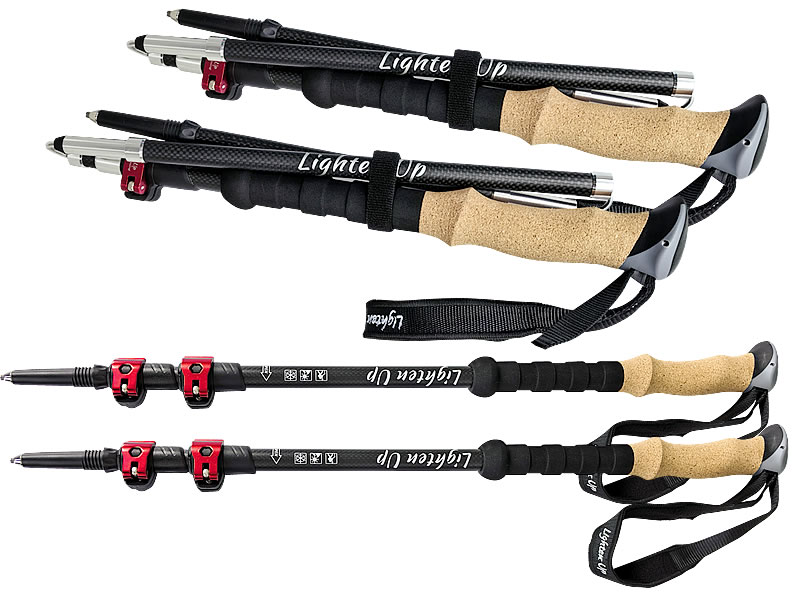
Recommended trekking pole purchase link: https://s.click.aliexpress.com/e/_c4M7OWaN
Telescopic Poles: The Adjustable Workhorses
Telescopic poles feature two or three adjustable sections that slide within each other, secured by either flick-lock or twist-lock mechanisms.
Key Advantages:
- Precise Adjustability: The standout feature is the ability to fine-tune pole length for different terrain. Shorten them for uphill climbs, lengthen for descents, or share them with partners of varying heights.
- Versatility Across Activities: From casual walking to demanding backpacking, their adaptability makes them suitable for diverse scenarios.
- Easier Field Repairs: If a locking mechanism fails, you can often continue using the remaining functional sections.
- Generally More Affordable: The simpler manufacturing process typically makes telescopic poles more budget-friendly.
Potential Drawbacks:
- Bulkier When Packed: Even when collapsed, their extended sections create a longer package that can be challenging to stow in a backpack.
- Heavier Construction: More metal components in the locking systems add weight compared to folding models.
- Maintenance Requirements: Locking mechanisms require regular cleaning and occasional lubrication to prevent slipping or seizing.
Folding Poles (Z-Poles): The Ultralight Specialists
Folding poles utilize three or four segments connected by internal cords, collapsing into a compact Z-shape pattern.
Key Advantages:
- Superior Packability: Their ability to fold into a short, predictable length (typically 12-16 inches) makes them ideal for travel and easy storage.
- Lightweight Design: By eliminating external locks and reducing metal components, folding poles often weigh 20-30% less than telescopic equivalents.
- Rapid Deployment: Most models extend to full length with a single pulling motion, perfect for quick transitions.
- Streamlined Profile: Without external locks, they're less likely to snag on vegetation or gear.
Potential Drawbacks:
- Limited Adjustability: Most folding poles offer fixed lengths or minimal adjustment ranges (typically 5-10 cm).
- All-or-Nothing Functionality: If the internal cord snaps, the entire pole becomes unusable until repaired.
- Higher Cost: Advanced engineering and materials typically command premium prices.
Head-to-Head Comparison: Critical Decision Factors
Durability and Maintenance:
Telescopic poles generally offer better long-term durability for rough use, though their locks require regular maintenance. Folding poles have fewer serviceable parts but can be vulnerable to internal cord damage.
Weight and Packability:
Folding poles are the clear winner for weight-conscious hikers and those needing compact storage. The difference becomes significant on long-distance hikes where every ounce matters.
Adjustability and Versatility:
Telescopic poles provide unmatched versatility for changing terrain and multiple users. This makes them particularly valuable for backpacking trips with significant elevation changes.
Ease of Use:
Folding poles offer quicker deployment, while telescopic poles provide more customization. Your preference for convenience versus control will guide this decision.
Making the Right Choice for Your Needs
Choose Telescopic Poles If You:
- Need to frequently adjust length for varying terrain
- Plan to share poles with hiking partners of different heights
- Prioritize durability and repairability over minimal weight
- Have budget constraints but want quality performance
- Engage in activities requiring precise length customization (like snowshoeing)
Choose Folding Poles If You:
- Value lightweight gear and minimal pack volume
- Frequently travel with carry-on luggage
- Need quick deployment for trail running or fastpacking
- Primarily hike on consistent terrain without needing frequent adjustments
- Want the simplest, most streamlined system
Top Recommendations in Each Category
Telescopic Excellence:
- Black Diamond Trail Pro: Renowned for durable 7075 aluminum construction and reliable FlickLock Pro adjustment system.
- LEKI Micro Vario Carbon: Combines carbon lightweight performance with precise Speed Lock adjustment.
Folding Performance:
- Black Diamond Distance Z: A trail-running favorite known for its simple, robust folding mechanism.
- MSR DynaLock Trail: Features a unique folding design with MSR's secure locking system for demanding conditions.
The Hybrid Solution
Some manufacturers now offer hybrid designs that combine folding convenience with limited adjustability. These "adjustable folding poles" provide 10-15 cm of length variation while maintaining relatively compact folded dimensions.
Your choice between telescopic and folding walking poles ultimately depends on which qualities you value most: the customization and durability of telescopic models, or the lightweight convenience and packability of folding designs. Consider your typical hiking environment, transportation needs, and personal preferences. Both systems represent significant advancements over traditional fixed-length poles, and either choice will enhance your stability, reduce joint impact, and increase your overall hiking enjoyment. The best poles aren't necessarily the most technologically advanced—they're the ones that best suit your individual hiking style and will accompany you reliably on all your adventures.




