




What Issues Should Be Considered When Designing Children's Hiking Poles?
Creating hiking poles specifically for children involves far more than simply scaling down adult models. It requires a thoughtful approach that balances safety, ergonomics, education, and fun to create a tool that empowers young adventurers rather than hinders them. A well-designed children's hiking pole can foster a lifelong love for the outdoors by making exploration safer and more engaging. Here are the critical issues manufacturers and parents must consider.
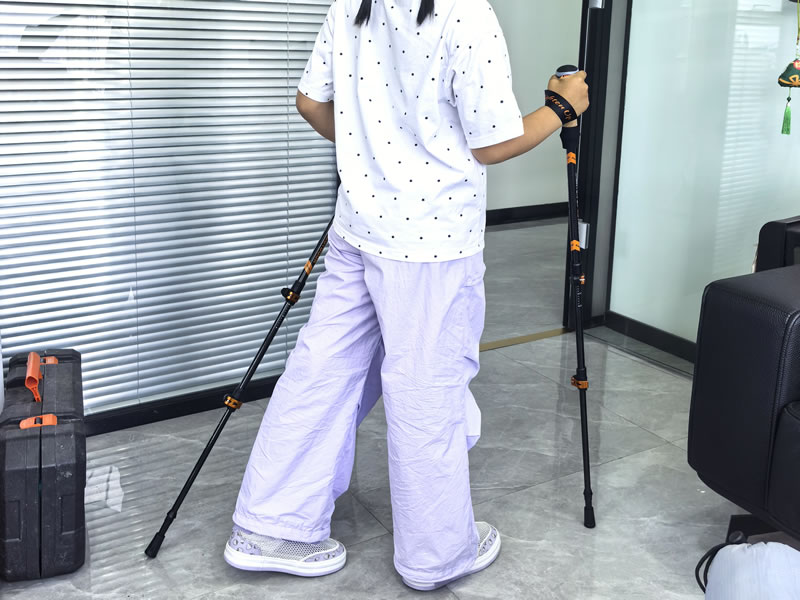
Recommended trekking pole purchase link: https://s.click.aliexpress.com/e/_c4M7OWaN
1. Safety as the Paramount Concern
Safety is the non-negotiable foundation of any children's outdoor product.
- Tip Design: Adult-style sharp, carbide tips are inappropriate and dangerous for children. Tips should be blunt, durable rubber or plastic that provides traction without puncture risk. They should also be wide enough to prevent sinking into soft ground.
- Elimination of Pinch Points: The adjustment mechanism must be completely safe. Flick-lock systems are preferable to twist-locks for smaller hands, but the design must ensure little fingers cannot get caught in the moving parts. Fully internal or shielded mechanisms are ideal.
- Structural Integrity: The poles must be robust enough not to bend or break under enthusiastic use, but also designed to fail safely if subjected to extreme force, avoiding sharp, jagged edges.
- Non-Toxic Materials: All materials, including paints, plastics, and foams, must be certified non-toxic, as children may handle the poles and then put their hands in their mouths.
2. Ergonomic Design for Growing Bodies
Children are not just small adults; their proportions, strength, and motor skills are different.
- Weight is Everything: The poles must be exceptionally lightweight. Heavy poles will be discarded quickly as they cause more fatigue than they relieve. Aluminum alloys are a good starting point, but advanced composites can offer a superior strength-to-weight ratio.
- Grip Size and Shape: Grips must be contoured for smaller hands with a significantly reduced circumference. The material should be soft, non-slip foam that wicks moisture and is comfortable against bare skin. An overly large grip will force the child to over-clench, leading to rapid hand fatigue.
- Adjustable Length Range: Children grow rapidly. A single-season pole is impractical. The ideal pole should have a wide adjustment range, typically from around 55 cm (22 inches) to 110 cm (43 inches), to accommodate a range of ages from toddlers to pre-teens. Clear, easy-to-read markings can help parents set the correct height.
3. Simplicity and Ease of Use
If it's not easy, a child won't use it.
- Intuitive Adjustment System: The mechanism for lengthening or shortening the poles must be simple and require minimal hand strength. A large, easy-to-flip lever is better than a complex twist-lock.
- Tangle-Free Wrist Straps: Traditional adult straps can be confusing and cumbersome. Simplified, quick-release straps or even optional strap-less designs are better for young children who are still learning coordination.
- Effortless Deployment: Folding (Z-pole) designs are often excellent for kids because they deploy instantly with a single pull, requiring no fine motor skill adjustments.
4. Durability and Maintenance
Children's gear is subjected to a unique level of abuse—being dragged, dropped, and used in ways designers never intended.
- Robust Construction: While lightweight, the poles must withstand being used as a sword, a digging tool, or a stick for puddles. Reinforced stress points are crucial.
- Weather and Impact Resistance: The materials must be corrosion-resistant and able to handle being left outside occasionally.
- Easy to Clean: Grips and shafts should be easy to wipe clean of mud, candy, and whatever else a child might encounter.
5. The "Fun Factor" and Educational Value
For a child, the primary purpose of gear is often enjoyment.
- Aesthetics: Bright, cheerful colors and perhaps even themed designs (animals, space, etc.) can make the poles a coveted piece of gear rather than a chore to carry.
- Integrated Learning: The design can subtly teach proper technique. For example, color-coded sections can show parents and children the correct length setting for different terrains. Simple instructions or graphics on the pole itself can remind kids of the "right pole, left foot" rhythm.
- Encouraging Independence: A well-designed pole gives a child a sense of ownership and responsibility for their own hiking experience, boosting confidence and independence on the trail.
Conclusion: Designing for the Future
Designing children's hiking poles is an exercise in empathy and foresight. It requires seeing the trail from a three-foot-tall perspective and understanding that the goal is not just to get a child to the end of a path, but to plant the seed for a lifetime of adventure. By prioritizing safety without being restrictive, tailoring ergonomics to developing bodies, ensuring simplicity, building for durability, and injecting a sense of fun, designers can create a product that truly supports the youngest explorers. The best children's hiking pole is one that a child willingly picks up, confidently uses, and is excited to take on the next adventure, helping them walk farther, see more, and build a deep, lasting connection with the natural world.




