




Advanced Nordic Walking Techniques: Elevate Your Workout to an Art Form
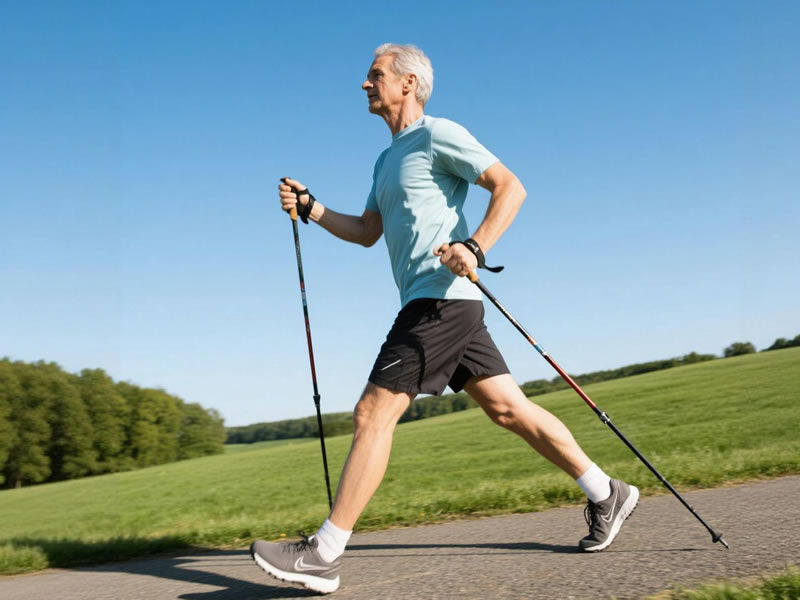
Once you've mastered the fundamental rhythm of Nordic walking—the coordinated opposition of arms and legs and the basic pole push—a world of advanced techniques awaits. These methods transform the activity from excellent cardio into a dynamic, full-body strength and conditioning workout that challenges your coordination, power, and muscular endurance in new ways. Embracing these advanced techniques will break through fitness plateaus and unlock the true athletic potential of Nordic walking.
Recommended trekking pole purchase link: https://s.click.aliexpress.com/e/_c4M7OWaN
1. The Power Sprint: Double Poling for Explosive Speed
This technique, borrowed from cross-country skiing, is the ultimate tool for high-intensity intervals.
- Execution: From your standard stride, plant both poles simultaneously in front of your body as you take a powerful forward leap. Your feet land together as you pull your body forcefully over the poles, engaging your entire core, latissimus dorsi, and abdominals. This creates a bounding motion.
- Benefits: Dramatically increases heart rate and recruits fast-twitch muscle fibers. It builds explosive power in the core and upper body, significantly boosting caloric burn in a short amount of time.
- Application: Use during interval training. After a 5-minute warm-up, perform 30-second power sprints followed by 90 seconds of recovery walking. Repeat 5-8 times.
2. High-Intensity Interval Training (HIIT) Integration
Systematically varying your intensity is the most efficient way to improve cardiovascular fitness and burn fat.
- Execution:High-Intensity Phase (1 minute): Combine a significantly faster walking pace with exaggerated, powerful pole plants. Focus on a strong, accelerated push-off behind your body.Active Recovery Phase (2 minutes): Return to a comfortable, moderate pace while maintaining perfect technique.
- Benefits: Maximizes the "afterburn" effect (Excess Post-Exercise Oxygen Consumption), where your body continues to burn calories at an elevated rate for hours after the workout.
- Application: Structure your workout with a 1:2 work-to-rest ratio. A 30-minute HIIT session can be more effective for fat loss than a 60-minute steady-state walk.
3. Technical Descents: Controlled Engagement on Downhills
Downhills are often seen as a rest period, but with advanced technique, they become a prime opportunity for core and eccentric muscle control.
- Execution: Resist gravity. Instead of letting your body fall forward, lean back slightly and use your poles as powerful brakes. Plant the poles firmly ahead and below you, using your arms, shoulders, and core to control the speed of your descent. This turns the motion into a series of controlled, resisted lunges.
- Benefits: Builds incredible eccentric strength in the quadriceps and develops rock-solid core stability. This is highly beneficial for joint health and injury prevention in daily life.
- Application: Focus on slow, deliberate steps on steep sections. The goal is control, not speed.
4. Lateral and Carioca Movements: Engaging the Obliques
Break out of the sagittal plane (forward-and-back motion) to engage often-neglected stabilizer muscles.
- Lateral Shuffles: Turn sideways and take a wide step to the side, following with the other foot. Plant the poles in the direction of travel, using them to push off and power each lateral step.
- Carioca (Grapevine): Cross one foot in front of the other as you move sideways, then behind. The poles provide crucial stability for this complex coordination pattern.
- Benefits: Activates the gluteus medius, abductors, and obliques, improving hip stability and building a more resilient, balanced physique. Enhances agility and coordination.
- Application: Integrate 1-2 minutes of lateral movement into your regular route, perhaps on a wide, safe path.
5. Nordic Running: The Ultimate Cardio Challenge
For the supremely fit, Nordic walking poles can be incorporated into a running or jogging rhythm.
- Execution: Maintain the opposite arm/leg rhythm but at a running pace. The pole plants become quicker and more dynamic, providing propulsion and absorbing impact. This requires excellent coordination and a strong core.
- Benefits: Further increases cardiovascular intensity and calorie expenditure compared to running alone. The poles help maintain an upright posture and reduce impact forces on the knees and hips.
- Application: Start with short intervals—jog for 1 minute with poles, then walk for 2 minutes to recover. Ensure you have a strong foundation in standard Nordic walking before attempting this.
6. Terrain-Specific Power Techniques
- Sand or Soft Ground: The unstable surface dramatically increases the resistance for both your legs and poles, turning your workout into a power and stability session.
- Steep Inclines: Shorten your grip on the poles and focus on a powerful, piston-like push with each step, driving from your legs and amplifying it through your upper body.
Safety and Progression
As with any advanced training, progression is key. Master one technique before moving to the next. Always perform a dynamic warm-up and end with a cool-down stretch. Listen to your body; these techniques are demanding and require a solid foundation of fitness and proper form to prevent injury.
By integrating these advanced Nordic walking techniques, you transform your workout from a simple walk in the park into a sophisticated, holistic fitness regimen that builds strength, power, agility, and unparalleled cardiovascular endurance. It's the evolution of walking into a true athletic discipline.




