




Walking Poles for Uphill Climbing: Mastering the Art of Efficient Ascent
Tackling steep inclines presents one of hiking's most demanding challenges, where proper use of walking poles transforms from helpful assistance to essential technique. When deployed correctly on uphill sections, poles do much more than provide balance—they become propulsion tools that engage your entire body, redistribute workload, and significantly boost your climbing efficiency. Understanding the specific strategies for ascending terrain can make the difference between arriving at the summit exhausted or arriving energized.
Recommended trekking pole purchase link: https://s.click.aliexpress.com/e/_c4M7OWaN
The Biomechanical Advantage: Why Poles Work on Climbs
Uphill climbing places extraordinary demands on your lower body, particularly the quadriceps, glutes, and calves. Walking poles fundamentally change this dynamic by:
- Engaging Upper Body Muscles: Your arms, shoulders, back, and chest contribute to forward motion, sharing the workload that would otherwise fall entirely on your legs.
- Improving Traction: With each pole plant, you gain additional points of contact, preventing backward slippage on loose surfaces.
- Enhancing Posture and Breathing: Poles encourage a forward-leaning yet upright torso position that keeps your airways open for optimal oxygen intake.
- Creating Rhythm: The consistent pole-planting rhythm establishes a sustainable pace that helps maintain momentum through challenging sections.
Research indicates that using poles on ascents can reduce perceived exertion by up to 25%, allowing you to climb longer with less fatigue.
Technical Adjustment: Setting Your Poles for Ascents
Before beginning your climb, make this crucial adjustment:
- Shorten Your Poles: Reduce pole length by 5-10 cm (2-4 inches) from your standard flat-ground setting. This prevents you from overreaching upward, which can strain your shoulders and disrupt your balance. The shortened length allows for powerful pushes at an optimal angle.
Mastering the Uphill Technique: The Power Phase
The key to effective uphill poling lies in maximizing what's known as the "power phase":
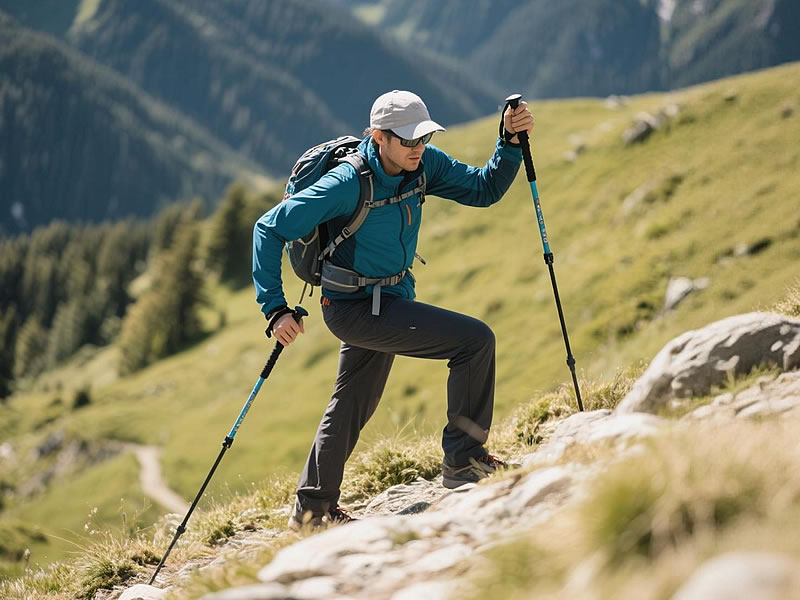
- Plant and Push: As you step forward with your right foot, plant the left pole approximately level with your right foot. Focus on pushing down and backward through the pole, driving yourself forward and upward.
- Utilize the Straps: Transfer power through the wrist straps rather than gripping tightly. This allows you to generate force using your larger arm and back muscles while preventing hand fatigue.
- Coordinate with Breathing: Establish a breathing pattern synchronized with your pole plants—exhale during the push phase for maximum power output.
- Maintain Forward Momentum: Keep your poles moving in a forward-backward motion rather than wide, sweeping arcs that waste energy.
Advanced Uphill Strategies for Varied Conditions
Steep, Rocky Terrain:
- Use a "double plant" technique for extra stability on particularly steep or technical sections.
- Plant both poles firmly ahead, then step up between them, using your upper body to pull yourself upward.
Long, Gradual Ascents:
- Establish a sustainable rhythm where your breathing, stepping, and pole planting create a fluid, continuous motion.
- Periodically vary your grip position slightly to distribute muscle fatigue across different areas.
Switchback Navigation:
- On tight turns, shorten the inside pole slightly for better maneuverability.
- Use the outside pole for powerful pushes that propel you through the turn.
Equipment Considerations for Optimal Uphill Performance
- Lightweight Construction: Every ounce matters when lifting poles repeatedly on long climbs. Carbon fiber poles offer significant advantages here.
- Secure Locking Mechanisms: Ensure your pole locks are fully secure before beginning ascents to prevent dangerous slippage mid-push.
- Aggressive Tips: Sharp, durable carbide tips provide essential grip on rocky, loose, or root-covered surfaces.
Common Mistakes to Avoid
- Overreaching: Planting poles too far ahead reduces power transfer and can pull you off-balance.
- Death Grip: Clutching the handles too tightly quickly fatigues forearm muscles.
- Incorrect Length: Using flat-ground pole length on steep ascents forces awkward body positioning.
- Poor Rhythm: Allowing your pole plants to become irregular disrupts your climbing efficiency.
Training Drills for Improved Uphill Performance
- Power Intervals: Find a moderate incline and practice powerful, exaggerated pole pushes for 30-60 second intervals.
- Tempo Climbs: Maintain a consistent, challenging pace on longer ascents, focusing on flawless technique throughout.
- One-Pole Drills: Practice climbing with only one pole to improve balance and identify strength imbalances.
The Mental Aspect: Poles as Psychological Tools
Beyond physical benefits, walking poles provide psychological advantages on daunting climbs. The rhythmic planting creates a meditative focus, while the tangible forward progress with each push provides encouragement. Many hikers report that having poles makes intimidating ascents feel more manageable and less overwhelming.
When mastered for uphill climbing, walking poles cease to be simple accessories and become powerful extensions of your body. They transform the exhausting, quad-dominant work of climbing into a full-body endeavor that distributes effort, conserves energy, and ultimately makes ascending not just easier, but faster and more enjoyable. Whether facing a short, steep pitch or a long, grinding mountain ascent, the proper application of uphill pole technique will revolutionize your climbing experience, turning what was once a struggle into a demonstration of efficient, powerful movement.




