




Do Walking Poles Build Muscle? The Surprising Truth About Trekking Pole Fitness
When most people picture muscle-building activities, they typically imagine weight rooms, resistance machines, or high-intensity interval training—not walking with poles. However, the growing body of research on trekking pole use reveals some surprising benefits for muscular development. While walking poles won't give you bodybuilder-sized muscles, they can significantly enhance muscular endurance, improve muscle tone, and promote balanced strength development throughout your body. Understanding how poles engage different muscle groups and learning to maximize this engagement can transform your ordinary walk into a comprehensive strength-building session.
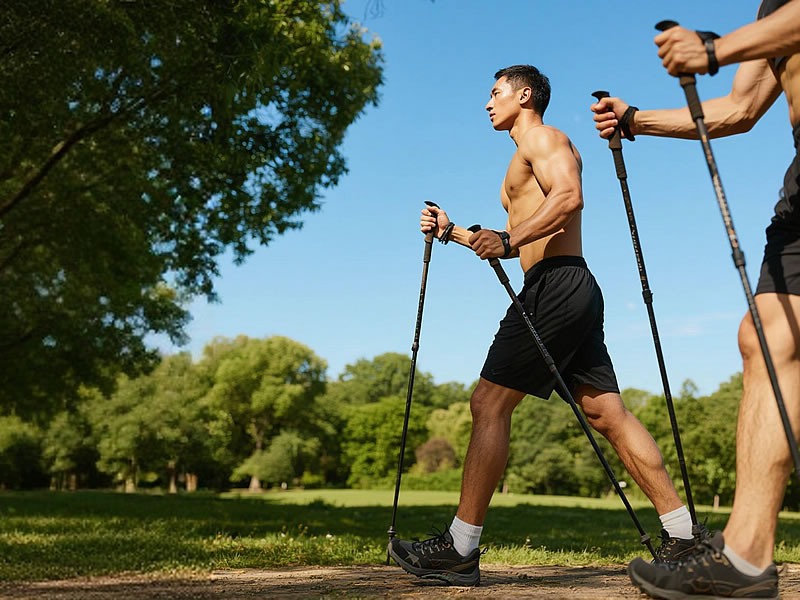
Recommended trekking pole purchase link: https://s.click.aliexpress.com/e/_c4M7OWaN
The Muscles Worked: A Comprehensive Overview
Using walking poles correctly transforms a lower-body dominant activity into a full-body workout that engages multiple muscle groups simultaneously:
Upper Body Muscles:
- Triceps Brachii: The pushing motion during the pole plant and follow-through actively engages your triceps, making this one of the most worked upper body muscles during pole walking.
- Deltoids and Rotator Cuff: Your shoulder muscles work continuously to swing and plant the poles, providing excellent endurance training for these often-neglected stabilizers.
- Latissimus Dorsi: The large back muscles activate during the pulling phase of the motion, particularly when climbing hills or using more aggressive technique.
- Forearm Flexors and Extensors: Gripping the poles and controlling their placement provides constant low-level engagement of forearm muscles.
Core Muscles:
- Obliques and Transverse Abdominis: The contralateral movement pattern (right arm with left leg) creates gentle torso rotation that engages your oblique muscles.
- Erector Spinae: These spinal support muscles work isometrically to maintain proper posture throughout the walking motion.
- Deep Stabilizers: The constant balance adjustments required when using poles engage the deeper core stabilizers that are difficult to target with traditional exercises.
Lower Body Impact:
While the lower body remains the primary driver of walking motion, poles can enhance muscle engagement by:
- Allowing for longer, more powerful strides that increase glute and hamstring activation
- Providing stability that enables better form and deeper muscle recruitment
- Reducing fatigue in overworked muscles, allowing for longer workout duration
The Science Behind Muscle Engagement
Research supports the muscular benefits of pole walking:
- A study published in the Journal of Strength and Conditioning Research found that Nordic walking (a specific pole walking technique) produced significantly higher muscle activation in the triceps, shoulders, and core compared to regular walking.
- Electromyography (EMG) studies show that proper pole use increases muscular activity in the upper body by 30-50% compared to standard walking.
- The constant low-resistance, high-repetition nature of pole walking is ideal for building muscular endurance—the ability of muscles to perform repetitive contractions over extended periods.
Pole Walking vs. Traditional Strength Training
It's important to understand what walking poles can and cannot do for muscle development:
What Pole Walking Excels At:
- Building muscular endurance rather than maximal strength
- Promoting balanced development between opposing muscle groups
- Improving functional strength that translates directly to daily activities
- Providing low-impact cross-training for recovery days between intense workouts
Limitations for Muscle Building:
- Lack of progressive overload necessary for significant hypertrophy (muscle growth)
- Insufficient resistance to build substantial muscle mass
- Limited ability to target specific muscles for isolation work
Maximizing Muscle Building Potential
To get the most muscular benefit from your walking poles:
- Focus on Technique:Ensure proper pole planting with an active push-off phaseMaintain a full range of motion through your arms and shouldersEngage your core consciously throughout the movement
- Increase Intensity:Incorporate intervals of more vigorous polingAdd wrist weights (1-3 pounds) for increased resistanceSeek out hilly terrain to increase muscular demands
- Vary Your Routine:Alternate between different pole techniques (Nordic walking vs. trekking style)Incorporate strength-specific exercises using your poles (such as pole push-ups or triceps dips)Mix in periods of faster pacing with powerful pole plants
Specific Techniques for Targeted Muscle Development
For Upper Body Emphasis:
- Use a more aggressive forward pole plant angle
- Focus on powerfully pushing yourself forward with each plant
- Use poles with minimal shock absorption to increase resistance
For Core Development:
- Maintain conscious engagement of your abdominal muscles throughout
- Allow natural torso rotation but avoid excessive twisting
- Practice walking on uneven terrain to challenge stabilizers
For Comprehensive Engagement:
- Use the Nordic walking technique with its specific planting and pushing mechanics
- Ensure proper pole length—typically 65-70% of your height
- Maintain a consistent rhythm that allows full extension through arms and hips
Complementary Exercises for Balanced Development
While walking poles provide excellent muscular benefits, consider supplementing with:
- Resistance Training: 1-2 weekly sessions focusing on major muscle groups
- Flexibility Work: Regular stretching to maintain range of motion
- Balance Training: Additional exercises to enhance stability and proprioception
Progression and Adaptation
Like any fitness modality, your muscles will adapt to pole walking over time. To continue seeing benefits:
- Gradually increase your walking duration and intensity
- Vary your routes to include different terrains and challenges
- Periodically reassess your technique to ensure maximum muscle engagement
- Consider advanced techniques such as running with poles for increased demands
Who Benefits Most from Pole Walking for Muscle Development?
Certain populations may find particular value in using walking poles for muscular fitness:
- Older Adults: The low-impact nature and balance benefits make poles ideal for maintaining muscle mass and function
- Rehabilitation Patients: The graduated resistance and stability support make poles excellent for rebuilding strength after injury
- Endurance Athletes: The cross-training benefits and additional upper body engagement complement sport-specific training
- Fitness Beginners: The natural movement pattern and moderate intensity provide an accessible entry to strength building
Conclusion: A Valuable Tool in Your Fitness Arsenal
Walking poles won't replace dedicated strength training for those seeking significant muscle hypertrophy, but they represent a valuable tool for developing functional strength, improving muscular endurance, and creating balanced muscle development. The accessibility, low-impact nature, and integration with outdoor activity make pole walking an excellent addition to any fitness routine. By understanding which muscles benefit from pole use and implementing techniques to maximize this engagement, you can transform your daily walk into a comprehensive strength-building session that leaves you with better posture, improved functional capacity, and more balanced muscular development. Whether you're a dedicated athlete looking for cross-training benefits or someone seeking to maintain strength and mobility as you age, walking poles offer a unique approach to muscle conditioning that's both effective and enjoyable.




