




How to Use Walking Poles on Stairs: A Complete Safety Guide
Stair navigation presents unique challenges that transform walking poles from simple aids into essential safety equipment. Whether you're facing a short flight of porch steps or a lengthy staircase on your favorite trail, proper pole technique can mean the difference between confident movement and dangerous instability. Stairs demand specific adaptations to the standard walking pole techniques used on level ground, particularly because they alter your center of gravity and require precise weight distribution. This comprehensive guide will teach you how to safely navigate both ascent and descent on various stair types while maximizing the stability benefits of your poles.
Recommended trekking pole purchase link: https://s.click.aliexpress.com/e/_c4M7OWaN
Understanding the Physics of Stair Navigation
Stairs fundamentally change the biomechanics of walking by introducing significant elevation changes within short distances. This creates several challenges that poles help address:
Center of Gravity Shifts:
When ascending, your body naturally leans forward, while descending creates a backward lean. Both positions compromise your natural balance. Poles provide additional contact points that stabilize these potentially unstable positions.
Impact Force Management:
Descending stairs generates impact forces up to 3.5 times body weight on knee joints. Proper pole use can reduce these forces by distributing load to your upper body and providing controlled descent speed.
Limited Stability Base:
The narrow, often uneven surface of stair treads dramatically reduces your base of support. Poles effectively widen this base, creating a more stable platform, especially on stairs without handrails.
Essential Pre-Stair Preparation
Pole Length Adjustment:
For stair navigation, many users benefit from slightly shorter poles than they use on level ground:
- Ascending: Shorten poles by 2-5 cm (1-2 inches) to prevent overreaching
- Descending: Standard length typically works well, but some prefer slight lengthening
- Quick adjustment practice: Master your pole's adjustment system for transitions between stair sections and level areas
Safety Equipment Check:
Before approaching stairs, verify:
- All locking mechanisms are fully secured
- Rubber tips are clean and provide adequate traction
- Straps are properly positioned for quick release if needed
- No visible damage to poles that could compromise safety
Ascending Stairs: Technique and Safety
The Standard Ascent Method:
This technique works well for most stair situations:
- Plant both poles securely on the step below you
- Step up with your stronger leg first
- Bring your other foot to join it on the same step
- Reposition poles to the next lower step
- Repeat the process methodically
The Alternating Ascent Method:
For wider stairs or those with handrails:
- Hold both poles in one hand if a railing is available
- Use the free hand to grip the handrail
- Step up normally while keeping poles available for additional support
- Switch pole hand at landings if needed for longer flights
Advanced Power Ascent:
For fitness-focused stair climbing:
- Plant one pole slightly ahead on a higher step
- Push down forcefully as you step up
- Alternate poles with each step in rhythm with your footwork
- Maintain an upright posture rather than leaning heavily on poles
Descending Stairs: Control and Confidence
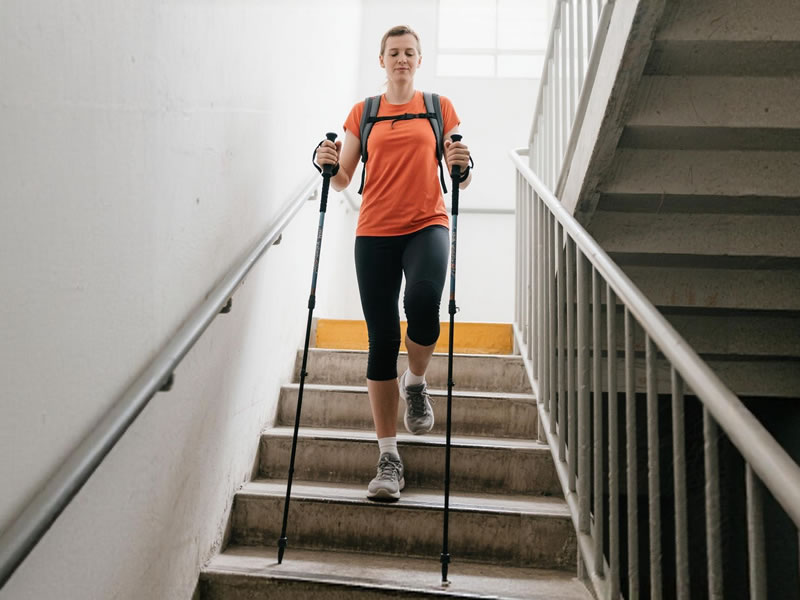
The Controlled Descent Method:
This safety-focused approach works for most situations:
- Plant both poles securely on the step below
- Step down with your weaker leg first
- Follow with your stronger leg to the same step
- Reposition poles to the next lower step
- Maintain a slow, deliberate pace throughout
The Sideways Descent Technique:
Particularly useful for steep, narrow, or unfamiliar stairs:
- Turn sideways to the staircase
- Place both poles on the lower step
- Step down with your lower foot first
- Follow with your upper foot
- Use poles as a stable "handrail" throughout
The Dynamic Descent Method:
For experienced users on familiar, well-designed stairs:
- Plant poles diagonally as you descend
- Maintain a contralateral rhythm (right pole with left foot)
- Keep movements fluid but controlled
- Use poles primarily for balance rather than weight-bearing
Special Staircase Situations and Adaptations
Spiral and Curved Stairs:
These present unique challenges due to their irregular step dimensions:
- Use shorter, more frequent pole placements
- Keep poles closer to your body for better control
- Take smaller steps to accommodate varying tread widths
- Consider the single-file technique if space is limited
Outdoor and Uneven Stairs:
Trail stairs often have irregular surfaces and may be slippery:
- Test each pole placement before committing weight
- Use pole tips to check for unstable or slippery surfaces
- Widen your pole placement for increased stability
- Shorten your stride to maintain balance on uneven steps
Stairs Without Handrails:
Poles become your primary safety system:
- Use a wider pole stance than normal
- Plant poles firmly before each step
- Consider the double-pole planting method for maximum stability
- Move with extra deliberation and care
Common Mistakes and How to Correct Them
Overreaching with Poles:
Planting poles too far ahead on stairs disrupts balance and reduces effectiveness.
Correction: Focus on planting poles directly on the step immediately below or at most one step ahead.
Rushing the Process:
Moving too quickly on stairs significantly increases fall risk.
Correction: Establish a deliberate, methodical rhythm and maintain it consistently.
Improper Weight Distribution:
Leaning too heavily on poles can cause tip slippage.
Correction: Use poles primarily for balance rather than full weight support.
Inadequate Attention to Environment:
Failing to assess stair conditions before starting.
Correction: Always pause at the top or bottom to evaluate the staircase before proceeding.
Equipment-Specific Considerations
Pole Tip Selection:
- Rubber tips: Essential for indoor stairs and most outdoor concrete stairs
- Carbide tips: Better for rough outdoor stone or wooden stairs
- Mixed-use: Some situations may benefit from removable rubber tip covers
Shock Absorption Settings:
- Consider reducing or turning off shock absorption for maximum stability on stairs
- The predictable impact pattern of stairs often makes shock absorption less beneficial
- Test your preferred setting on a safe staircase before committing to it in challenging environments
Building Confidence Through Progressive Practice
Beginner Level:
- Practice on single steps before progressing to full flights
- Use stairs with handrails initially, even when using poles
- Focus on technique rather than speed
- Practice both ascending and descending equally
Intermediate Skills:
- Progress to stairs without handrails
- Increase the number of steps between breaks gradually
- Practice on different stair types and materials
- Incorporate turning on landings
Advanced Application:
- Navigate stairs while carrying additional weight
- Practice in various weather conditions (for outdoor stairs)
- Increase pace while maintaining safety
- Help others learn stair techniques
Safety Protocols and Emergency Procedures
Fall Prevention Strategies:
- Always maintain at least three points of contact with stairs
- Keep your center of gravity centered over your feet
- Avoid carrying items that obstruct your view of the stairs
- Use extra caution when stairs are wet, icy, or poorly lit
Recovery Techniques:
- If you feel unstable, lower your center of gravity immediately
- Don't be afraid to sit on the stairs if needed
- Practice how you would use poles to arrest a potential fall
- Always know where the nearest handrail is located
Conclusion: Mastering Stairs with Confidence
Stair navigation with walking poles represents a skill that blends technical knowledge with practical experience. While initially challenging, proper technique quickly becomes second nature, transforming staircases from obstacles into manageable terrain. The key to success lies in starting with simple situations, progressing gradually, and always prioritizing safety over speed.
Remember that every staircase presents unique characteristics, and the most effective pole users remain adaptable in their approach. Don't hesitate to modify techniques based on specific stair designs, your physical condition on any given day, and environmental factors like weather and lighting.
Your walking poles are powerful tools for stair navigation, but their effectiveness depends entirely on your skill in using them. With the techniques outlined in this guide and consistent practice, you'll find yourself moving up and down stairs with newfound confidence, stability, and independence. The next staircase you encounter isn't an obstacle—it's an opportunity to demonstrate your mastery of pole-assisted mobility.




