




How to Use Walking Poles in a Crowd: Navigating Safely and Courteously
Navigating crowded spaces with walking poles presents unique challenges that require adapted techniques and heightened awareness. Whether you're moving through a busy farmers market, festival, or urban sidewalk, proper crowd navigation ensures both your safety and the comfort of those around you. Many pole users avoid crowded situations entirely due to concerns about inconveniencing others or causing accidents, but with the right approach, you can maintain your mobility support while being a considerate community member. This comprehensive guide covers everything from equipment adjustments to advanced crowd-reading techniques that will keep you moving confidently in any populated environment.
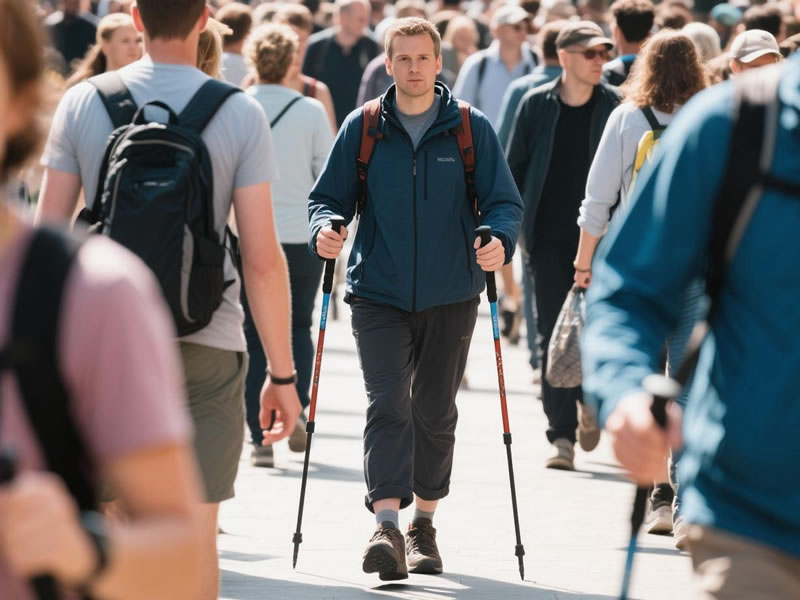
Recommended trekking pole purchase link: https://s.click.aliexpress.com/e/_c4M7OWaN
Essential Pre-Crowd Preparation
Equipment Adjustments for Crowded Spaces:
Before entering dense areas, make these crucial modifications:
- Shorten pole length by 5-10 cm (2-4 inches) for better control and reduced swing radius
- Install rubber tips if not already using them—they provide better pavement grip and eliminate metal-on-concrete noise
- Remove large baskets that can snag on bags, clothing, or mobility aids
- Verify locking mechanisms are secure to prevent accidental collapse in close quarters
Mental Preparation and Planning:
- Identify rest points where you can step aside if needed
- Plan your route through less congested areas when possible
- Set realistic pace expectations—crowd navigation will slow your progress
- Prepare polite responses for questions or comments about your poles
Fundamental Techniques for Crowd Navigation
The Modified Grip and Swing:
Adjust your standard technique for confined spaces:
- Shorten your arm swing dramatically, focusing on vertical rather than horizontal movement
- Tuck elbows closer to your body to reduce your spatial footprint
- Use wrist-focused motion rather than full arm swings
- Maintain light grip pressure to quickly adjust to unexpected movements around you
The Vertical Carry Position:
When moving through particularly dense areas:
- Carry poles vertically with tips pointing upward
- Keep poles close to your body, aligned with your shoulder line
- Maintain awareness of pole tips' height to avoid overhead obstacles
- Practice quick transitions between carrying and planting positions
The "Follow-the-Leader" Technique:
When possible, position yourself behind someone moving at your desired pace:
- Maintain safe distance while using their movement to create space
- Match their rhythm to establish consistent pacing
- Use their path to anticipate directional changes
- Remain prepared to stop suddenly if they do
Spatial Awareness and Movement Strategies
Creating Personal Space:
- Angle poles slightly outward to create a subtle buffer zone
- Use visual presence—poles often encourage others to provide more space
- Position yourself strategically near building lines or other boundaries
- Make eye contact with approaching pedestrians to ensure mutual awareness
Navigating Different Crowd Types:
- Orderly queues: Keep poles vertical and stay centered in your space
- Milling crowds: Use shorter, more frequent pole plants
- Moving rivers of people: Go with the flow while maintaining your stability
- Mixed-speed areas: Stay to the side matching your pace
Direction Change Protocols:
- Check your "pole radius" before turning
- Signal your intentions with obvious body language
- Make wider turns than usual to account for pole length
- Pause if necessary to let others pass before executing turns
Safety Considerations and Hazard Management
Pedestrian Priority Protocol:
- Always yield to children, elderly individuals, and those with mobility challenges
- Exercise extra caution around people with service animals or guide dogs
- Be particularly careful near individuals using canes, walkers, or wheelchairs
- Anticipate unpredictable movements from people distracted by phones or conversations
Trip Prevention Strategies:
- Keep tips visible to others—bright colored tips help with awareness
- Avoid planting poles where people need to step
- Never leave poles lying across walkways
- Immediately apologize if your poles inconvenience anyone
Emergency Response Preparation:
- Practice quick pole collapsing for unexpected dense areas
- Know how to secure poles against your body if hands-free movement becomes necessary
- Have a "bail-out plan" for when crowds become overwhelming
- Carry identification with emergency contact information
Communication and Social Considerations
Non-Verbal Communication:
- Use deliberate movements that clearly signal your intentions
- Make brief eye contact to acknowledge others' awareness
- Nod or smile when people make space for you
- Apologize with gestures if accidental contact occurs
Verbal Strategies:
- Have polite phrases ready like "Thank you for the space" or "Pardon my poles"
- Respond graciously to questions about why you use poles
- Keep explanations brief unless the situation warrants more detail
- Offer to step aside if someone seems uncomfortable near your poles
Managing Unwanted Attention:
- Practice neutral responses to stares or comments
- Remember your right to use mobility aids in public spaces
- Focus on your safety rather than others' opinions
- Carry yourself confidently—your comfort with poles affects how others perceive them
Special Crowd Scenarios
Public Transportation:
- Collapse poles before boarding buses or trains when possible
- Position poles vertically between your knees when seated
- Stand near poles/walls to minimize interference with other passengers
- Offer to move if your poles inconvenience others
Event Navigation:
- Arrive early to settle before crowds peak
- Identify accessible viewing areas that accommodate pole use
- Scope out less-congested routes to facilities
- Position yourself at the periphery where you have more space
Retail Environments:
- Be mindful of displays and merchandise when turning
- Use baskets rather than trying to manage poles while handling products
- Ask for assistance rather than reaching across displays with poles
- Shop during off-peak hours when possible
Skill Development Exercises
Progressive Exposure Training:
- Begin in moderately crowded but predictable environments like library entrances
- Progress to moderately dynamic spaces such as post offices
- Advance to challenging environments like busy transit stations
- Finally practice in highly unpredictable crowds like festivals
Technical Skill Drills:
- Practice quick transitions between carrying and planting positions
- Develop one-handed techniques for when you need a free hand
- Master the "pause-and-plant" for sudden stops in crowd flow
- Time your movements to sync with natural crowd rhythm patterns
Equipment Customizations for Crowded Use
Visibility Enhancements:
- Add reflective tape to increase pole visibility in low light
- Use brightly colored grips or shaft sections
- Consider light attachments for evening crowd navigation
- Choose distinctive designs that help people remember your poles' presence
Functional Modifications:
- Quick-adjust systems that allow rapid length changes
- Magnetic tip protectors that stay secure but remove easily
- Custom grips that provide security with minimal hand movement
- Compact folding models that store easily when not needed
Conclusion: Confidence Through Competence
Navigating crowds with walking poles represents the intersection of technical skill, spatial awareness, and social consideration. While initially intimidating, mastering crowd navigation opens up countless opportunities to participate in community life without sacrificing the mobility support you need. The key lies in recognizing that your right to use mobility aids comes with responsibility toward those sharing your space.
Remember that most people are accommodating when they understand your needs. Your confidence and competence with poles will put others at ease, creating positive interactions rather than conflicts. With the techniques outlined in this guide and regular practice, you'll find yourself moving through crowded spaces with the same assurance you feel on open trails.
Your poles are tools of independence—don't let crowded environments diminish their benefits. Each successful crowd navigation builds both skill and confidence, gradually transforming what once felt daunting into just another environment where your poles serve you well. The world is meant to be explored and experienced, and with these techniques, crowded spaces no longer need to be exceptions to that exploration.




