




How to Use Poles for Stream Crossings
A rushing stream can be one of the most intimidating obstacles on a trail. Slippery, unstable rocks and powerful current can turn a beautiful water feature into a significant hazard. While fording a stream always requires caution, using trekking poles correctly is the single most effective technique to transform a precarious balancing act into a stable, controlled, and safe crossing.
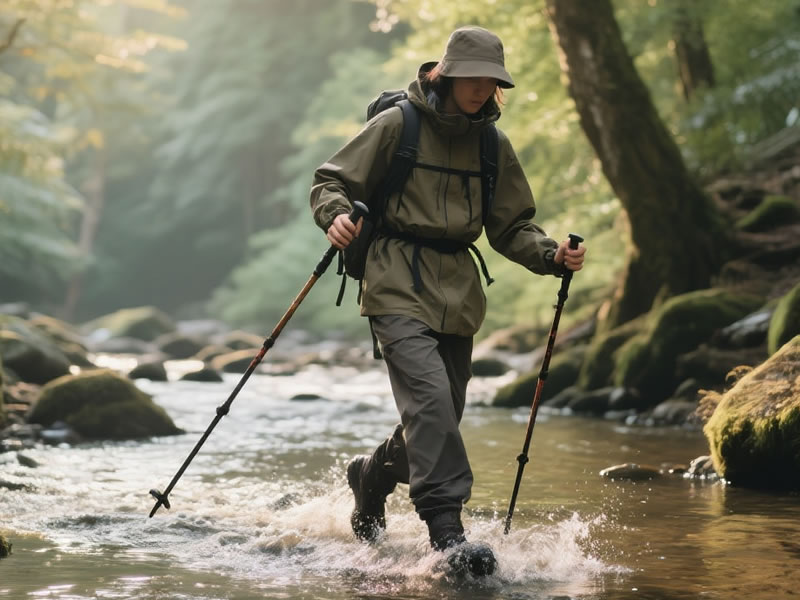
Recommended trekking pole purchase link: https://s.click.aliexpress.com/e/_c4M7OWaN
This guide will walk you through the techniques and tips to master this essential skill.
Why Poles are Non-Negotiable for Water Crossings
Before diving into technique, it's crucial to understand why poles are so vital:
- Create a Stable Tripod: Your two legs provide two points of contact. Adding two poles instantly gives you four. This creates a stable, wide base of support that is far more resistant to slips and shifts.
- Probe for Hazards: What looks like a solid bottom can be deep mud, loose gravel, or an unstable log. Poles allow you to test the depth, bottom composition, and firmness of each step before you commit your weight.
- Brace Against Current: Water pressure against your legs can easily throw you off balance. Planting your poles upstream acts as a brace, allowing you to lean slightly into the current without being swept away.
- Reduce Joint Impact: By engaging your arms and shoulders, poles absorb a significant amount of the impact and strain that would otherwise be placed on your knees and ankles as you navigate uneven terrain.
The Pre-Crossing Checklist: Safety First
Never rush a stream crossing. Your first step happens on dry land.
- Scout the Best Route: Look for the widest, slowest-moving section of the stream (a wider area is often shallower). Avoid areas directly above waterfalls or rapids. If possible, cross at a slight diagonal heading downstream, as this often presents a more stable footing.
- Unbuckle Your Backpack: This is a critical safety step. Unbuckle your backpack's waist belt and sternum strap. In the unlikely event you fall, you need to be able to shed your pack quickly to prevent it from pulling you under.
- Keep Your Footwear On: Never cross barefoot or in socks. Your hiking boots provide essential protection from sharp rocks and give you much-needed traction. You can change into dry socks and shoes or camp sandals on the other side.
The Technique: The Four-Point "Shuffle"
This is the core method for a safe crossing using poles.
- Face Upstream: Position your body sideways, facing upstream. This presents a narrower profile to the current, reducing its force on your body.
- Establish Your Tripod: Plant both poles firmly on the stream bed, slightly upstream from your body. You, plus the two poles, now form a stable three-point stance before you even move a foot.
- Move One Pole at a Time: The golden rule is always maintain at least three points of contact. The sequence is:Move the downstream pole to a new, secure spot. Probe the bottom.Then, move your upstream foot to a new position.Next, move the upstream pole.Finally, move your downstream foot.
- Shuffle, Don't Step: Take small, deliberate steps. Avoid large, high steps that compromise your balance. Slide your feet along the bottom, feeling for a secure placement.
- Lean into the Current: Use your poles to support a slight forward lean into the current. This counteracts the water's force pushing against your legs. Your poles are your anchor.
Choosing and Adjusting Your Poles
- Length: For deep or powerful crossings, some hikers prefer to lengthen their poles by 5-10 cm. This provides a higher brace point and allows you to reach for more stable spots without over-leaning.
- Baskets: Remove the small trekking pole baskets. In a stream, they can catch the current and create drag. Large powder baskets for snow are a definite no-go.
- Tips: Keep the metal carbide tips exposed for the best grip on rocky surfaces.
What to Do if You Fall
Despite all precautions, a fall is possible. If you go in:
- Let Go of Your Poles: Most modern poles have wrist straps that are quick-release. Let them go to avoid injury.
- Shuck Your Pack: Use the quick-release buckles to get your backpack off.
- Focus on Self-Rescue: Don't try to stand up in fast-moving water. Roll onto your back with your feet pointing downstream to fend off obstacles and float on your back towards calmer water or the nearest shore.
In conclusion, trekking poles are far more than just walking aids; they are fundamental safety tools for navigating water obstacles. By mastering the four-point shuffle and respecting the power of moving water, you can approach your next stream crossing not with trepidation, but with confidence and control.




