




Walking Poles for Military Use: Beyond Hiking, Into Tactical Advantage In the world of military equipment, where every piece of gear is scrutinized for its tactical valu
In the world of military equipment, where every piece of gear is scrutinized for its tactical value and weight, the walking pole might seem like an unlikely candidate for standard issue. Often associated with recreational hikers and alpine tourists, these tools are frequently overlooked in military contexts. However, a closer examination reveals that modern trekking poles offer a significant force multiplier, enhancing soldier mobility, endurance, and resilience in demanding operational environments. They are not mere walking aids; they are performance and sustainability tools for the modern warfighter.
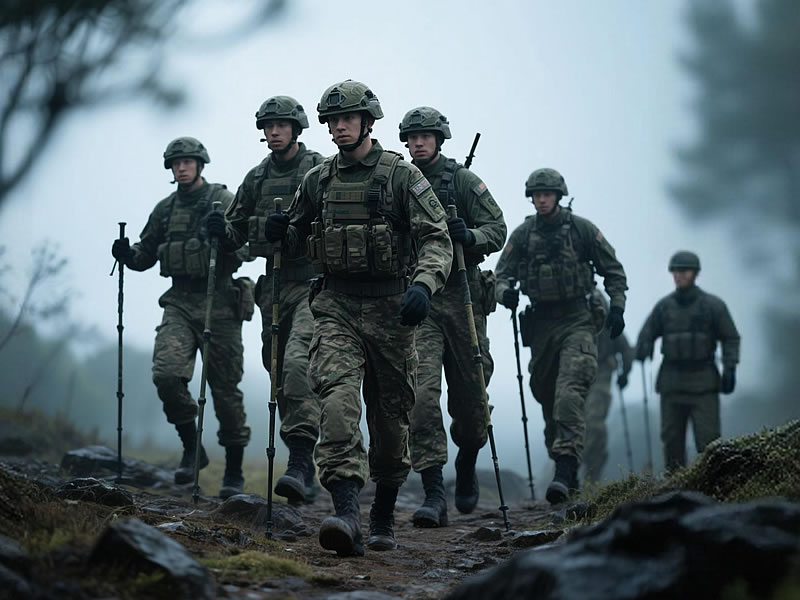
Recommended trekking pole purchase link: https://s.click.aliexpress.com/e/_c4M7OWaN
The application of walking poles in military use moves far beyond simple trail hiking, addressing core challenges faced by dismounted soldiers on the move.
The Core Benefits: Enhancing the Soldier's Capabilities
The primary value of trekking poles for military personnel lies in their direct impact on physical performance and injury prevention, which are critical to mission success.
- Load Distribution and Fatigue Reduction: The single greatest physical challenge for a dismounted soldier is moving under a heavy combat load. This weight, often exceeding 100 pounds, places immense strain on the lower body—knees, ankles, and hips. Trekking poles engage the upper body—shoulders, back, arms, and core—to bear a portion of this load. By effectively turning the soldier into a four-point stabilization system, poles reduce the metabolic cost of movement, conserve lower-body energy, and significantly delay the onset of fatigue during long-range patrols. This conserved energy is then available for tactical actions at the objective.
- Superior Stability and Injury Prevention: Operational terrain is rarely a paved road. It includes loose gravel, muddy riverbanks, uneven rock fields, and slippery slopes. In such conditions, especially when fatigued and under load, the risk of ankle rolls, knee twists, and falls is high. A tactical injury can be a mission-killer. Poles provide two additional points of contact, creating a stable platform that prevents missteps and falls. This is crucial for night operations, during river crossings, or when moving quickly over unstable ground. Protecting a soldier from a non-combat injury is a direct contribution to unit readiness.
- Tactical Applications and Versatility: While their primary use is for mobility, poles have secondary tactical functions.Stealth and Movement: The quiet "tap" of a carbide tip is far less disruptive than the scuffling and stumbling of a soldier fighting for balance.Reconnaissance Aid: A pole can be used to gently part vegetation for observation, check ground for instability, or probe for tripwires in a permissive environment (though this is not a replacement for specialized EOD procedures).Improvised Tool: In a pinch, poles can be used to construct an emergency shelter, splint a limb, or as a marker.
Addressing the Objections: Weight and Encumbrance
The most common objections to poles in a military context are valid but can be mitigated.
- "They take up my hands." This is a critical concern for weapon readiness. The solution is training and modern pole designs. Many poles feature quick-release wrist straps that allow a soldier to instantly drop the poles and bring their weapon to bear. Furthermore, with practice, a soldier can learn to manage a pole while shouldering a rifle, similar to how one might operate with a slung weapon.
- "It's just more weight to carry." This is where technology helps. High-end tactical-grade poles are made from carbon fiber or advanced aluminum alloys, weighing often less than a single loaded rifle magazine (around 1-1.5 lbs for a pair). The energy savings and injury prevention they offer far outweigh this minimal penalty.
Selection Criteria for a "Tactical Pole"
Not all poles are suitable. The ideal military-grade pole would feature:
- Material: Carbon fiber for its superior vibration dampening and light weight, or 7075 aluminum for ultimate durability and strength.
- Locking Mechanism: External lever (flick) locks are preferred. They are more reliable when muddy or sandy, easier to operate with cold or gloved hands, and provide a more secure lock than twist mechanisms.
- Color and Finish: Matte, non-reflective finishes in neutral colors like Coyote Brown, Ranger Green, or Flat Dark Earth to avoid light signature.
- Tips: Interchangeable carbide tips for hard ground and rubber tip protectors for urban or quiet movement. Large snow baskets should be removable.
- Collapsibility: Collapsible Z-poles or foldable poles that can be swiftly stowed on a pack when not in use, such as during a tactical advance or in a vehicle.
Training and Integration
To be effective, the use of poles cannot be ad-hoc. It requires integration into physical training and tactical drills. Soldiers must practice:
- Efficient deployment and stowing under simulated stress.
- Maintaining weapon drills and immediate action procedures while using poles.
- Developing a rhythmic, efficient walking gait that maximizes energy savings.
In conclusion, walking poles for military use represent a shift towards leveraging civilian-endurance technology to enhance soldier survivability and performance. They are a low-cost, high-impact tool that directly addresses the physical burdens of the dismounted infantryman. By reducing fatigue, preventing injuries, and increasing stability on challenging terrain, they help ensure that soldiers arrive at their objective physically prepared to fight and win. In the demanding calculus of military logistics, the walking pole has earned its place as a serious piece of tactical gear.




