




What is 7075 Aluminum in Walking Poles?
When investing in a pair of trekking poles, you'll often see materials like "carbon fiber" and "aluminum" broadly advertised. However, not all aluminum is created equal. Among the various alloys used, 7075 aluminum stands out as the premium choice, frequently found in high-performance and mountaineering-grade poles. But what exactly is it, and why does it matter for your hiking experience?
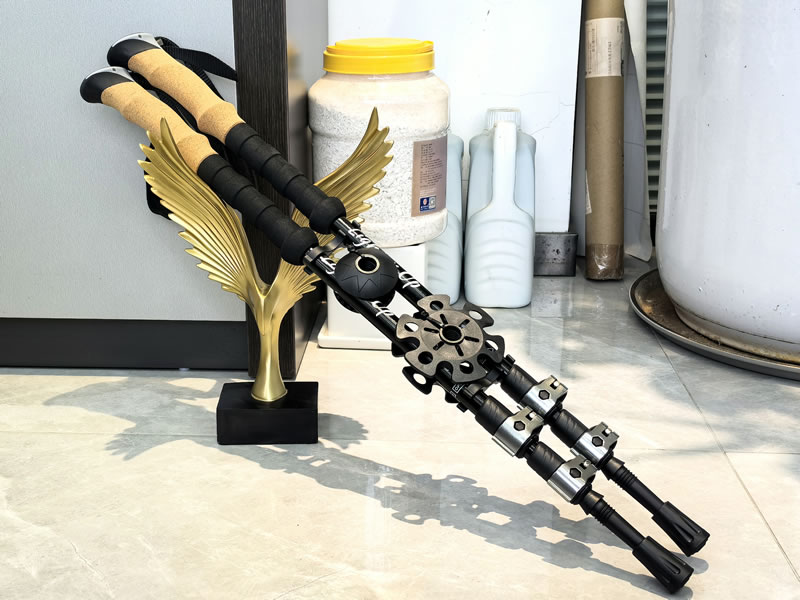
Recommended trekking pole purchase link: https://s.click.aliexpress.com/e/_c4M7OWaN
Beyond Basic Aluminum: The Aerospace Alloy
First, it's crucial to understand that 7075 is not a base metal but a specific aluminum alloy. Its composition is engineered for maximum performance, primarily comprising aluminum, zinc as the primary alloying element, along with magnesium and copper. This specific formulation was originally developed for the aerospace industry, where the demand for materials that are both incredibly strong and lightweight is non-negotiable—think aircraft fuselages and helicopter rotors. This pedigree immediately signals its high-performance nature.
The Key Advantage: Unmatched Strength-to-Weight Ratio
The most significant benefit of 7075 aluminum in walking poles is its exceptional strength-to-weight ratio. Let's break down what this means on the trail:
- Superior Strength: 7075 aluminum is significantly stronger than the more common 6061 aluminum used in many entry-level and mid-range poles. The strength of an aluminum alloy is measured by its yield strength—the point at which it will bend permanently. 7075 aluminum has a yield strength nearly double that of 6061. In practical terms, this means a pole made from 7075 is far more resistant to bending under extreme stress, such as a heavy sideways impact against a rock, or the full weight of a backpacker stumbling on a steep descent.
- Lightweight: Despite this immense strength, 7075 aluminum remains remarkably lightweight. While it may be slightly denser than 6061, the difference is minimal and often unnoticeable in hand. The key is that manufacturers can use less material to achieve the same or greater strength, resulting in a pole that is both strong and easy to swing for thousands of steps.
7075 vs. Other Common Pole Materials
To fully appreciate 7075 aluminum, it's helpful to compare it to its competitors:
- vs. 6061 Aluminum: 6061 is a good, general-purpose alloy known for its good strength and excellent corrosion resistance. However, it is softer and more malleable. Under high stress, a 6061 pole is more likely to suffer a permanent "set" or bend, while a 7075 pole is more likely to withstand the force or, in an extreme case, snap rather than bend.
- vs. Carbon Fiber: Carbon fiber is prized for being ultralight and for its ability to dampen trail vibration, reducing arm fatigue. However, it can be brittle and is susceptible to splintering or cracking from a sharp, point-impact (like a rock strike). 7075 aluminum, by contrast, is more predictable and generally more durable against such impacts and lateral forces.
The Trade-Off: Understanding "Brittleness"
A common point of discussion is that 7075 aluminum can be more "brittle" than 6061. This isn't brittleness in the glass-like sense of carbon fiber, but rather a difference in failure mode. When pushed beyond its limit, 6061 will bend, while 7075 is more likely to fracture. It's a "bend vs. break" scenario. For most serious hikers, a pole that resists bending in the first place is preferable, as a bent pole is unusable, while a broken one can often be field-repaired with a splint.
Is a 7075 Aluminum Pole Right for You?
You will benefit most from 7075 aluminum poles if:
- You are a backpacker carrying heavy loads.
- You frequently tackle technical, rocky terrain where pole strikes are common.
- You engage in mountaineering or snow travel, where poles are often used to probe for stability and bear significant, off-axis loads.
- You value long-term durability and want a pole that will withstand years of hard use.
For the casual day hiker on well-groomed trails, a 6061 aluminum or carbon fiber pole may be perfectly sufficient. However, for those who demand the highest margin of safety and reliability from their gear, a pole constructed from 7075 aluminum represents the pinnacle of metal shaft performance, offering the robust, trustworthy support you need when the terrain gets tough.




