




How Does Vibration Damping Work in Walking Poles?
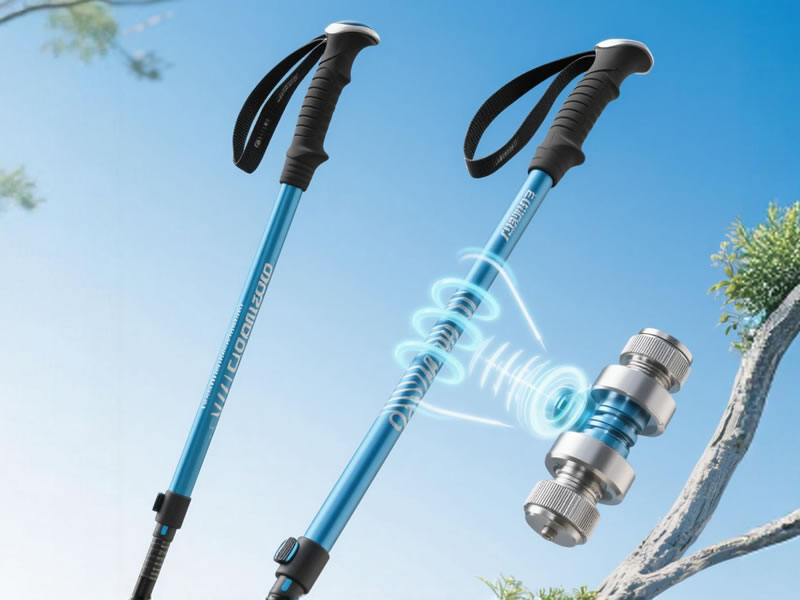
If you've ever used a basic pair of trekking poles on a rocky descent, you're familiar with the jarring sting and persistent buzz that travels up the shafts and into your hands and arms. This vibration is more than just an annoyance; it's a source of fatigue that can detract from your enjoyment and endurance on the trail. To combat this, pole manufacturers have developed sophisticated vibration damping technologies. But how do these systems actually work to create a smoother, more comfortable experience?
Recommended trekking pole purchase link: https://s.click.aliexpress.com/e/_c4M7OWaN
The Source of the Problem: Trail Shock
Every time a pole tip strikes a rock or root, a sharp impact shock is generated. This shock travels as high-frequency vibrational waves up the rigid structure of the pole. Think of it like striking a tuning fork—the energy vibrates through the entire object. Your hands and arms act as the final recipients of this energy, causing muscle fatigue and discomfort over long distances. Vibration damping aims to interrupt this energy transfer.
The Two Primary Methods of Damping
There are two main approaches to reducing vibration in walking poles: inherent material damping and engineered mechanical systems.
1. Material Damping: The Carbon Fiber Advantage
This is the most common and passive form of vibration reduction.
- How It Works: Carbon fiber is not just lightweight; its composite structure is inherently better at absorbing and dispersing vibrational energy than aluminum. An aluminum shaft is uniformly rigid and transmits vibrations very efficiently. In contrast, carbon fiber consists of thousands of tiny carbon filaments held in a resin matrix. When vibrational waves hit this complex structure, the energy is scattered and converted into minuscule amounts of heat within the material itself. It doesn't eliminate vibrations but significantly "smoothes out" the sharp, high-frequency shocks, turning a harsh "buzz" into a softer "thud."
- The Trade-Off: While carbon fiber excels at damping high-frequency vibrations, it can be stiffer and transmit larger, low-frequency impacts more directly than some advanced mechanical systems.
2. Mechanical Damping Systems: Internal Shock Absorbers
Some poles take a more active approach, incorporating internal mechanisms that function much like a miniature suspension system.
- Spring Systems: Found in poles like those from Black Diamond with their "FlickLock Pro" design, a small, robust spring is integrated into the upper section of the pole. When the tip hits an obstacle, the spring compresses, absorbing the initial shock impulse before it can travel up to your hand. The spring then gently re-extends, ready for the next impact.
- Elastomer or Rubber Systems: Other designs use a viscoelastic polymer or rubber component inside the shaft or grip. These materials have "give" and flex under impact, effectively soaking up the vibrational energy and dissipating it as heat. This is similar to the principle used in high-end running shoes.
- Sand-Filled Handles: A less common but ingenious method involves a small, sealed chamber within the handle containing fine sand or a similar granular material. The moving particles absorb and disrupt vibrational energy through friction, effectively "scrambling" the shockwaves.
Which Damping Method is Right for You?
Your choice depends on your priorities and typical terrain:
- For General Hiking and Weight Consciousness: A standard carbon fiber pole offers an excellent balance of lightweight performance and passive vibration damping that will satisfy most users.
- For Technical Descents and Joint Sensitivity: If you primarily hike on rocky, uneven trails or have sensitive wrists, elbows, or shoulders, a pole with a mechanical damping system may be worth the slight weight penalty. The active shock absorption is more effective at mitigating the larger, jarring impacts common in such environments.
- A Note on Aluminum: Don't discount all aluminum poles. Some higher-end models may use specialized alloys or internal coatings to help break up vibrations, though they will generally not perform as well as carbon fiber in this specific area.
In conclusion, vibration damping in walking poles is a battle against unwanted energy. Whether through the inherent properties of carbon fiber or the engineered intelligence of an internal spring, these technologies work to transform your trekking poles from simple sticks into sophisticated tools that protect your body from fatigue, allowing you to hike longer and with greater comfort.




