




How to Use Walking Poles on Unstable Rocky Terrain?
Navigating unstable rocky terrain—whether it's a scree field, a boulder-strewn slope, or a trail of jagged talus—is one of the most demanding challenges for any hiker. In these environments, your trekking poles transform from simple aids into critical tools for balance, propulsion, and safety. However, using them effectively requires a significant shift in technique from walking on a smooth path. Mastering a few key principles will give you the confidence to move efficiently and securely across even the most unstable ground.
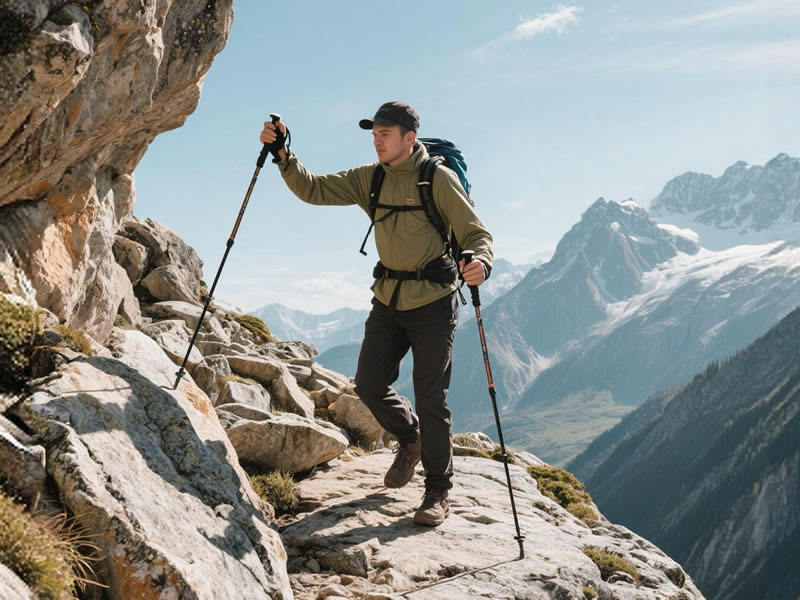
Recommended trekking pole purchase link: https://s.click.aliexpress.com/e/_c4M7OWaN
The core philosophy on rocky terrain is deliberate stability over speed. Every pole plant and every footstep must be intentional and tested.
1. Adjust Your Technique and Pole Setup
- Shorten Your Poles: On flat or ascending terrain, a slightly shorter pole provides better control and a quicker plant. It allows you to keep your arms in a more powerful, compact position, ready to react to a slip or shifting rock.
- The "Three Points of Contact" Rule: This is the golden rule. At least three of your four points (two feet, two poles) should be securely placed before you move the fourth. The sequence is key: plant the right pole and left foot, then move the left pole and right foot. This creates a stable tripod at all times.
- Deliberate, Not Forceful, Planting: Avoid stabbing the ground. Instead, look for a secure placement—a crack between rocks, a flat spot, or against the side of a large, stable boulder. Gently place the tip and apply increasing pressure to test its stability before committing your full weight.
2. Master the Art of Pole Placement
Where you plant your pole is more important than how hard you push on it.
- Avoid the "Rolling Rock": Never plant your pole on top of a loose, round rock. It will roll out from under you, potentially causing a fall.
- Seek Solid Ground: Aim for placements in solid dirt between rocks, in cracks, or against the uphill side of a stable boulder. The goal is to find an anchor point.
- Use the Pole for Probing: Tap suspicious rocks before you step on them. A hollow sound or shifting movement is a warning to find a different route.
- Angling for Leverage: On traverses, you may plant the uphill pole shorter for leverage and the downhill pole longer for support, creating a brace against a downhill slide.
3. Refine Your Grip and Body Position
- Loose Grip, Strong Wrist: Avoid a "death grip." Hold the poles firmly but loosely, allowing your wrists and arms to act as shock absorbers when a pole suddenly stops against a rock. This prevents jarring impacts from travelling to your shoulders.
- Center of Gravity: Keep your weight centered over your feet. On steep or unstable sections, a slight forward lean can help maintain balance and forward momentum.
- Eyes on the Path: Look 2-3 moves ahead to plan your foot and pole placements, but constantly scan the immediate area for your next secure pole plant.
4. Advanced Techniques for Specific Scenarios
- Downclimbing: Shorten your poles significantly. Use them for balance as you turn sideways to the slope, feeling for secure placements below you before carefully lowering your body.
- The "Third Leg" Assist: When stepping down a large drop, plant both poles firmly ahead and below you. They act as a "third leg," allowing you to lower yourself with control and take significant weight off your knees.
- Falling Safely: If you do lose your balance, your number one priority is to protect your body. Let go of the poles immediately to free your hands for catching yourself and to avoid injuring yourself with them. A pole can be replaced; a wrist or rib cannot.
Equipment Considerations for Rocky Terrain
- Rubber Tips: Using the rubber "paw" tips provides superior grip on slick rock surfaces compared to the bare metal carbide tip.
- Small Baskets: Remove large snow/sand baskets and use the smallest baskets possible or go without. This prevents the basket from snagging on rocks and roots.
In conclusion, unstable rocky terrain demands respect and a refined skill set. By shortening your poles, adhering to the three-points-of-contact rule, and focusing on deliberate, intelligent pole placement, you transform your trekking poles from simple sticks into extensions of your own limbs. This practiced technique provides the stability to navigate technical sections, the confidence to tackle challenging descents, and the security to enjoy the rugged beauty of a rocky landscape without fear.




