




Can Walking Poles Be Used in Rescue Situations?
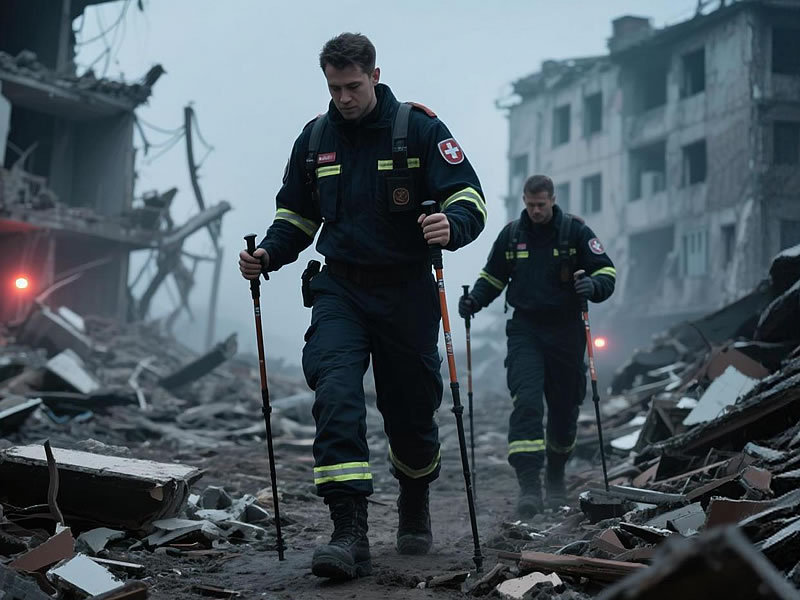
When an emergency strikes in the wilderness, whether a solo hiker's injury or a group incident, the immediate response often determines the outcome. In these critical moments, standard trekking poles can transcend their role as mere hiking aids and become vital, multi-functional tools for wilderness rescue. While they are no substitute for professional medical equipment or trained personnel, their strategic use can significantly improve stabilization, safety, and signaling while awaiting or facilitating evacuation.
Recommended trekking pole purchase link: https://s.click.aliexpress.com/e/_c4M7OWaN
A trekking pole's value in a rescue scenario stems from its fundamental design: it is a strong, lightweight, and often adjustable pole that can be repurposed in numerous creative ways to manage a crisis.
The Multipurpose Role of Poles in Rescue
- Stability and Safety for Rescuers: The primary and most immediate use is to provide stability for both the rescuer and the victim. A rescuer navigating slippery, uneven, or steep terrain to reach an injured person can use poles to maintain their own balance, preventing a second accident. When moving a conscious, ambulatory victim, an extra pole can offer them crucial support.
- Emergency Splinting and Immobilization: For suspected fractures in an arm or leg, trekking poles are excellent for creating a makeshift splint.How to: Use the poles, along with clothing, bandanas, or tape, to immobilize the injured limb. Pad the limb first for comfort, then secure the poles on either side of the fracture. For a leg, one pole might suffice on the outside, while two can be used to fully sandwich the limb. This immobilization reduces pain, prevents further damage to nerves and blood vessels, and stabilizes the injury for transport.
- Probing and Hazard Assessment: Before approaching a victim in uncertain terrain—such as near a cliff edge, on a snowfield hiding a crevasse, or in a muddy area—a pole can be used to probe the ground. This helps identify unstable surfaces, drop-offs, or other hidden dangers, allowing the rescuer to choose a safe path.
- Signaling for Help: As previously discussed, poles can be critical for signaling.Visual: Reflective tape on the shafts can be used to create ground-to-air signals or flashed in the sun to attract attention.Audible: Tapping poles together or against a rock in a rhythmic SOS pattern (three short, three long, three short) is an effective way to guide searchers when voice calls are insufficient.
- Construction of Emergency Shelters and Litters: In a prolonged scenario, poles can serve as structural components. Two or more poles can be integrated with a tarp or emergency blanket to create a more robust shelter. In extreme circumstances, with the addition of a jacket or strong fabric, they can be fashioned into the sides of an improvised litter or drag sled to move a victim short distances over smooth ground. This should only be attempted if absolutely necessary and with extreme caution to avoid worsening injuries.
Critical Limitations and Safety Warnings
It is imperative to understand the boundaries of this equipment.
- They Are Not Medical Devices: A trekking pole splint is a temporary field expedient. It does not provide the rigid support of a proper medical splint and should be monitored and adjusted as needed.
- Structural Integrity: Poles, especially carbon fiber, can fail under stresses they weren't designed for, such as the lateral forces involved in carrying a litter. Never rely on them for life-supporting weight-bearing in such applications.
- Do Not Create New Risks: The goal is to stabilize the situation, not complicate it. Avoid using poles in a way that could injure the victim further (e.g., poking with the sharp tip) or that puts the rescuer in undue danger.
The Preparedness Mindset
The most effective use of poles in a rescue begins before the emergency.
- Choose Poles with Reflective Elements or add reflective tape proactively.
- Carry a Small Repair Kit including duct tape, which is invaluable for splinting and other repairs.
- Practice Basic Skills like creating a splint or a signal before you need to do it under pressure.
In conclusion, while walking poles will never replace a dedicated rescue kit or professional training, their potential utility in a wilderness emergency is substantial. From providing critical stability to creating an emergency splint and signaling for help, they are a force multiplier for the prepared individual. By viewing your trekking poles through the lens of a multi-tool and understanding their applications and limitations, you add a significant layer of resilience and self-reliance to your backcountry skill set. In a rescue situation, this knowledge can make the crucial difference between chaos and controlled, effective response.




