




What Are Ultralight Trekking Poles?
In the world of hiking and backpacking, where every ounce counts, ultralight trekking poles have emerged as essential gear for enthusiasts who prioritize efficiency and speed. But what exactly defines an ultralight pole, and how do they differ from their standard counterparts? Essentially, ultralight trekking poles are engineered to provide the core benefits of traditional poles—stability, balance, and reduced joint impact—while shaving off every possible gram through advanced materials and minimalist design.
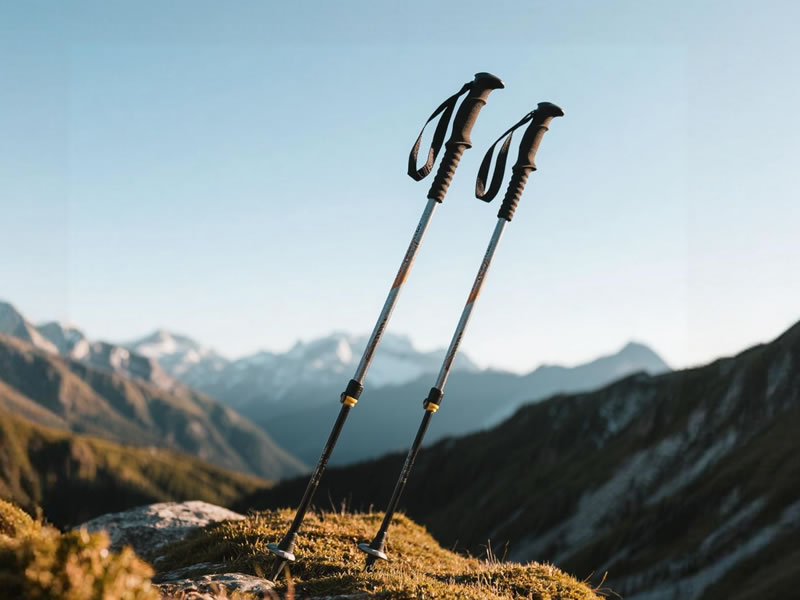
Recommended trekking pole purchase link: https://s.click.aliexpress.com/e/_c4M7OWaN
The most defining characteristic of an ultralight pole is its weight. While a standard aluminum trekking pole might weigh between 280-350 grams (10-12 ounces) per pole, an ultralight model typically falls into the 100-200 gram (3.5-7 ounce) range. This dramatic reduction is achieved through several key design choices:
- Material: The Carbon Fiber Advantage. The vast majority of ultralight poles are constructed from high-modulus carbon fiber. This composite material offers an exceptional strength-to-weight ratio, meaning it can be both incredibly strong and remarkably light. While some ultralight models use premium, thin-walled aluminum alloys, carbon fiber is the undisputed champion for minimizing weight without a massive sacrifice in strength.
- Design: Folding (Z-Pole) vs. Telescopic. Ultralight poles overwhelmingly favor a folding "Z-pole" design. These poles consist of three or four segments connected by a durable internal cord. They fold down into a compact, packable size (often under 40cm or 16 inches) and snap open quickly for use. While telescopic poles (which adjust via lever or twist locks) can also be made light, the Z-pole design often wins for its combination of minimal weight, packed size, and rapid deployment.
- Minimalist Components. Every component is scrutinized for weight savings:Grips: They often feature smaller, minimally padded grips made of cork or sparse foam.Shafts: The shaft diameter is often slimmer.Baskets and Straps: Ultralight poles typically come with tiny, basic baskets and lightweight, minimalist straps or even just a finger loop.
The Trade-Offs: Performance vs. Weight
Choosing an ultralight pole involves accepting certain compromises. The primary trade-off is often durability. While strong for their weight, carbon fiber poles are more susceptible to snapping under sharp, lateral impacts (like a rock strike) compared to aluminum, which is more likely to bend. The minimalist components may also be less comfortable on very long, jarring descents compared to the more cushioned grips and straps on heavier-duty models.
Who Are They For?
Ultralight trekking poles are not for everyone, but they are a game-changer for specific users:
- Thru-Hikers: Covering 20+ miles a day, saving a pound on pole weight translates to significant energy conservation.
- Fastpackers and Trail Runners: Their low weight and packable size are ideal for fast-moving athletes.
- Aspiring Ultralight Backpackers: Anyone trying to reduce their base pack weight will find these poles to be a highly effective way to shed ounces.
In conclusion, ultralight trekking poles are a masterpiece of specialized engineering. They represent a deliberate choice to prioritize minimal weight and packability, accepting a slight reduction in brute-force durability for the sake of unparalleled efficiency on the trail. For the hiker whose philosophy is "lighter is better," these poles are not just an accessory; they are a fundamental component of a faster, less burdensome, and more enjoyable wilderness experience.




