




What to Look for in Ultralight Trekking Poles?
The pursuit of ultralight trekking poles represents a careful balancing act between minimizing weight and maintaining essential functionality. As you move beyond simply looking at the number on the scale, several critical factors determine whether a pair of poles will become trusted trail companions or a source of frustration. Knowing what to prioritize will guide you toward a pole that enhances your hike without becoming a liability.
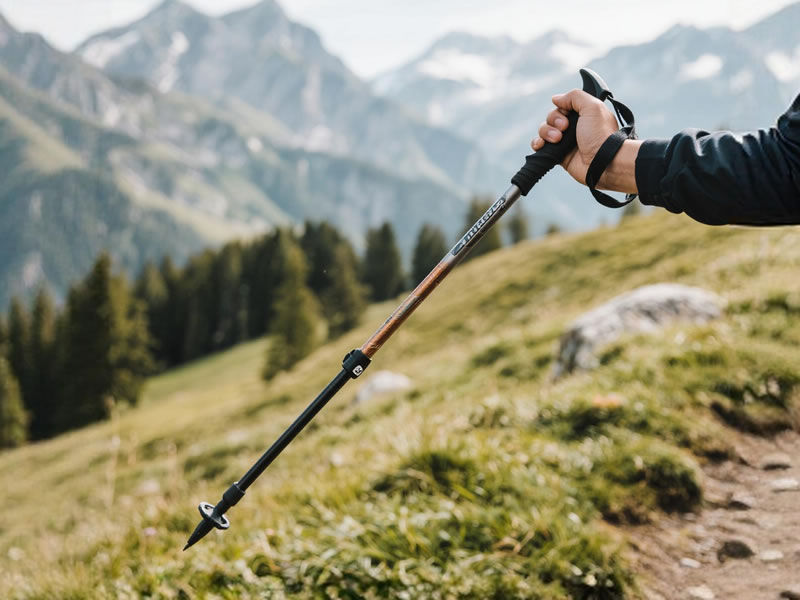
Recommended trekking pole purchase link: https://s.click.aliexpress.com/e/_c4M7OWaN
The ultimate goal is to find the lightest pole that still meets the demands of your specific hiking style. This involves a series of intentional compromises across several key areas.
1. Material: The Foundation of Weight and Durability
This is the most fundamental choice, dictating the pole's core characteristics.
- Carbon Fiber: The top choice for maximum weight savings. It offers an exceptional strength-to-weight ratio and provides excellent vibration dampening, reducing "trail buzz" and hand fatigue. The trade-off is a specific failure mode: it can be brittle and may snap under a sharp, lateral impact. Look for high-modulus carbon for the best performance.
- Aluminum (7075-T6 Alloy): The choice for durability-focused ultralight hikers. Slightly heavier than carbon fiber, aluminum is tougher and more ductile. Under impact, it will typically bend rather than break, which can be a field-repairable situation. It transmits more vibration but can withstand more abuse on rocky, off-trail terrain.
2. Design: Folding (Z-Pole) vs. Telescopic
The mechanism defines the pole's packability and adjustability.
- Folding (Z-Pole) Design: These poles, with segments connected by an internal cord, are the standard for ultralight hiking. Their primary advantage is a highly compact packed size (often under 40cm), making them easy to stow in or on a pack. They deploy quickly but typically offer only limited length adjustment via removable sections.
- Telescopic Design: These poles adjust via lever or twist locks and offer infinite adjustability on the fly. This is invaluable for fine-tuning length for uphill/downhill sections. They are generally easier to repair in the field but have a longer packed length and can be slightly heavier due to the locking mechanisms.
3. Grip and Strap: The Human Interface
Comfort here is non-negotiable, as it directly impacts your experience over long distances.
- Grip Material:Cork: Conforms to your hand over time, wicks moisture well, and provides a secure, non-slip grip even when wet. It's a top choice for most conditions.Foam (EVA): Softer and highly absorbent, providing excellent cushioning and a secure grip with sweaty hands. It can wear down faster than cork over many years.
- Strap: Look for a thin, lightweight, and breathable strap designed as a "wing" shape to distribute pressure across the back of your hand. It should be easily adjustable and made of quick-drying material.
4. Locking Mechanisms and Adjustability
A secure lock is critical for safety.
- Folding Poles: Ensure the segments lock together firmly with a secure "click" and do not feel loose or wobbly when extended.
- Telescopic Poles: External lever locks (FlickLocks) are generally preferred for their reliability, ease of use with cold hands, and field-repairability over twist locks, which can be prone to slipping and freezing.
5. The Weight vs. Features Balance
Finally, scrutinize the weight in the context of the features offered. A pair weight of 240-360 grams (8.5-12.7 oz) is the sweet spot for ultralight poles. Ask yourself if added features (like a more complex grip or shock absorption) are worth the extra grams for your needs.
Conclusion: A Tool Tailored to Your Journey
Selecting the right ultralight trekking pole is a personal process. There is no single "best" pole, only the best pole for you. By carefully considering material, design, grip, and locking mechanism, you can find a pair that perfectly aligns with your priorities. The ideal ultralight poles will disappear from your consciousness on the trail, not because they are fragile, but because they function so seamlessly as an extension of your body, providing reliable support while allowing you to move with effortless efficiency.




