




How to Use Ultralight Trekking Poles for Downhill Hiking
Downhill hiking presents one of the greatest challenges to a hiker's body, particularly the knees, quadriceps, and joints. While ultralight trekking poles are celebrated for reducing fatigue on flat and ascending terrain, their true transformative power is perhaps most apparent during sustained descents. Using them correctly on downhill sections is not just about balance; it's an active technique that can reduce impact forces on your lower body by up to 25%, transforming a jarring, painful descent into a controlled and confident progression.
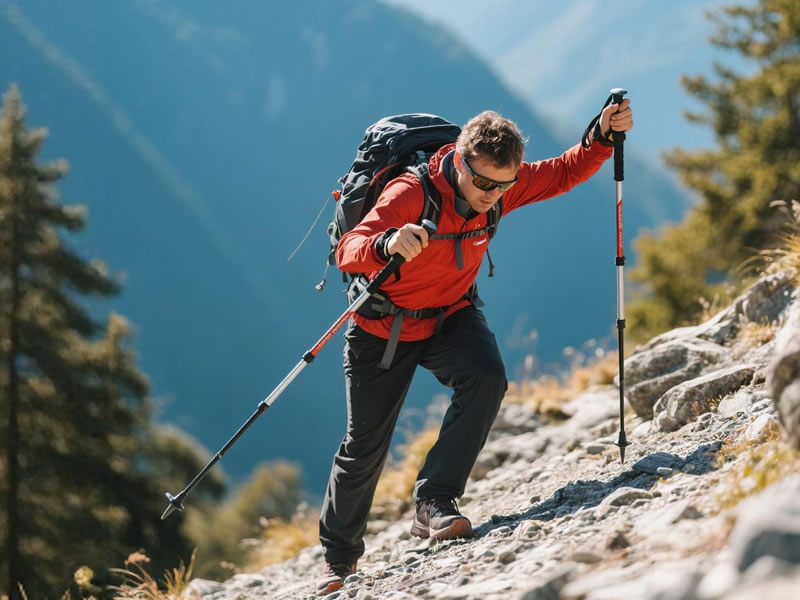
Recommended trekking pole purchase link: https://s.click.aliexpress.com/e/_c4M7OWaN
The fundamental principle of downhill pole use is to shift the workload from your legs to your upper body, using your arms and poles to absorb shock and provide braking power. For ultralight poles, this requires a slightly modified technique to account for their specific characteristics, such as their lower weight and potential for more flex compared to heavier models.
Step 1: The Crucial Adjustment - Lengthen Your Poles
On a descent, your feet are below you, increasing the distance between your hands and the ground. To maintain proper posture without bending over, you need to lengthen your poles by 5 to 10 centimeters (2 to 4 inches) compared to your flat-ground setting.
- Why it matters: Properly lengthened poles allow you to keep your torso upright, which is essential for balance and breathing. A pole that is too short will force you into a hunched position, straining your back and reducing the effectiveness of your arm support.
- Technique Tip: If you have adjustable telescopic poles, make this adjustment before you begin the steepest part of the descent. If you use fixed-length folding Z-poles, plan ahead and set them to a "downhill" length at the top of the pass.
Step 2: Master the Planting and Stepping Rhythm
The sequence of movement is what creates stability and control.
- Plant First, Step Second: The golden rule. Reach forward and plant both pole tips securely on the ground ahead of you and slightly to the sides, creating a stable, wide base.
- Create a Stable Triangle: Your two poles and your upcoming footstep should form a triangle. This tripod structure is incredibly stable.
- Step Through: Only after the poles are securely planted do you step forward, bringing your feet to a point level with or just behind the pole tips. This allows your body weight to be partially supported by your arms as you lower yourself down.
Step 3: Employ Effective Body Mechanics
How you use your body is as important as how you use your poles.
- Engage Your Arms: Don't just let the poles dangle. Actively press down on the grips as you step down. This uses your lats, triceps, and shoulder muscles to control your descent and "catch" your body weight, sparing your knees.
- Keep a Loose Grip: While you engage your arms, avoid a white-knuckle grip. Hold the poles firmly enough to control them, but loosely enough to allow your wrists to act as secondary shock absorbers. This is especially important with ultralight poles, as a death grip can transmit more vibration.
- Use Rubber Tips for Traction: On hard-packed surfaces, rocky slabs, or pavement, use the rubber "paw" tips. They provide superior grip, preventing the metal carbide tips from skittering dangerously across the surface.
Step 4: Adapt to Specific Downhill Challenges
- Loose Scree and Gravel: Use a quicker, more frequent planting motion, "testing" the surface with a quick tap before committing your weight. The poles can help you "surf" down these slopes with control.
- Large Step-Downs: For a big drop, plant the poles firmly at the base of the drop. As you lower yourself, you can transfer a significant amount of your weight onto the poles, essentially using your upper body to lower your lower body gently.
A Note on Ultralight Pole Considerations
The lighter weight of these poles means they are easier to swing and place quickly. However, be mindful that they may have more flex than heavy-duty models. Trust the flex—it's part of the shock-absorption system—but avoid situations where you might lever them against a rock with extreme lateral force.
In conclusion, mastering downhill technique with ultralight trekking poles turns a descent from a dreaded, joint-pounding ordeal into an opportunity for active recovery and confident travel. By lengthening your poles, mastering the "plant-before-you-step" rhythm, and actively engaging your upper body, you harness the full potential of your gear. This conscious approach not only protects your body from cumulative damage but also instills the confidence to tackle steep, technical terrain, knowing you have a reliable and efficient system to support every step down.




