




Repairing a bent section on an ultralight trekking pole.
Discovering a bent section in your ultralight trekking pole can be disheartening. Whether it resulted from a misstep on rocky terrain, an accidental fall, or the pole being crushed in a door, the sight of a curved shaft raises immediate questions about repair, replacement, and safety. While carbon fiber poles tend to fail catastrophically (snapping rather than bending), aluminum poles—particularly those made from durable 7075 alloy—are more likely to deform under extreme pressure. The good news is that many bends can be repaired, restoring your pole to functional service and saving you the cost of a full replacement.
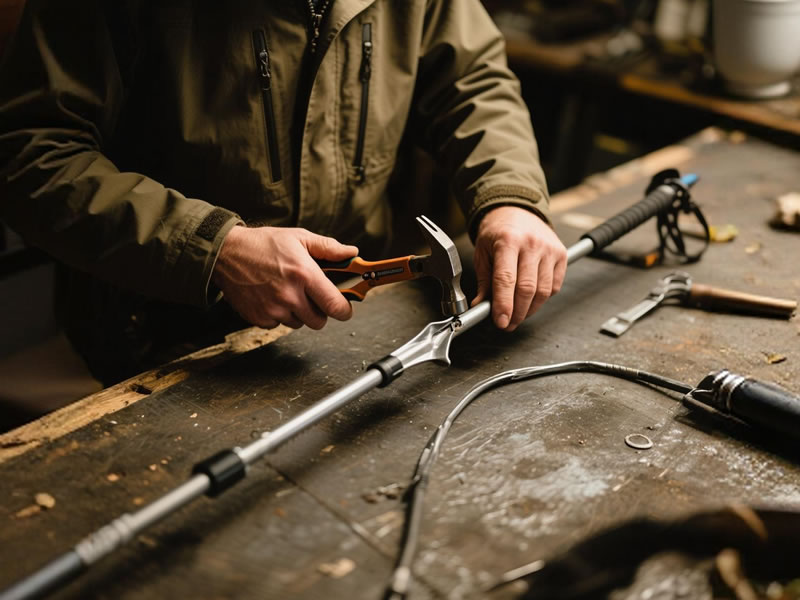
Recommended trekking pole purchase link: https://s.click.aliexpress.com/e/_c4M7OWaN
The first and most critical step is assessment. Before attempting any repair, carefully examine the bend. Is it a gentle curve or a sharp kink? Where is it located—in the middle of a section or near a locking mechanism? Your approach will depend entirely on these factors.
Assessing the Damage: When Repair is Possible
Not all bends should be repaired. Consider these guidelines:
- Repairable Bends: Gentle curves in the middle of an aluminum shaft are good candidates for repair. The metal has memory and can often be coaxed back toward its original shape.
- Problematic Bends: Sharp kinks, creases, or any bend located within 2-3 inches of a locking mechanism or joint should not be repaired. These areas are under higher stress, and attempting to straighten them could compromise the structural integrity.
- Carbon Fiber Poles: If you have a carbon fiber pole that appears bent, it has likely suffered delamination or internal fracturing. Do not attempt to straighten it. The damage is structural, and the pole should be retired immediately to prevent sudden failure.
The Straightening Process: A Methodical Approach
For repairable aluminum shaft bends, follow this careful process:
- Gather Materials: You'll need a flat, hard surface (like a workbench or clean floor), a soft cloth or towel, and possibly a round object like a PVC pipe slightly larger in diameter than your pole.
- The Rolling Method:Lay the cloth on your work surface to protect the pole's finish.Place the bent section on the cloth with the apex of the bend facing upward.Using the palms of your hands, apply firm, even pressure and slowly roll the pole back and forth over the bend. Focus your pressure directly on the highest point of the curve.Check your progress frequently. This gradual approach helps the metal return to its original shape without overcorrecting.
- The Leverage Method (for more stubborn bends):Slide the bent section through a piece of PVC pipe or similar round object.Use the pipe as a lever to apply more targeted pressure, gently bending the pole back in the opposite direction of the damage.Work slowly, making small adjustments and checking frequently.
Important Considerations During Repair:
- Patience is Essential: Rushing this process can weaken the metal or create a weak spot.
- Cold Working: Always perform this repair at room temperature. Never apply heat, as this can alter the temper of the aluminum and permanently weaken it.
- Test Thoroughly: After straightening, extend the pole and apply gradual weight, listening for any cracking or creaking sounds. Inspect the straightened area closely for hairline cracks.
When Replacement is the Better Option
Many premium trekking pole manufacturers sell individual replacement sections. If your bend is severe or located in a problematic area, purchasing a new middle or lower section is often safer and more cost-effective than replacing the entire pole. Contact the manufacturer directly with your pole model information to inquire about replacement parts.
The Field Repair Compromise
In a backcountry emergency where a bent pole must serve temporarily, you might carefully straighten it just enough to function. However, this should be viewed strictly as a "get-me-home" solution, and the pole should be properly repaired or replaced afterward.
In conclusion, while a bent trekking pole is never welcome news, it's often not the end of its service life. By carefully assessing the damage and applying a patient, methodical straightening technique, you can frequently restore an aluminum pole to safe functionality. Understanding when repair is appropriate—and when replacement is necessary—will ensure your gear remains reliable for many future adventures. Remember that a perfectly straight pole isn't the goal; a safe, functional one is.




