




Foldable vs Telescopic Lighten Up Trekking Poles: A Comprehensive Guide
When selecting trekking poles from a trusted brand like Lighten Up, one of the most fundamental decisions you'll face is the choice between foldable (often called Z-poles) and telescopic (adjustable) models. This isn't merely a matter of personal preference; it's a choice that impacts your hiking style, packability, and on-trail flexibility. Both designs have distinct advantages, and understanding their core differences is key to finding the perfect pole for your needs.
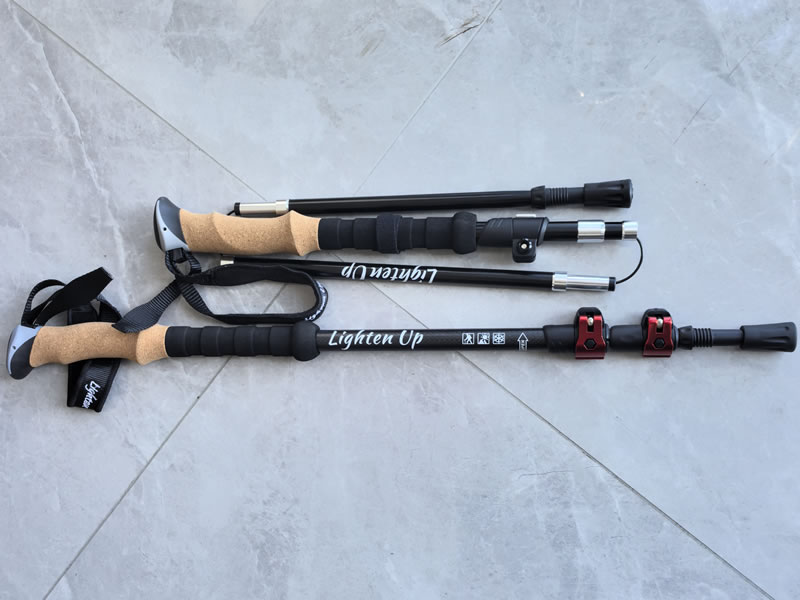
Recommended trekking pole purchase link: https://s.click.aliexpress.com/e/_c4M7OWaN
Lighten Up, known for its practical and durable designs, offers options in both categories, each engineered with the brand's signature focus on reliability. Let's delve into the specifics of each design to help you make an informed decision.
Telescopic Trekking Poles: The Versatile Workhorse
Telescopic poles are the traditional design, featuring two or three adjustable sections that slide within one another, secured by a locking mechanism (typically an external flick-lock).
Key Advantages:
- Ultimate Adjustability: This is their greatest strength. You can fine-tune the pole's length to the exact centimeter. This is crucial for maintaining proper ergonomic form on varying terrain—shortening them for uphill climbs and lengthening them for descents to reduce strain on your knees and joints.
- Adaptability and Sharing: Their adjustable nature makes them perfect for hikers who need different lengths throughout a single hike. They are also easily shared among hiking partners of different heights.
- Proven Durability and Field Repairability: Lighten Up's telescopic poles, often made with 7075 aluminum, are known for their robust construction. The flick-lock mechanisms are generally simple to troubleshoot and tighten on the trail with a basic tool if they become loose.
- Tent and Shelter Support: For ultralight hikers using trekking pole-supported tents, the precise adjustability of telescopic poles is essential for achieving the perfect pitch tension for their shelter.
Potential Drawbacks:
- Packability: Even when collapsed, telescopic poles form a long, relatively rigid shape (typically 60-70cm) that can be awkward to strap to a small pack or fit inside.
- Slightly Heavier: The locking mechanisms and overlapping sections add a small amount of weight compared to an equivalent foldable pole.
- More Moving Parts: The locks require occasional maintenance and can, in rare cases, fail if not properly cared for.
Foldable Trekking Poles (Z-Poles): The Compact Specialist
Foldable poles use a system of three or four connected segments that collapse down via an internal tension cord, folding into a compact, often tri-fold (Z-shaped) bundle.
Key Advantages:
- Superior Packability: This is their defining feature. When folded, Z-poles are incredibly short and compact, easily fitting inside even a medium-sized backpack. This is a huge advantage for travel, airline carry-on, or any situation where you might not need your poles for a section of the journey (e.g., a long approach hike).
- Rapid Deployment: They can be unfolded and snapped into place in seconds, without any adjustment needed—perfect for quick transitions on rugged terrain or during trail runs.
- Lightweight and Streamlined: With no external locks and a simpler overall design, high-quality Z-poles often shave off precious ounces and have a cleaner, snag-free profile.
Potential Drawbacks:
- Lack of Adjustability: Most foldable models come in fixed sizes (Small, Medium, Large) and offer little to no on-the-fly length adjustment. This limits your ability to adapt to changing terrain for optimal ergonomics.
- Durability Concerns (The Shock Cord): The internal cord is a potential failure point. It can degrade over time with UV exposure or snap in extremely cold weather. While often user-replaceable, it's a repair not typically needed with telescopic poles.
- Harder to Share: Their fixed length makes them difficult to share with others.
Head-to-Head Comparison Table
| Feature | Telescopic Poles | Foldable (Z-) Poles |
|---|---|---|
| Adjustability | Fully adjustable | Fixed or limited adjustment |
| Packability | Fair (longer profile) | Excellent (very compact) |
| Deployment Speed | Good (requires adjusting) | Excellent (instant) |
| Weight | Slightly heavier | Often lighter |
| Durability Focus | Locking mechanisms | Internal tension cord |
| Ideal For | Thru-hiking, varied terrain, tent support | Fastpacking, travel, alpine climbs |
Making the Right Choice for Your Hike
Your decision should be guided by your primary hiking style and priorities:
- Choose Telescopic Lighten Up Poles if: You are a thru-hiker or backpacker who values versatility above all. You need to adjust your pole length constantly for comfort, use them to pitch your tent, and prioritize field-repairable durability over absolute packability.
- Choose Foldable Lighten Up Poles if: You are a fastpacker, trail runner, or travel-focused hiker. Your priorities are speed, minimal weight, and the ability to stow your poles quickly and compactly inside your pack when not in use. You typically hike on terrain where a single pole length is sufficient.
In conclusion, both telescopic and foldable Lighten Up trekking poles are excellent tools, each optimized for a different mission. By honestly assessing how and where you hike most, you can select the design that will become a seamless extension of your stride, providing reliable support for every adventure.




