




Types of Carabiners: A Guide to Design, Safety, and Purpose
Choosing the right carabiner is a critical decision that balances safety, weight, and functionality. Far from being one-size-fits-all, carabiners are engineered into specific types, each optimized for distinct roles. Understanding these categories—primarily defined by gate mechanism and shape—is essential for safe and effective use in any application, from life-support climbing to everyday organization.
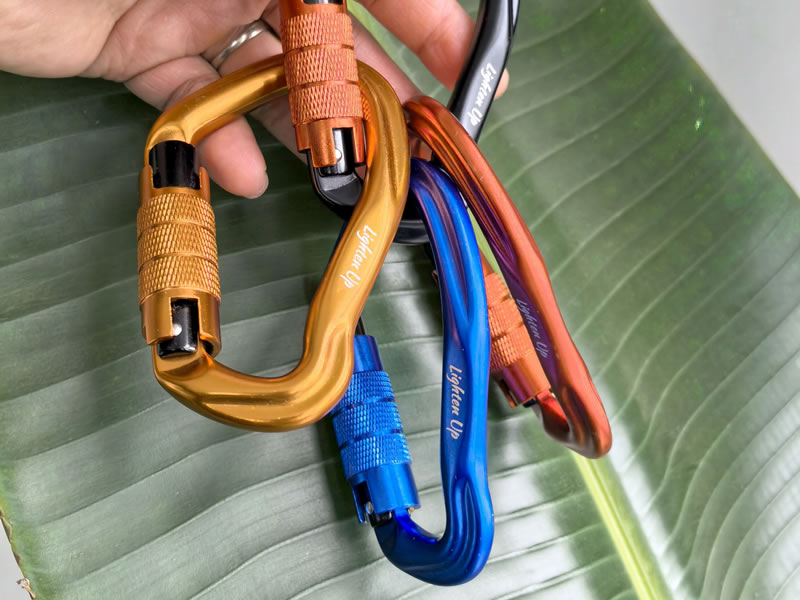
I. Categorization by Gate Mechanism
The gate is the carabiner's moving part and its most critical safety feature. This categorization separates general-use clips from life-critical connectors.
1. Non-Locking Carabiners
- Design: Feature a simple, spring-loaded gate that snaps shut but has no locking mechanism.
- Common Types: Straight-gate and wire-gate (lighter, less prone to freezing).
- Primary Use: Exclusively for non-critical applications. Ideal for racking gear on a harness, attaching items to a backpack, or organizing equipment. Their lightweight and speed make them perfect for ancillary tasks.
- Critical Rule: Never use a non-locking carabiner to connect into the core safety system (e.g., directly to a harness, belay device, or anchor). An accidental knock can open the gate.
2. Locking Carabiners
These are mandatory for any connection where a gate opening could lead to a fall or injury. They feature a locking sleeve over the gate.
- Screw-Gate (Manual Locking): The most common type. The user must manually screw the sleeve down to lock the gate. Requires a conscious safety check to ensure it is fully locked.
- Auto-Locking (Twist-Lock / Triple-Action): Features a mechanism that automatically locks when the gate closes. Unlocking requires a specific, often multi-step action (e.g., pull, twist, then open). Examples include Petzl's Ball-Lock and Magnetron systems. These provide superior security against accidental opening.
- Primary Use: The cornerstone of all life-support systems: connecting the rope to a harness (belay/rappel), securing an anchor, or any point where failure would be catastrophic.
II. Categorization by Shape
The shape determines how force is distributed and impacts strength and usability.
1. Oval
- Profile: Symmetrical, rounded ends.
- Pros: Gear moves smoothly around the entire shape. Good for clipping multiple slings or gear loops.
- Cons: The load is shared equally between the spine and the gate side, making it the weakest shape under load.
- Best For: Gear racks, accessory clipping, and specific aid climbing techniques. Less common in modern lead climbing.
2. D-Shape
- Profile: The spine is straight, with a curved gate side forming a "D."
- Pros: The design directs the majority of the force onto the stronger spine, offering a superior strength-to-weight ratio compared to ovals.
- Best For: The all-round workhorse for climbing. Ideal for most connections, especially when the carabiner will be loaded in a straight pull.
3. Asymmetric D (HMS / Pearabiner)
- Profile: A larger, asymmetrical D-shape with a wide, rounded gate opening.
- Pros: The enlarged cavity accommodates a Munter hitch (Italian hitch) or two ropes with a belay device comfortably.
- Best For: Belaying and rappelling. Often used with a belay plate (HMS stands from the German Halbmastwurfsicherung, meaning Munter hitch belay).
4. Specialized Shapes
- Offset D: A D-shape with a gate opening offset for easier rope clipping in sport climbing.
- Wire-Gate Carabiners: Not a shape but a gate type; however, their reduced weight and mass make them highly resistant to "gate flutter" during a fall and less prone to freezing in cold conditions.
Choosing the Right Type: A Safety Framework
Your choice must always begin with a safety assessment:
- Is this for life support? → Yes = A Locking Carabiner. No exceptions.
- What is the primary load direction? → Straight pull = D-Shape. Belaying = Asymmetric D.
- What are the weight and usage priorities? → For alpine climbing, lightweight wire-gate D’s are standard. For a gear sling, oval or non-locking D’s suffice.
Final Imperative: Regardless of type, always use carabiners certified by the UIAA (International Climbing and Mountaineering Federation) and/or CE for recreational safety. Inspect them regularly for cracks, gate wear, and sharp burrs. By matching the carabiner type to its intended task with knowledge and respect, you harness a fundamental tool of safety and connection.




