




Heavy Duty Carabiners: The Ultimate Guide to Industrial Strength and Safety
When the task demands unwavering strength and absolute reliability under extreme loads, a standard carabiner simply won't suffice. Enter the domain of heavy duty carabiners—engineered components designed for the most demanding professional, industrial, and tactical applications. Understanding their unique specifications, proper use cases, and critical safety protocols is essential for anyone working in environments where failure is not an option.
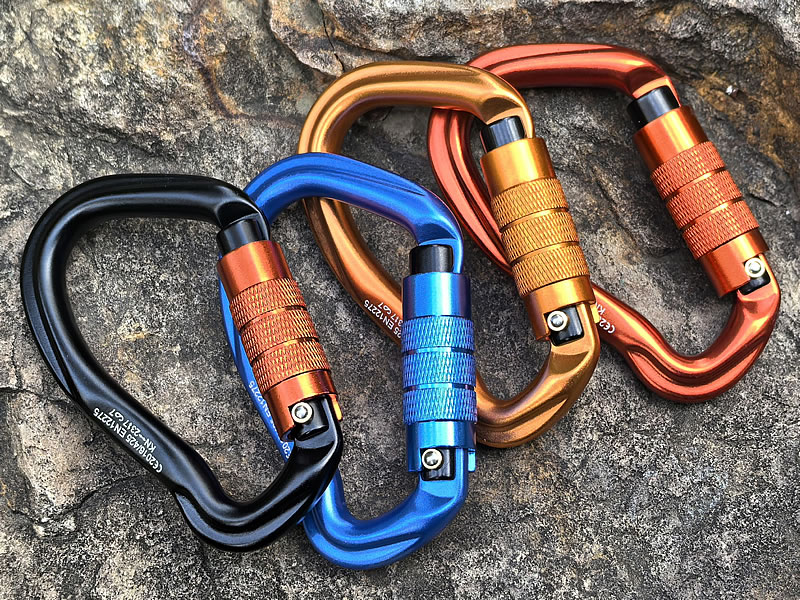
Defining "Heavy Duty": Beyond Climbing Specifications
While climbing carabiners prioritize a high strength-to-weight ratio (typically 22-28 kN in aluminum), heavy duty carabiners are defined by their maximum load capacity and durability. They are built to withstand repetitive, high-force applications, harsh environments, and abrasive wear. Key defining characteristics include:
- Material: Primarily constructed from forged or machined steel, which offers superior tensile strength and abrasion resistance compared to aluminum. Some heavy-duty models may use high-grade aluminum alloys for specific weight-conscious rigging.
- Strength Ratings: Load capacities significantly exceed climbing gear, commonly ranging from 30 kN (6,744 lbf) to 50 kN (11,240 lbf) and beyond. These ratings are for the major axis with the gate closed and locked.
- Standards: They are manufactured to meet stringent industrial standards (like ASME, OSHA guidelines in the US, or EN 362 for fall protection in Europe), not recreational climbing (UIAA) standards.
Key Applications: Where Heavy Duty Carabiners Are Essential
These carabiners are the connective backbone in numerous critical fields:
- Rigging and Lifting: In construction, logging, and stagecraft, they connect slings, ropes, and chains to lift and secure heavy loads, machinery, or theatrical scenery.
- Fall Protection and Confined Space Work: Used as a secure termination point on harnesses for safety lanyards, winch systems, and rescue setups in industrial settings.
- Towing and Recovery: A critical link in vehicle recovery straps and winch lines, where dynamic shock loads can be immense.
- Tactical and Military Use: For securing equipment, fast-roping, and load-bearing gear where extreme durability is required.
- Arboriculture and Tree Work: Connecting climbing lines, rigging pulleys, and supporting heavy limbs during removal.
Critical Features and Selection Criteria
Choosing the correct heavy duty carabiner involves careful consideration of several factors:
- Gate Type: A secure locking mechanism is mandatory. Screw-gates are common, but triple-action auto-locking gates (requiring multiple motions to open) provide the highest security against accidental snagging and opening under load or vibration.
- Shape: Standard D-shapes are prevalent for direct loading. Omega or Delta shapes offer wider openings for multiple connections. Large, round pear-shaped carabiners are useful for connecting multiple slings or shackles.
- Finish: A hot-dip galvanized or stainless steel finish provides maximum corrosion resistance for outdoor, marine, or chemical environments.
- Work Load Limit (WLL) vs. Breaking Strength: Always note the Working Load Limit—the maximum force the product is rated for during routine use. The Minimum Breaking Strength (MBS) is the ultimate failure point. Safety factors are typically 4:1 or 5:1 (e.g., a 50 kN MBS carabiner has a 12.5 kN WLL).
Safety First: Non-Negotiable Usage Rules
- Never Substitute for Climbing Gear: Their weight and design are not suitable for personal rock climbing or mountaineering.
- Rigorous Inspection: Before every use, inspect for cracks, corrosion, gate deformation, and wear. Retire any carabiner with significant wear or damage.
- Avoid Side Loading: Load the carabiner only along its major axis (spine). Side loading can reduce strength by 60-70%.
- Ensure Proper Engagement: Verify that the gate is fully closed and locked, and that attachments contact the spine, not the gate.
- Understand the Load: Calculate static and dynamic forces in your system. Always stay within the Working Load Limit, accounting for shock forces.
Top Brands and Trusted Manufacturers
Reputable manufacturers in this space include:
- Camp / C.A.M.P. (industrial line)
- DMM (professional rigging)
- Petzl (technical rescue and work-at-height)
- Kong (industrial and speleo)
- SMC
- CMI (Cumberland Mountain Industries)
In conclusion, heavy duty carabiners are specialized tools for professional-grade challenges. Their value lies not in their weight, but in their formidable strength and reliability. Selecting the right one requires a clear understanding of the application, a commitment to rigorous inspection, and unwavering respect for its rated limits. When lives and critical infrastructure depend on a single connection, the heavy duty carabiner stands as a testament to engineered safety.




