




Carabiner Strength Ratings Explained: Your Guide to kN, Safety, and Certification
When selecting a carabiner, understanding the small, stamped numbers on its spine is not just technical knowledge—it is fundamental to safety. These figures, expressed in kilonewtons (kN), are a precise language of engineering limits. Misinterpreting them can lead to catastrophic failures. This guide decodes carabiner strength ratings, explaining what they mean, why they matter, and how to apply this knowledge in real-world use.
The Unit of Force: What is a Kilonewton (kN)?
A kilonewton (kN) is a metric unit of force. For practical understanding:
- 1 kN ≈ 225 pounds (lbs) of force.
- A 22 kN carabiner can theoretically withstand a static force of about 4,950 lbs.
It’s crucial to remember that these ratings measure force, not weight. In a dynamic fall, the force exerted on a carabiner can multiply far beyond the climber's static weight due to the physics of falling (the "fall factor").
The Three Critical Ratings: A Multi-Axial Safety Story
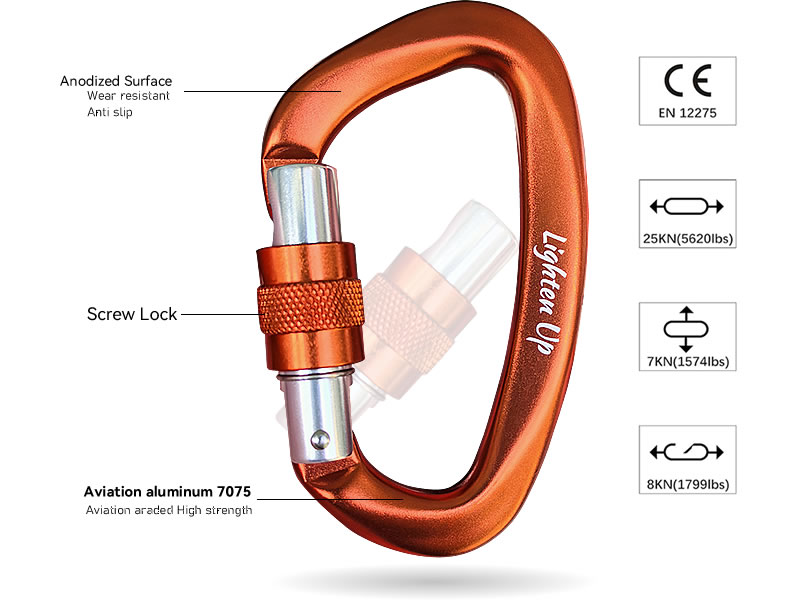
Every climbing-rated carabiner is tested and stamped with three distinct strength ratings. These correspond to different, possible loading scenarios:
- Major Axis Strength (Spine Load):The Key Rating: This is the carabiner's strength when loaded along its long, curved spine with the gate closed. This is its optimal and intended loading configuration.Typical Value: 22 kN to 28 kN for standard aluminum carabiners. This is the number most prominently displayed (e.g., "24 kN").
- Minor Axis Strength (Cross-Loaded):The Warning Rating: This is the strength when force is applied across the carabiner's narrow side, causing it to be loaded on its minor axis. This often happens accidentally if the carabiner is twisted or pulled sideways in an anchor.Typical Value: Approximately 7 kN to 9 kN. This is 60-70% weaker than the major axis rating. Cross-loading is a common and dangerous mode of failure.
- Open Gate Strength:The Critical Safety Rating: This is the strength when the carabiner is loaded along the major axis with the gate open.Typical Value: Approximately 6 kN to 9 kN. An open gate reduces the carabiner's strength by about 65-75%. This rating underscores why locking carabiners are essential for life-support connections and why avoiding gate contact with rock or other gear is vital.
Why Three Ratings? The Philosophy of Real-World Safety
Manufacturers provide these ratings to account for real-world misuse and accidents. A carabiner in a system is not always perfectly loaded. By understanding the dramatic strength reduction in sub-optimal scenarios, users gain critical insight into why proper orientation and locking gates are non-negotiable safety practices.
Certification: The Stamp of Trust
These ratings are validated through rigorous testing. Look for certifications from:
- UIAA (International Climbing and Mountaineering Federation): The global standard for climbing equipment.
- CE (Conformité Européenne): The European health, safety, and environmental protection standard.
A UIAA/CE stamp means the carabiner has been batch-tested to meet or exceed its stamped ratings under controlled conditions.
Practical Application: From Numbers to Safe Practice
- Contextualize the Numbers: A 22 kN rating is vastly stronger than the forces generated in most lead falls (which rarely exceed 5-8 kN on a single piece). The high rating is a safety margin accounting for material fatigue, aging, and unexpected forces.
- Prioritize Proper Orientation: Actively ensure your carabiners are loaded along the major axis (spine). In anchor setups, use techniques that keep carabiners aligned with the direction of pull.
- Respect the Gate: The open-gate rating is the carabiner's greatest vulnerability. Use locking carabiners for any critical connection, and be mindful of gate position on quickdraws to prevent accidental opening.
- Understand “Strong Enough”: For climbing, any UIAA/CE-certified carabiner has sufficient major axis strength. The focus should be on preventing the weak scenarios (cross-loading, open gate) rather than seeking the highest kN number.
The Industrial Exception: Working Load Limit (WLL)
For heavy-duty industrial carabiners (steel, 50+ kN), you may also see a Working Load Limit (WLL). This is the maximum recommended load during normal use, which includes a significant safety factor (often 4:1 or 5:1). For example, a carabiner with a 50 kN Breaking Strength may have a 12.5 kN WLL. This concept does not apply to recreational climbing carabiners, where the stamped kN is the minimum breaking strength.
Conclusion
Carabiner strength ratings are a direct communication from engineer to end-user. They tell a complete story of optimal performance and vulnerable failure modes. By moving beyond just the major axis number to a full understanding of cross-loaded and open-gate weaknesses, you transform from a passive user into an informed safety analyst. The ultimate goal is to ensure that every carabiner in your system is loaded only in its strongest configuration, keeping the immense forces of a fall or load squarely within the bounds of its formidable, stamped strength. Remember: knowledge of these ratings, applied through correct technique, is what makes a simple metal loop a trustworthy lifeline.




