




How to Choose a Climbing Carabiner: A Decision Guide for Safety and Performance
Selecting the right climbing carabiner is a foundational skill that impacts safety, efficiency, and enjoyment on the rock. With countless models available, the choice can seem overwhelming. However, by systematically considering three core pillars—Safety Application, Shape & Design, and Weight & Discipline—you can build a rack that is both trustworthy and tailored to your climbing style.
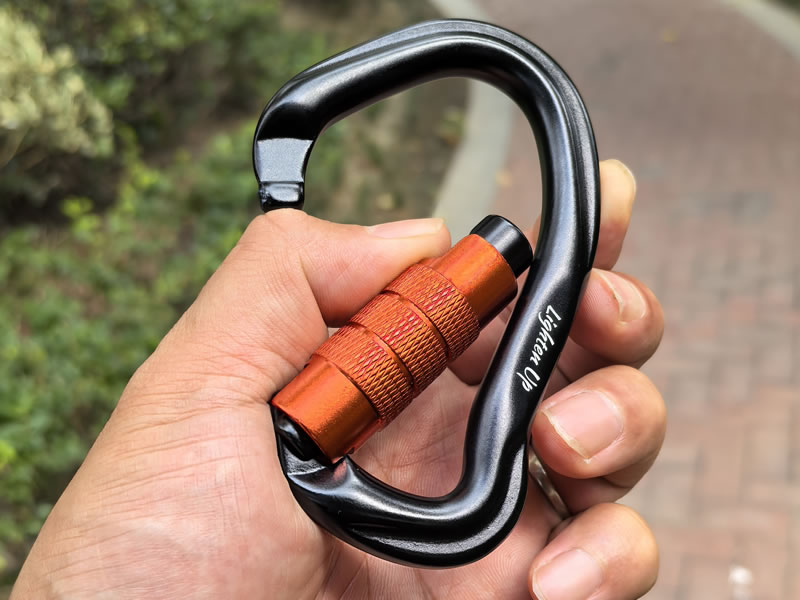
Pillar 1: Safety Application – Locking vs. Non-Locking
This is the most critical binary choice, dictated by one question: What happens if this carabiner opens accidentally?
- Choose a Locking Carabiner when the consequence is a fall or injury. Locking carabiners (screw-gate or auto-locking) are mandatory for all direct life-support connections. This includes:Belaying & Rappelling: Use a large, asymmetric D (HMS/pear-shaped) locker to accommodate your belay device and allow for a Munter hitch.Anchors: Use D-shaped or oval lockers at the master point or for connecting critical anchor components.Personal Attachment: Anywhere you are directly clipped in.
- Choose a Non-Locking Carabiner for speed and efficiency in non-critical roles. These are for connections where a gate failure is not catastrophic.Sport Quickdraws: The rope-end carabiner is almost always a non-locking, wire-gate model (often bent-gate) for smooth clipping.Racking Gear: Use standard non-locking D-shapes to organize cams, nuts, and quickdraws on your harness.Alpine Draws: Composed of two non-locking carabiners connected by a sling.
Pillar 2: Shape & Design – Matching Form to Function
Shape dictates how force is distributed and impacts usability.
- D-Shape: The standard workhorse. The straight spine directs force efficiently, offering the best strength-to-weight ratio for general clipping and anchor building.
- Asymmetric D (HMS/Pear): The belay and rappel specialist. Its wide, rounded base prevents cross-loading with a belay device and comfortably fits a Munter hitch.
- Oval: Less common today. Symmetrical shape is useful for gear racks or specific aid climbing scenarios, but it is weaker under load than a D-shape.
- Key Design Features:Wire Gate: Lighter, less prone to icing, and exhibits less "gate flutter" in a fall. The standard for performance.Solid Gate: Slightly more durable but heavier. A classic, reliable choice.KeyLock/No-Snag Nose: A must-have feature. Eliminates the hook-like notch, preventing the carabiner from snagging on bolts, gear, or rope.
Pillar 3: Weight & Discipline – Optimizing Your Rack
The number of carabiners you carry multiplies weight savings or penalties. Your primary climbing discipline should guide your final selection.
- Sport Climbing: Prioritize high-performance, lightweight wire-gate carabiners. For quickdraws, a bent-gate on the rope end facilitates clipping, paired with a straight-gate on the bolt end. One or two robust HMS lockers for belaying complete the set.
- Traditional & Multi-Pitch Climbing: You'll carry many carabiners, so weight savings are crucial across the board. Choose lightweight lockers for anchors and lightweight wire-gate Ds for your entire rack. Durability remains key for abrasion against rock.
- Alpine & Big Wall Climbing: Every gram counts. This is the domain of ultra-light carabiners like the Petzl Ange or Camp Photon. Expect trade-offs in gate action smoothness for minimum weight. For big walls, prioritize a mix of ultra-light and more durable models for high-wear points.
A Practical Selection Framework
Follow this decision flow for each carabiner you buy:
- Define its Job: "This will be my belay carabiner," or "This is for the rope-end of my sport quickdraws."
- Apply the Safety Rule: Belay = Locking. Quickdraw end = Non-Locking.
- Select the Shape: Belay = HMS. Quickdraw = Wire-gate D (likely bent-gate).
- Refine for Discipline: Sport cragging = Optimize for clipping feel. Alpine = Choose the lightest certified option in that category.
Final Non-Negotiables
- Certification: Only purchase carabiners stamped with UIAA and/or CE certification. This guarantees they meet independent safety standards.
- Brand Reputation: Stick with reputable climbing manufacturers (e.g., Black Diamond, Petzl, DMM, Camp, Edelrid, Mammut). Their engineering and quality control are proven.
- Inspection: Regardless of choice, regularly inspect every carabiner for cracks, gate wear, and smooth function. Retire damaged gear immediately.
In conclusion, choosing a climbing carabiner is an exercise in applied risk management and efficiency. There is no single "best" carabiner, but there is a definitively correct type of carabiner for every specific task on the rock. By understanding the why behind the design—the locking mechanism for life support, the D-shape for strength, the wire gate for weight—you move from simply using gear to mastering it. Your informed choices become the reliable, silent partners in every ascent, allowing you to focus on the climb itself.




