




Carabiners for Rock Climbing: Your Essential Guide to the Unsung Hero of Safety
In the world of rock climbing, where strength, technique, and courage are visibly tested, there exists a small, unassuming piece of equipment that plays the most critical role of all: the carabiner. More than just a metal loop with a gate, the carabiner is the fundamental connective tissue of a climbing system, the indispensable link between you, your rope, and your protection. Choosing and using the right carabiners is not a matter of preference; it's a cornerstone of safety.
Beyond the Basic 'Biner: Understanding Types and Uses
Not all carabiners are created equal. Their design is meticulously tailored to specific functions:
- Non-Locking Carabiners: These are the workhorses, featuring a spring-loaded gate for quick, one-handed operation. They are ideal for clipping rope into quickdraws, organizing gear on your harness, or attaching non-critical items. However, their key limitation is that the gate can potentially open if pressed against the rock.
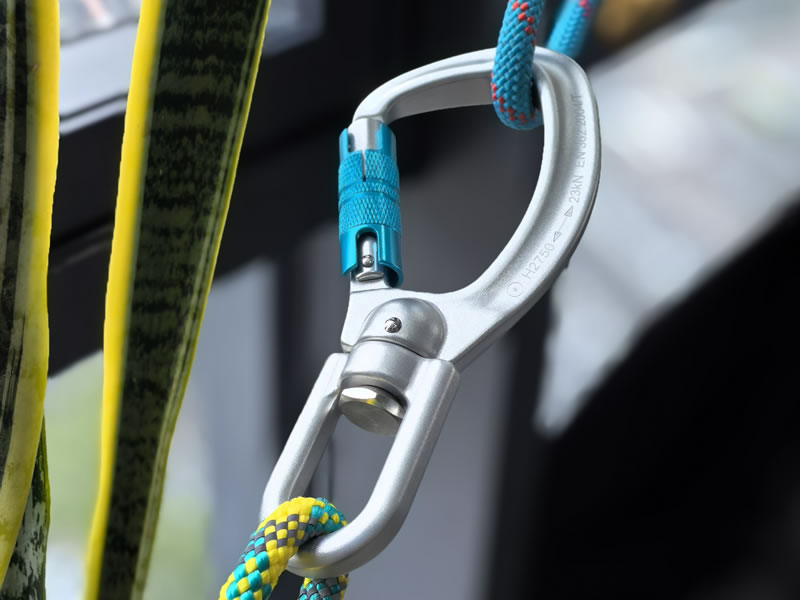
- Locking Carabiners: When failure is not an option, locking carabiners come into play. They feature a locking sleeve (screw-gate, twist-lock, or auto-locking) that secures the gate closed, preventing accidental opening. These are essential for connecting your belay device, anchoring yourself to protection, or any other "master point" where a secure, closed connection is vital.
- Specialized Shapes: Their form dictates function. Oval carabiners are symmetrical and work well for gear slings. D-shaped carabiners are stronger on the spine (non-gate side), efficiently directing force. Asymmetric D or HMS carabiners have a larger, curved gate side specifically designed to accommodate the Munter hitch used in belaying and rappelling.
The Anatomy of Safety: What to Look For
When selecting a carabiner, these are the non-negotiable elements:
- Certification: Always look for stamps indicating UIAA (International Climbing and Mountaineering Federation) and/or CE (European Conformity) certification. This means the carabiner has passed rigorous strength tests for major-axis (gate closed), minor-axis (sideways), and gate-open loads.
- Strength Ratings: These are printed on the spine. "kN" stands for kilonewton (approximately 225 lbs of force). A typical rating like 24 kN refers to its major-axis strength with the gate closed. The gate-open strength (usually 7-9 kN) is significantly lower, underscoring why locking carabiners are crucial for critical points.
- Material: Most modern carabiners are made from 7075 aluminum alloy, offering an excellent strength-to-weight ratio. For ultimate strength in critical applications like rescue or rigging, steel carabiners are used, though they are much heavier.
Proper Use and Critical Maintenance
The best carabiner is only as good as the climber using it. Adhere to these golden rules:
- Gate Direction: When leading, orient quickdraw carabiners so the gates face away from your direction of travel to reduce rope-induced gate opening.
- The "Three-Point Check": Before committing your weight, visually and physically check: (1) The rope is inside the carabiner, (2) The gate is fully closed, and (3) For locking 'biners, the sleeve is locked.
- Avoid Cross-Loading: Never allow force to be applied across the minor axis (sideways on the gate). This drastically reduces its strength.
- Inspect and Retire: Regularly inspect for cracks, deep grooves from rope wear, gate stickiness, or any signs of damage. A dropped carabiner from significant height can have internal damage—when in doubt, retire it. Your life is worth more than a piece of metal.
In conclusion, carabiners are far more than simple clips. They are precision-engineered safety devices that demand respect and understanding. By investing in certified, purpose-specific carabiners and committing to their meticulous use and care, you are not just buying gear—you are investing in the very foundation of your safety on the rock. Always pair this knowledge with professional instruction and never exceed your certified training limits.




