




Carabiner Weight Limit: A Critical Guide to Understanding Strength Ratings and Safe Use
The question "What is this carabiner's weight limit?" is fundamental to safety, yet the answer is often misunderstood. Interpreting a carabiner's strength rating correctly is not about finding a simple number, but about understanding a complex language of engineering standards, safety factors, and intended use. Misapplication can lead to catastrophic failure. This guide decodes the critical concept of "weight limit" to ensure you choose and use carabiners with confidence and safety.
Beyond "Pounds": The Language of Kilonewtons (kN)
First, discard the term "weight limit" in favor of "strength rating," measured in kilonewtons (kN). A kilonewton is a unit of force (approximately 225 pounds of force under Earth's gravity). This shift in terminology is crucial because carabiners are tested for the forces they can withstand, not just the static weight they can hold.
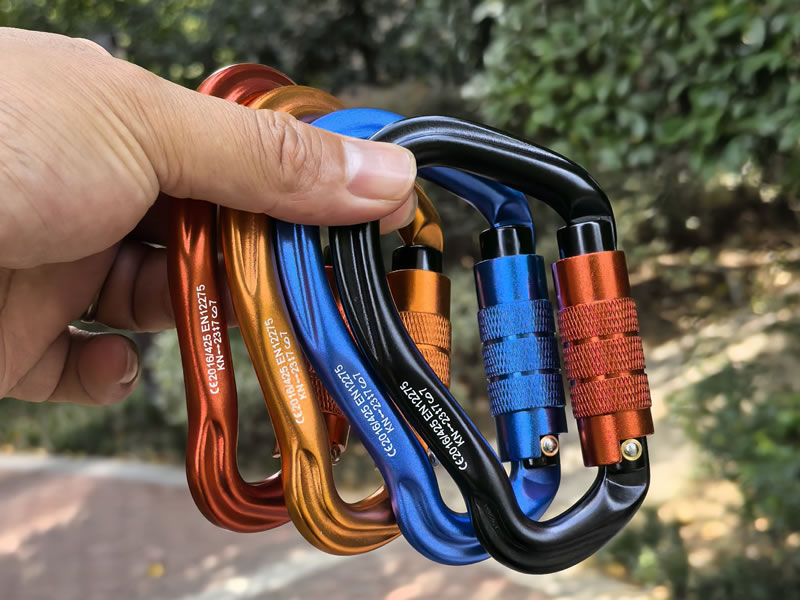
Every certified carabiner has its kN rating stamped on its spine. This number represents its minimum breaking strength (MBS) under specific, ideal laboratory conditions. For example, a carabiner stamped "22 kN" is engineered not to break under a force less than 22 kilonewtons (about 4,945 lbs of force) when loaded along its major axis with the gate closed.
The Three Critical Strength Ratings
A single "weight limit" does not exist. A carabiner has three distinct strength ratings depending on how force is applied:
- Major-Axis Strength (Gate Closed): This is the prominent kN rating (e.g., 22-25 kN for climbing). It's the strongest configuration, with load applied lengthwise on the spine.
- Minor-Axis Strength (Gate Closed): When load is applied sideways (cross-loaded), the strength plummets, typically to 7-10 kN. This is a common and dangerous mode of failure in misuse.
- Gate-Open Strength: In a worst-case scenario where the gate is open during loading, strength drops dramatically to approximately 6-9 kN. This highlights the vital importance of using locking carabiners for critical connections.
Working Load Limit (WLL) vs. Breaking Strength: The Safety Factor
This is the most important distinction for safe use. The MBS (e.g., 22 kN) is not the safe "weight limit" for daily use. Engineers apply a significant safety factor to determine the Working Load Limit (WLL)—the maximum load the product should sustain in routine service.
- Climbing (UIAA/CE): The safety factor is implicit. A UIAA-certified carabiner must withstand multiple test falls (simulating a severe 80 kg climber falling). The 22 kN rating is a test of ultimate integrity, not a daily allowance. Industry practice suggests a safe working load is a fraction of this, often considered to be in the range of 5-6 kN for normal climbing forces.
- Industrial (ANSI/OSHA): Standards like ANSI Z359 explicitly define a 5:1 safety factor. A carabiner with a 50 kN MBS has a strict WLL of 10 kN (approx. 2,250 lbs). This WLL is the absolute maximum load permitted in use.
In simple terms: You must never plan to load a carabiner anywhere near its breaking strength. The safe operating load is its Working Load Limit, which is much lower.
Application Dictates the Standard
The "safe weight limit" is entirely dependent on the carabiner's design standard and your activity:
- Rock Climbing: Use UIAA/CE-certified carabiners. Their ratings are designed for the high-impact, dynamic loads of a fall. Never use a non-certified hardware store carabiner.
- Industrial & Fall Protection: Use ANSI/CE-certified carabiners with a clearly stated WLL. They are designed for static or steady loads in construction, rescue, and rigging.
- Everyday/Utility Use (Camping, Gear Organization): For non-life-critical applications, a general-purpose aluminum carabiner with a 5-10 kN breaking strength is ample. The "limit" here is often the attachment point on your gear, not the carabiner itself.
Key Factors That Lower Effective Strength
Even a carabiner with a high kN rating can fail at a much lower force if:
- It is Cross-Loaded: As noted, this reduces strength by 60-70%.
- The Gate is Open or Unlocked: Reduces strength by over 60%.
- It is Damaged: Cracks, deep grooves, or corrosion create stress points.
- It is Old or Worn Out: Metal fatigue from repeated loading or gate cycles.
Conclusion: Safety Lies in the Margin
Understanding carabiner weight limits is about respecting the margin of safety engineered into the device. It requires you to:
- Identify the Correct Standard (UIAA for climbing, ANSI for industry).
- Understand the Critical Difference between Breaking Strength (MBS) and Safe Working Load (WLL).
- Never Load a Carabiner Along Its Minor Axis.
- Always Use Locking Carabiners for any critical, life-support connection.
- Inspect Regularly and Retire Immediately if damaged.
By internalizing these principles, you move beyond seeing a carabiner as a simple clip and recognize it as a precisely rated safety component. Its true "weight limit" is the safe load you apply within the context of your activity, always leaving a substantial buffer between use and failure. When in doubt, consult a qualified professional and always prioritize certified gear for any safety-critical application.




