




Carabiner Breaking Strength: Understanding the Ultimate Limit of Your Gear
In the world of climbing, rigging, and high-stakes outdoor pursuits, the term "breaking strength" is a fundamental metric that defines the absolute limit of a carabiner's integrity. It represents the point of catastrophic failure—a threshold no user should ever approach in practice. Understanding what breaking strength truly means, how it is determined, and its critical relationship to safe working limits is essential for anyone whose safety depends on this vital piece of equipment.
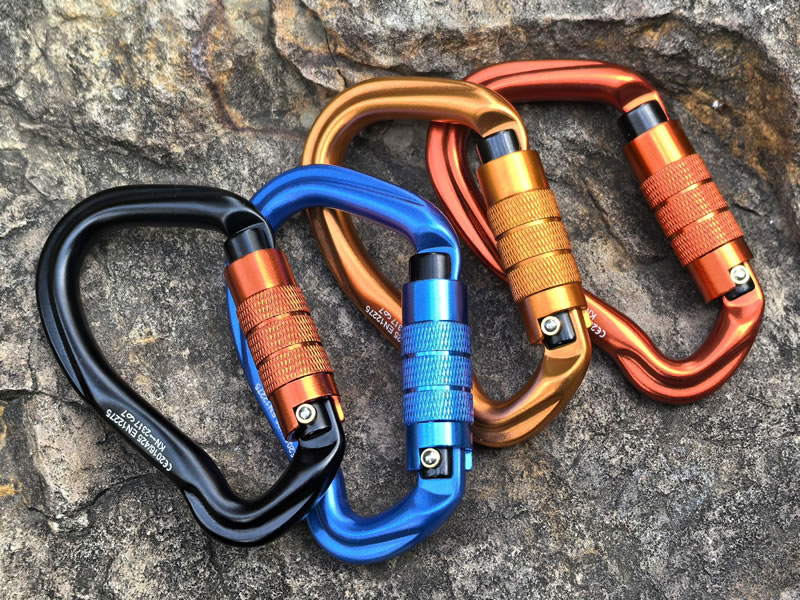
Defining the Benchmark: What is Breaking Strength?
Breaking strength, also known as Minimum Breaking Strength (MBS), is the minimum amount of force, measured in kilonewtons (kN), that a carabiner is required to withstand in a standardized, controlled, single-pull-to-failure test conducted by a certified body. One kilonewton is approximately equivalent to 225 pounds of force.
For example, a climbing carabiner stamped with "24 kN" on its spine has been laboratory-tested to hold at least 24 kN (roughly 5,400 pounds) of force when pulled along its major axis with the gate closed and locked, before deforming or fracturing. This number is not an average or a maximum—it is a guaranteed minimum that every carabiner of that model must exceed.
The Testing Standard: How Breaking Strength is Certified
Breaking strength is not a theoretical number; it is validated through rigorous, standardized testing. For climbing equipment, the two primary certifying bodies are the UIAA (International Climbing and Mountaineering Federation) and, in Europe, the CE under the EN 12275 standard.
The test is devastatingly simple and absolute: a carabiner is mounted in a hydraulic tensile testing machine and pulled until it fails. The test confirms three key MBS ratings:
- Major Axis Strength (Gate Closed & Locked): The primary rating (e.g., 22-25 kN).
- Minor Axis Strength (Gate Closed): Testing side-loading force (typically 7-10 kN).
- Gate Open Strength: Testing the weakest configuration (typically 6-9 kN).
Certification ensures that the weakest carabiner in a production batch still meets or exceeds these minimums, providing a consistent and reliable safety baseline.
The Critical Distinction: Breaking Strength vs. Working Load Limit
This is the most crucial concept for safe usage: Breaking Strength (MBS) is not the safe operating load. The safe operating load is defined by the Working Load Limit (WLL) or Safe Working Load (SWL).
The relationship between the two is governed by the Safety Factor:
- In Climbing: While not explicitly stated as a ratio, a massive safety factor is engineered into the system. A severe climbing fall might generate 5-6 kN of force on a carabiner. A carabiner with a 22 kN MBS therefore has an implicit, real-world safety factor of approximately 4:1 or higher for that dynamic event.
- In Industrial/Rigging: Standards like ANSI Z359 (USA) or EN 362 (Europe) explicitly mandate a 5:1 safety factor. A carabiner with a 50 kN MBS has a strict WLL of 10 kN. Exceeding the WLL is a violation of safety protocols.
In essence, the breaking strength is the ultimate "red line," while the WLL is the safe "green zone" for daily operation.
Factors That Influence Real-World Strength
The laboratory-derived MBS assumes perfect conditions. In the field, several factors can lower a carabiner's effective strength, moving it closer to its breaking point unexpectedly:
- Improper Loading: Cross-loading (loading on the minor axis) immediately reduces strength to its minor-axis rating (e.g., 7 kN vs. 24 kN). Gate loading (force pushing against the open gate) is even more dangerous.
- Material Fatigue: Repeated high-load cycles, though below MBS, can cause microscopic cracks and metal fatigue over time.
- Environmental Damage: Corrosion (especially stress corrosion cracking in aluminum), deep surface gouges, or abrasive wear create stress concentrators that can initiate failure at loads far below the rated MBS.
- Impact Damage: A carabiner dropped from height onto a hard surface can sustain internal crystalline damage or tiny cracks invisible to the naked eye, compromising its integrity.
Application and Interpretation: Reading the Numbers
- For a Rock Climber: A 22 kN rating on your quickdraw carabiner is reassuring evidence of its immense strength reserve for catching falls. Your focus should be on preventing cross-loading and gate-open loading, which can reduce its effective strength to a dangerous 6-9 kN range.
- For a Rigger or Rescue Technician: You will see both MBS and WLL on certified industrial gear. You must plan all lifts and connections based on the WLL, using the 5:1 safety factor. The MBS is a benchmark, not a tool for calculation.
- For a Gear Manufacturer: Achieving a high MBS with minimal weight is an engineering challenge, often involving advanced alloys like 7075-T6 aluminum and precision forging.
Conclusion: Respecting the Limit to Operate Safely Within It
The breaking strength of a carabiner is a testament to modern engineering and rigorous quality control. It provides the foundational confidence that our equipment is built to an extraordinarily high standard. However, informed users understand that this number represents a boundary to be respected from a great distance, not a target to be approached.
True safety lies in the vast margin between the Working Load Limit (governed by practice and standards) and the Minimum Breaking Strength (the absolute limit). By choosing certified gear, using it correctly within its intended design (proper loading, using lockers for critical connections), and conducting regular inspections for damage, we ensure that the breaking strength remains a theoretical laboratory value—never a reality in the field. The strength of your system is ultimately defined by your knowledge and discipline.




