




Carabiner Gate Types Explained: Choosing the Right Mechanism for Safety
The gate of a carabiner is its moving part and a critical component of its security and functionality. Choosing the correct gate type is not a matter of preference alone; it is a fundamental safety decision that depends on your specific activity, from rock climbing and industrial work to rescue operations. This guide explains the primary carabiner gate types, their mechanisms, and their ideal applications.
1. Non-Locking Gates
These gates operate with a simple spring mechanism and do not have a secondary locking feature. They are prized for speed and ease of use but are not suitable for life-critical, long-term connections.
- Straight Gate: The most common and basic design. The gate swings open in a straight arc. They are lightweight and allow for quick, one-handed clipping.
- Bent Gate: Features a gate that curves inward. This design creates a larger opening (the "gate mouth") when open, making it exceptionally easy to clip a rope into, especially during sport climbing. However, this same design can make it slightly more prone to accidental snagging and opening.
Best For: Quickdraws on sport climbs (where the rope side is often a bent-gate), temporary anchor management, and non-critical applications. Never use a non-locking carabiner as the primary connection point in a life-support system.
2. Locking Gates
These incorporate a secondary mechanism to prevent the gate from opening accidentally. They are mandatory for any critical connection point in climbing, work-at-height, and rescue.
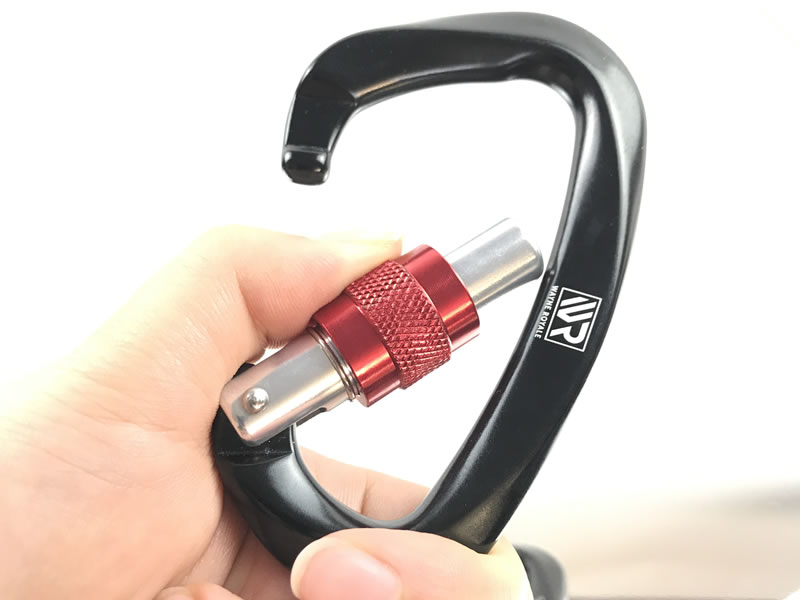
A. Manual Locking (Screwgate)
- Mechanism: After closing the gate, you must manually thread a locking sleeve down the gate's arm until it is fully engaged. This creates a physical barrier that prevents the gate from opening.
- Pros: Simple, reliable, and easy to visually verify if it's locked. Generally less expensive than auto-locking models.
- Cons: Requires a conscious, two-handed action to lock and unlock. Human error (forgetting to screw it down completely, or it vibrating open) is the primary failure risk.
- Best For: General multipurpose use where you can routinely check the lock. Common on harness belay loops, anchor building, and as a belay device carabiner.
B. Auto-Locking Gates
These gates automatically engage the lock when released. They are designed to minimize human error.
- Twist-Lock / Auto-Lock: The most common type. The gate has a spring-loaded collar that automatically rotates to cover the gate nose when the gate closes. To open, you must twist the collar back against the spring, then open the gate.
- Push-Lock / Ball-Lock: To open, you must first push a button or lever (often on the gate itself) to disengage the lock, then open the gate. This two-stage action can be very intuitive.
- Triple-Action / Triple-Lock: The most secure and complex design, often used in industrial and rescue settings. Opening requires three distinct motions in sequence (e.g., push, twist, then pull open). This virtually eliminates any chance of accidental opening.
Pros: Significantly reduces the risk of human error. Provides constant, automatic locking.
Cons: More expensive, can be harder to operate with gloves or cold hands, and may collect dirt that impedes the mechanism.
Best For: Critical, long-term connections like master points in anchors, haul systems, fixed ropes, and situations where the gate could be rubbed against rock or gear.
Key Considerations for Selection
- Standard Compliance: For climbing, ensure any locking carabiner meets UIAA or CE/EN standards (marked on the spine). A locking carabiner must withstand a minimum gate-open strength test.
- Operation with Gloves: Test auto-locking gates if you'll be operating in cold environments. Some mechanisms are more glove-friendly than others.
- Regular Inspection is Paramount: The moving parts of any gate are wear points. During inspections, pay close attention to smooth operation, spring strength, and any corrosion or grit in the locking mechanism.
- The Right Tool for the Job: Use a simple non-locker for a quickdraw where speed is key. Use a reliable screwgate for your belay device. Use a robust auto-locker for the central anchor carabiner that you might not touch for hours.
Conclusion
Understanding carabiner gate types is essential for building safe systems. There is no single "best" type; rather, there is the most appropriate type for a given task. By matching the gate's mechanism—whether the simple speed of a non-locker, the manual security of a screwgate, or the fail-safe design of an auto-locker—to the demands and risks of your activity, you make a informed choice that prioritizes safety without sacrificing necessary functionality. Always remember: when a connection is life-critical, a locking carabiner is the only acceptable choice.




