




Auto-Locking Carabiner: How It Works – The Mechanics of Fail-Safe Security
In the realm of climbing, rescue, and industrial safety, the auto-locking carabiner represents the pinnacle of secure connector design. Unlike a standard screw-gate carabiner, which relies on the user to manually lock it, an auto-locking carabiner is engineered to engage its lock automatically and mechanically the moment the gate closes. This built-in redundancy is designed to eliminate human error, providing a critical layer of safety where a forgotten twist could have catastrophic consequences.
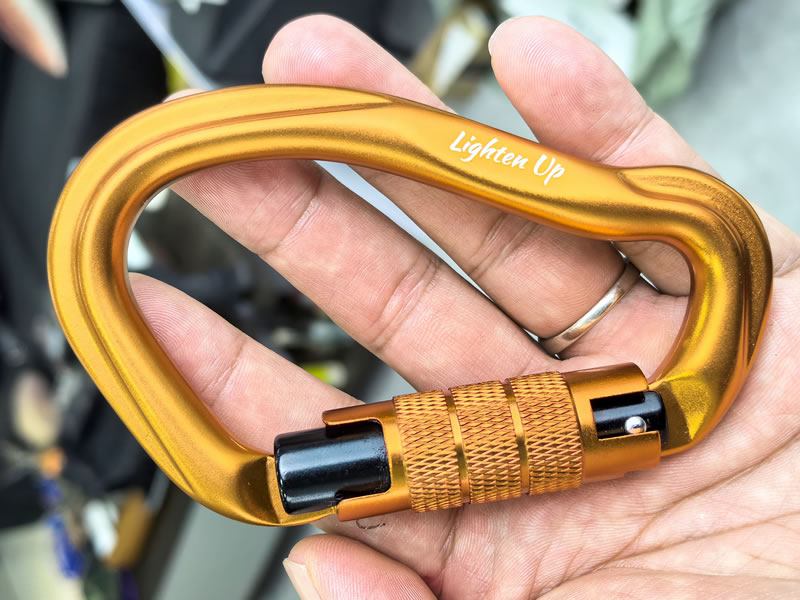
Core Philosophy: Security Without Conscious Action
The fundamental principle is passive safety. The mechanism ensures the carabiner is always in its locked state unless the user deliberately unlocks it. This is crucial in high-stress, fatiguing, or complex situations where a climber or worker might overlook a procedural step.
Common Types and Their Internal Mechanics
While designs vary by brand, they all achieve the same goal: automatic lock engagement. Here are the most prevalent systems:
1. The Triple-Action (Push-Twist-Pull) System
- How it Works: This is one of the most secure and common designs, used by brands like Black Diamond (GridLock) and DMM (Sentinel).Close: The gate swings shut, and a spring-loaded locking sleeve automatically slides forward or rotates to cover the gate pin, preventing it from being depressed.Unlock: Unlocking requires a deliberate, three-step sequence: a) Push the sleeve inward against its spring, b) Twist it to align with a channel, and c) Pull the gate open. This complex action makes it virtually impossible for the gate to open accidentally from a bump, snag, or vibration.
2. The Ball-Lock (or Pin-Lock) System
- How it Works: Pioneered by Petzl (Ball-Lock / I'D system), this mechanism uses a spring-loaded steel ball or pin.Close: As the gate closes, it pushes the ball inward, compressing its spring. Once the gate is fully closed, the ball snaps back into a matching detent (hole) in the gate, physically blocking it from rotating open.Unlock: The user must press a separate, dedicated button or lever that retracts the ball from the detent, freeing the gate to open. This creates a clear, distinct action separate from the gate itself.
3. The Magnetic Locking System
- How it Works: Used in models like the Petzl Am'D and some Mammut carabiners, this system employs magnets.Close: Magnets in the gate and the carabiner body align as the gate closes, pulling it firmly into the locked position and holding it there.Unlock: The user must apply a deliberate twisting and pulling force strong enough to overcome the magnetic attraction. This system offers incredibly smooth, one-handed operation but with strong magnetic resistance to accidental opening.
Why Choose an Auto-Locker? Key Advantages
- Elimination of User Error: The greatest advantage. It removes the risk of forgetting to screw down a sleeve.
- Security in Complex Systems: In crowded anchor setups or haul systems, a screw-gate can be inadvertently unscrewed by rubbing against another carabiner or the rock—a phenomenon called "cross-threading" or "unscrewing walk." Auto-lockers are immune to this.
- Faster to Secure: While unlocking requires steps, locking is instantaneous and guaranteed upon closure.
- Often Easier with One Hand or Gloves: Once the unlocking sequence is mastered, some find them easier to manage than fiddling with a small screw-gate with cold, gloved hands.
Important Considerations and Proper Use
- The Audible "Click": Most auto-lockers provide a positive auditory and tactile click when the lock engages. Never trust a closure without this confirmatory click.
- Mud and Ice Susceptibility: The more complex mechanisms can be more vulnerable to jamming if clogged with mud, ice, or sand compared to a simple screw-gate. Regular cleaning is vital.
- Visual Inspection: You must still visually confirm that the lock is fully engaged. The sleeve should be flush, or the button should be in the locked position.
- Not a Substitute for Vigilance: Automatic does not mean infallible. The mechanism is a mechanical device that can wear or fail. It must be part of a broader safety mindset that includes systematic equipment checks.
Ideal Applications
Auto-locking carabiners are especially valuable for:
- Belay and Rappel Devices: The primary point of personal safety.
- Critical Anchor Points: Where the carabiner is the master connector.
- Rescue and Rope Access Systems: Where protocols demand fail-safe connections and operators are under duress.
- Multi-Pitch Climbing: Reducing mental load during transitions at belay stances.
Conclusion: Engineering for Certainty
The auto-locking carabiner is a sophisticated answer to a simple, deadly problem: human fallibility. By integrating the locking action directly into the physics of the gate's closure, it engineers a higher default level of security. Understanding how it works—feeling the click, mastering the unlock sequence, and trusting but verifying its engagement—transforms it from a clever gadget into a foundational tool for managing risk. In environments where consequences are measured in gravity, the auto-locker's core promise is profound: it works to keep you safe even in the moment you might not.




