




Carabiner Gate Strength Comparison: Understanding the Critical Differences
When evaluating a carabiner's safety, the single most important concept is that its strength is not a fixed number—it varies dramatically based on how the carabiner is loaded. The stamped kN (kilonewton) ratings tell a comparative story of vulnerability, highlighting why proper use is non-negotiable. This guide provides a detailed comparison of gate strength under different loading scenarios and translates these numbers into crucial safety practices.
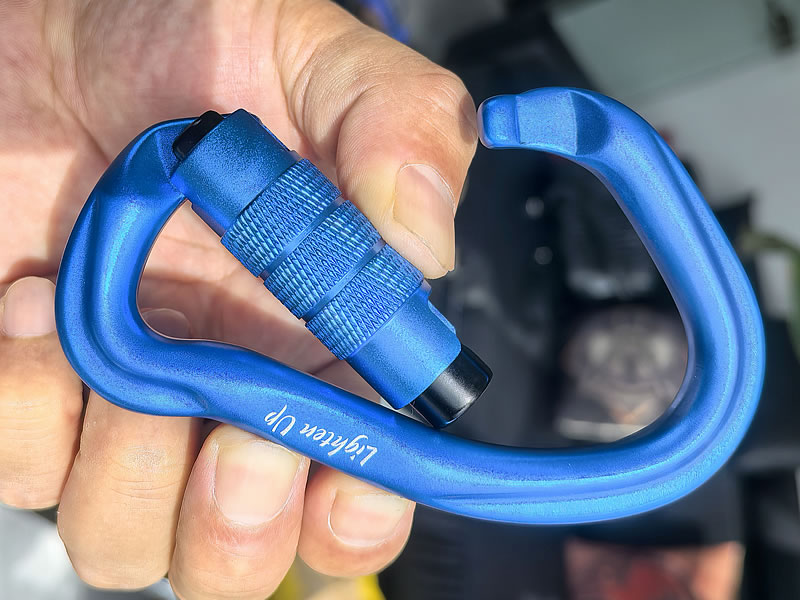
The Three Official Ratings: A Story of Progressive Weakness
Every UIAA/CE-certified climbing carabiner is tested and stamped with three strength ratings, forming a clear hierarchy:
1. Major Axis Strength (Spine Load)
- Typical Range: 22 kN to 28 kN (approx. 4,950 - 6,300 lbs force).
- Condition: Load applied along the carabiner's long, curved spine with the gate closed.
- The Benchmark: This is the optimal and intended loading configuration. The design channels force through the strongest part of the metal loop. This is the figure most prominently advertised and represents the carabiner at its full potential.
2. Cross-Loaded Strength (Minor Axis Load)
- Typical Range: 7 kN to 9 kN.
- Condition: Force applied across the carabiner's narrow side, loading the minor axis. This often happens accidentally if the carabiner twists in an anchor or against the rock.
- The Comparison: This is approximately 60-70% weaker than the major axis strength. A carabiner that can hold over 5,000 lbs when loaded correctly may fail at under 2,000 lbs if cross-loaded. This drastic reduction is why anchor-building techniques that prevent carabiners from twisting are essential.
3. Open Gate Strength
- Typical Range: 6 kN to 9 kN.
- Condition: Load applied along the major axis with the gate fully open.
- The Critical Comparison: This is the carabiner's greatest vulnerability. An open gate reduces strength by 70-75% compared to its closed-gate major axis rating. In practical terms, a 24 kN carabiner can become a 7 kN carabiner in an instant if the gate is open.
The Physics Behind the Comparison
The weakness in cross-loaded and open-gate scenarios stems from fundamental engineering:
- Cross-Loading: Leverage and bending moment are applied to the weakest geometric dimension. The force doesn't travel through the engineered load path of the spine.
- Open Gate: The carabiner is no longer a closed loop. It becomes a bent, open piece of metal with immense stress concentrated at the gate notch (the "nose"), a prime location for failure initiation.
Quantitative Comparison Table
The following table illustrates the dramatic differences using a typical 24 kN aluminum climbing carabiner as a baseline:
| Loading Scenario | Typical Strength | Percentage of Major Axis Strength | Approximate Force to Failure (lbs) | Common Cause |
|---|---|---|---|---|
| Major Axis (Closed Gate) | 24 kN | 100% | 5,400 lbs | Proper, intended use. |
| Cross-Loaded | 8 kN | 33% | 1,800 lbs | Carabiner twisted in anchor; improper sling attachment. |
| Open Gate | 7 kN | 29% | 1,575 lbs | Gate snagged on rock/rope; failure to lock; "gate flutter" in a fall. |
The Real-World Safety Implications
This comparison isn't academic—it dictates life-saving protocols:
- The Imperative for Locking Carabiners: The shockingly low open-gate strength is the fundamental reason why locking carabiners (screw-gate or auto-lock) are mandatory for all direct life-support connections—belay, rappel, and anchor master points. The locking mechanism physically prevents the gate from opening, preserving the major axis strength.
- Anchor Building Discipline: When connecting multiple slings or ropes to a carabiner in an anchor, techniques like the "load-equalizing, twist-free" configuration are used specifically to prevent cross-loading. A simple oversight here can reduce the system's strength by two-thirds.
- Quickdraw Orientation: Climbers are taught to orient quickdraws so the gates face away from the direction of travel. This minimizes the chance of the rope whipping against and opening the gate during a fall, which would instantly trigger the weak open-gate strength scenario.
Conclusion: Strength Lies in Configuration, Not Just Metal
The carabiner gate strength comparison delivers one of the most vital lessons in climbing and technical rope work: Your gear is only as strong as your ability to use it correctly. The difference between a 24 kN powerhouse and a 7 kN liability is a matter of millimeters in gate position or degrees of orientation.
Therefore, the informed user's goal is to ensure every carabiner in a safety-critical system is loaded only in its major-axis, closed-and-locked configuration. This understanding transforms how you clip, build anchors, and inspect your setup. Ultimately, these stamped numbers are a direct communication from engineer to end-user, compelling a practice of mindful, precise technique where the immense forces of a fall are managed not by metal alone, but by knowledgeable and disciplined application.




