




Oval vs D-Shape Carabiner: Pros and Cons
The choice between an oval and a D-shaped carabiner is more than aesthetic; it's a decision that hinges on fundamental engineering principles and intended use. Historically, the oval was the original design, but the D-shape emerged as a performance-driven evolution. Understanding the distinct advantages and limitations of each is crucial for selecting the right tool for climbing, rigging, or organization.
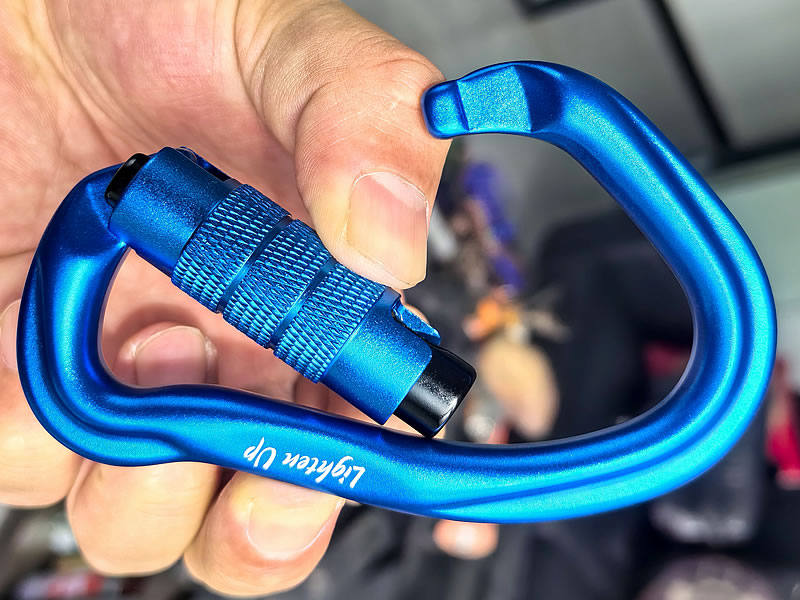
Oval Carabiner: The Symmetrical Workhorse
Design Principle: A symmetrical loop with a uniform curvature.
Pros:
- Versatile Gear Racking: The symmetrical shape allows gear (cams, nuts, slings) to slide freely around the entire circumference. This prevents bunching at one end and distributes wear evenly, making it a classic choice for traditional climbers building large racks.
- Predictable Loading in Multi-Directional Setups: In certain anchor configurations or when using older-style knots like a Munter hitch, the oval’s symmetry can be advantageous, as it presents no "wrong" orientation for the knot to sit against.
- Simplicity & Tradition: Its straightforward design is reliable and carries a heritage appeal in certain climbing disciplines.
Cons:
- Inferior Strength-to-Weight Ratio: This is the most significant drawback. Under load, force is distributed evenly between the stronger spine and the weaker gate side. This makes it the least efficient common shape, requiring more material to achieve the same major-axis strength as a D-shape.
- Heavier for a Given Strength: To meet modern strength standards (22-24 kN), ovals are typically bulkier and heavier than their D-shaped counterparts.
- Less Common in Modern Sport Climbing: Its performance disadvantages have made it largely obsolete for sport climbing quickdraws and primary safety carabiners.
D-Shape Carabiner: The Engineered Standard
Design Principle: A shape where the spine is straight, and the gate side is curved, forming a "D". The asymmetric design intentionally channels force along a specific path.
Pros:
- Optimal Strength-to-Weight Ratio: The D-shape masterfully directs the majority of the load onto the strong, straight spine. This allows manufacturers to use less material to achieve the same (or higher) strength rating, resulting in a lighter carabiner.
- Lighter Weight: For a given strength, a D-shape is almost always lighter than an equivalent oval, a critical factor when carrying many carabiners.
- Industry Standard for Safety: Due to its superior efficiency, the D-shape has become the default for virtually all critical climbing applications: quickdraws, belay carabiners, and anchor building. It is the most tested and trusted design.
Cons:
- Gear Bunching: On a gear sling, equipment tends to slide and congregate at the bottom of the "D" (the straight spine section), which can feel less organized than on an oval.
- Slightly Less "Fluid" for Certain Tasks: For racking multiple slings or in aid climbing where gear is constantly rotated, the asymmetry can be a minor hindrance compared to an oval’s free-spinning nature.
Side-by-Side Comparison
| Feature | Oval Carabiner | D-Shape Carabiner |
|---|---|---|
| Primary Advantage | Gear organization, symmetry | Strength-to-weight, efficiency |
| Load Distribution | Evenly between spine & gate | Concentrated on strong spine |
| Typical Weight | Heavier for same strength | Lighter for same strength |
| Modern Climbing Use | Niche: gear racks, traditionalism | Universal: sport, trad, alpine |
| Best For | Gear slings, specific aid techniques, classic anchors | Quickdraws, belaying, anchors, any weight-critical use |
The Special Case: HMS (Asymmetric D / Pearabiner)
A vital subcategory is the HMS (from the German Halbmastwurfsicherung), an asymmetric or pear-shaped D. It is specifically designed for belaying and rappelling.
- Pro: Its wide, rounded base perfectly accommodates a belay device or a Munter hitch, preventing dangerous cross-loading.
- Con: Its larger size and weight make it unsuitable for use as a general-purpose carabiner.
Conclusion: Making the Right Choice
The debate is largely settled in modern practice: the D-shape is the superior choice for nearly all safety-critical and performance-oriented applications. Its engineering advantages in strength and weight are decisive for climbing.
However, the oval carabiner retains a functional niche:
- For the traditional climber who prioritizes a spacious, easy-to-manage gear rack over absolute minimal weight.
- In specific rigging or industrial scenarios where symmetrical, multi-directional loading is a consistent requirement.
Final Recommendation: Build your primary safety kit (quickdraws, belay devices, anchor lockers) around D-shaped carabiners. If you find yourself wanting a more organized gear rack, consider adding a few oval carabiners to your collection for that specific purpose. Your choice should ultimately be dictated by the task: choose the D for performance and safety, and the oval for specialized utility and tradition.




