




Carabiners for Tree Climbing (Arborist): A Guide to Professional-Grade Connectors
In the professional world of arboriculture, the carabiner is not a recreational accessory but a critical, life-support component of a work positioning and fall arrest system. The demands of tree climbing—constant abrasion against bark and rope, exposure to weather, and the need for absolute, fail-safe security—require carabiners engineered to a completely different standard than recreational climbing gear. Selecting the correct carabiner is a matter of professional compliance and personal safety.
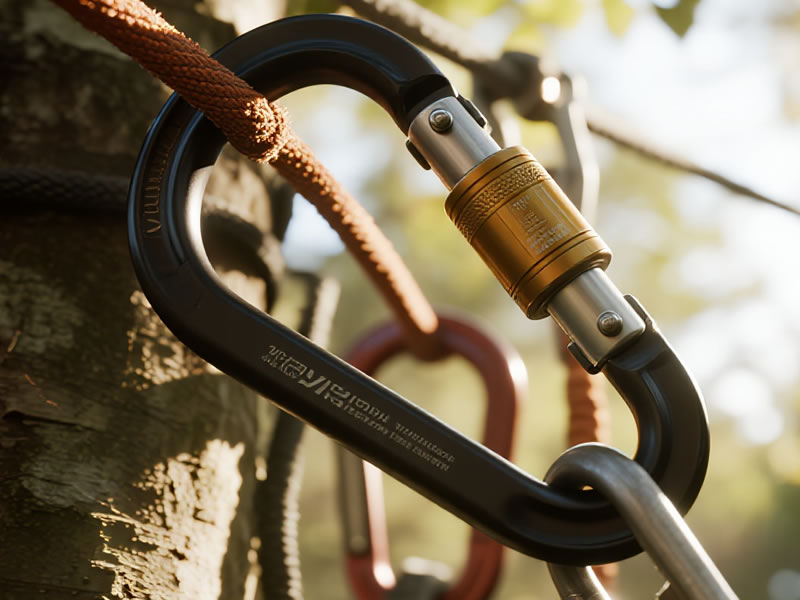
Why Recreational Climbing Carabiners Are Not Suitable
Recreational climbing carabiners (UIAA/CE certified for sport) are designed for dynamic rope systems and prioritized for weight savings. For the arborist, they present several critical failures:
- Insufficient Strength: While a 22 kN climbing carabiner is strong, arborist systems require connectors rated to 40 kN or higher to account for different shock loads and industrial safety factors.
- Poor Abrasion Resistance: Aluminum carabiners quickly develop deep, dangerous grooves from constant contact with Arborist climbing lines (which are often more abrasive than dynamic climbing ropes) and tree bark.
- Inadequate Security Mechanisms: A standard screw-gate can be inadvertently opened by brushing against branches or rigging.
Mandatory Standards and Certifications
Arborist carabiners must comply with industrial fall protection standards, not recreational climbing standards. The key certification to look for is:
- CE EN 362: The European standard for "Connectors" in personal fall protection equipment. This guarantees the carabiner meets minimum strength (typically 25 kN major axis, but professional models are much higher) and gate security requirements for work-at-height.
- Additional Standards: In North America, compliance with ANSI Z359.1 (for the overall system) is essential, and carabiners are often tested to CE EN 12275 (mountaineering) as a minimum, though professional-grade models far exceed these figures.
Critical Features of an Arborist Carabiner
- Material: Forged or Machined Steel. This is non-negotiable for primary life-support carabiners. Steel offers the necessary abrasion resistance and ultimate strength (40-50 kN). Anodized aluminum may be used for secondary, non-life-support applications like gear attachment.
- Locking Mechanism: Triple-Action Auto-Locking. The gold standard for arboriculture. This mechanism (push-twist-pull) cannot open accidentally from bumps, snags, or rope pressure. It ensures the gate stays locked without relying on the user to remember to screw it shut, a crucial safety feature during complex, distracting tasks.
- Size and Shape: Large and Oval or "H" Shaped. Arborist carabiners are generally larger to accommodate thick ropes, spliced eyes, and gloved hands. A wide, smooth shape (like an oval or the "H" shape of the Rock Exotica RockO) is easier to manipulate and kinder to spliced rope terminations.
- Major Axis Strength: Look for ratings of 40 kN to 50 kN (9,000 - 11,200 lbs force). This high rating provides the substantial safety margin required for professional rigging and life support.
Primary Types and Their Uses in the Tree
- Climbing System / Rope Snap Carabiner: This is the primary connector joining the climber's harness to the climbing line or lanyard. It is almost always a large, steel, triple-action auto-locker.Examples: Rock Exotica RockO, ISCTechnik (ISC) Sirius, DMM Captain (Steel).
- 2-in-1 Lanyard Snap / Flipline Carabiner: Used on adjustable lanyards for work positioning. It must be incredibly secure and often features a double-action (push-to-open) or triple-action lock for easy one-handed operation while maintaining safety.Examples: Buckingham (Steel) Lanyard Snaps, Notch Rope Boss.
- Rigging Carabiners (for Mechanical Advantage Systems): Used in setups like a 3:1 pulley system for lifting or advancing the rope. They need to be strong, smooth-running, and often feature a captive eye to keep a pulley side plate in place.Examples: DMM Revolver (Swivel), Petzl Omni (Swivel), ISC Rigger.
Safety Practices and Maintenance
- Daily Pre-Use Inspection: Check for cracks, deep grooves (especially from rope wear), corrosion, and smooth, positive locking action. Retire any carabiner with a groove deeper than 10% of its cross-sectional diameter.
- Keep Them Clean: Rinse off sap, dirt, and grit with water. Avoid petroleum-based lubricants; use a dry silicone spray on the gate mechanism only if specified by the manufacturer.
- Understand the System: A carabiner is only one component. Its safety is dependent on being used within a compatible, rated system—with the right rope, harness, and anchor points—and by a trained professional.
- Never "Side Load" or "Gate Load": As with all carabiners, force must be applied along the major axis (spine). Rigging techniques must ensure the carabiner is aligned correctly to avoid dangerous cross-loading.
Conclusion: The Professional's Lifeline
For the arborist, a carabiner is a fundamental tool of the trade, a compact piece of engineering that bears the full responsibility of a worker's safety high above the ground. By selecting steel, triple-action auto-locking carabiners certified for industrial fall protection (CE EN 362), and adhering to rigorous inspection and use protocols, the arborist invests in reliability that matches the demands of the canopy. In a profession where the margins for error are slim, the right carabiner isn't just a piece of gear—it's a lifeline, chosen with the same care and expertise applied to every cut and climb.




