




Carabiner with the Highest Breaking Strength: Understanding the Titans of Tensile Force
The quest for the carabiner with the highest breaking strength leads us out of the realm of recreational climbing and into the domain of industrial engineering, where the forces at play are measured not in kilonewtons but in tens of tons. The answer is not a single model but a category of connectors designed for the most demanding lifting, rigging, and maritime applications. Understanding this landscape reveals why "strongest" is a context-dependent term, and why the carabiner with the highest numeric rating is almost certainly the wrong tool for a climber.
The Industrial Champions: Where Strength is Measured in Tons
In heavy industry, construction, and maritime lifting, carabiners are replaced by or categorized alongside screw-pin anchor shackles and high-performance lifting connectors. These are the true titans of tensile strength.
- Typical Breaking Strengths: These devices have Minimum Breaking Loads (MBL) ranging from 50 tons to over 500 tons. For perspective:50 tons = 100,000 lbs ≈ 445 kN100 tons = 200,000 lbs ≈ 890 kN(A standard climbing carabiner is 22-28 kN).
- Prime Examples and Specifications:Crosby Group 320S / 321S Shackles: Industry standard. A 1" Screw Pin Anchor Shackle (Grade 6) has a minimum breaking strength of 52 tons (≈ 465 kN). Larger models go far higher.CM (Columbus McKinnon) Load-Rated Shackles: Offer similar ratings, with their G-209A series providing immense strength for rigging.Wichard Stainless Steel Shackles: In the marine world, their Grade 6 stainless shackles provide extraordinary corrosion-resistant strength, though slightly lower than carbon steel counterparts.
- Key Design Differences from Climbing Carabiners:Material: Forged Alloy Steel (Grade 6, 8, or 10). This is heat-treated for ultimate strength, not weight savings.Static vs. Dynamic Loads: Designed for controlled, static lifting. They are not engineered to absorb the shock load of a dynamic fall, which is a climbing carabiner's critical function.No "Gate" in the Climbing Sense: They use a screw pin or bolt that threads directly into the body, creating a complete, rigid circle under load. This eliminates the gate weakness entirely.Certification: Rated under standards like ASME B30.26 (Rigging Hardware) and marked with a Working Load Limit (WLL), which is typically 1/4 or 1/5 of the MBL for safety.
The Climbing World's Strongest: A Different Kind of Strength
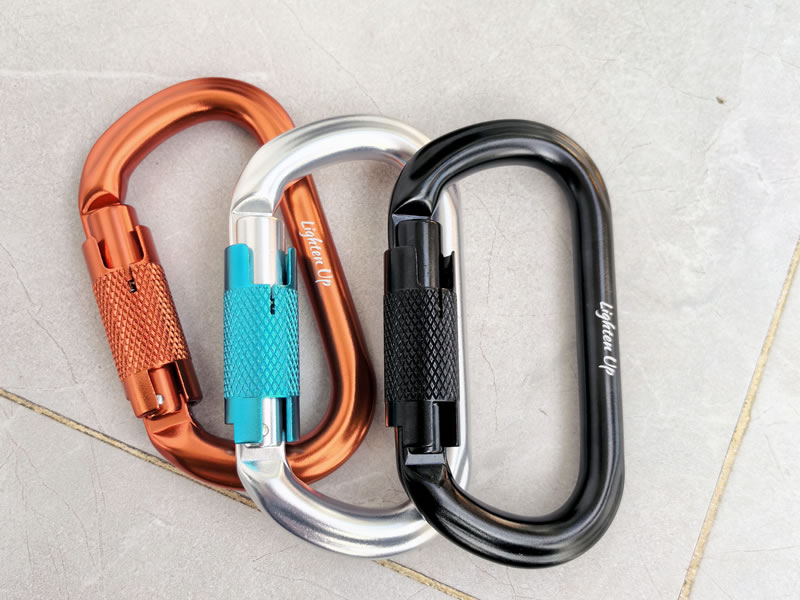
Within the UIAA/CE-certified universe of climbing and mountaineering equipment, strength is balanced against weight and dynamic performance.
- Typical Maximums: The strongest mass-produced climbing carabiners (usually steel locking Ds) have major axis breaking strengths in the range of 35 kN to 45 kN.
- Examples:Petzl WILLIAM ATTACHE (Steel): ~ 40 kN.DMM Captain (Steel): ~ 40 kN.Black Diamond RockLock (Steel): ~ 38 kN.
- Why Not Stronger? Beyond this point, the weight penalty of steel becomes excessive for a climber. Aluminum, with its superior strength-to-weight ratio, dominates climbing because a 22 kN aluminum carabiner is more than strong enough to handle the dynamic forces of a worst-case fall, which rarely exceed 8-10 kN on a single piece.
The Critical Concept: Strength is Not the Only Metric
Choosing a carabiner based solely on its maximum breaking strength is a profound mistake. The correct choice is governed by the application's required safety factor and load type.
- Climbing & Fall Arrest: Uses a dynamic safety factor. The system (rope, absorber) is designed to limit peak force. The carabiner's certified strength (22+ kN) provides a massive 5:1 or greater safety margin over the limited fall force. Higher strength offers no practical benefit, only dead weight.
- Industrial Lifting & Rigging: Uses a static safety factor. The WLL is set at 1/4 or 1/5 of the MBL to account for unknown variables (shock, angle). The hardware must be strong enough to handle the full, calculated static load with this safety margin. Here, ultra-high MBL is directly relevant.
Conclusion: The Right Strength for the Right Job
The "carabiner with the highest breaking strength" is a heavy-duty, alloy steel screw-pin shackle with a rating measured in tens of tons, used to lift steel beams or secure ship cargo.
However, for human life support in dynamic situations (climbing, via ferrata, rescue), the "strongest" tool is the one that is appropriately certified for the activity, offering not just high kilonewtons, but the right combination of dynamic performance, weight, gate security, and certified reliability.
Therefore, the informed user seeks not the highest number, but the correct specification: a UIAA/CE-certified carabiner for climbing, an EN 362-certified connector for work-at-height, or an ASME B30.26-rated shackle with a suitable WLL for industrial lifting. Ultimate breaking strength is a fascinating engineering datum, but in practice, functional suitability and correct certification always trump a raw strength record.




