




Largest Carabiners for Heavy Equipment: The Industrial Connectors Beyond "Carabiner"
In the realm of heavy equipment, construction, and industrial lifting, the term "carabiner" gives way to the more precise descriptors of "screw-pin anchor shackles," "chain shackles," or "industrial lifting connectors." These are the true titans of the connection world—forged steel behemoths designed not for the dynamic loads of a human fall, but for the immense, sustained, and often static forces of moving multi-ton loads.
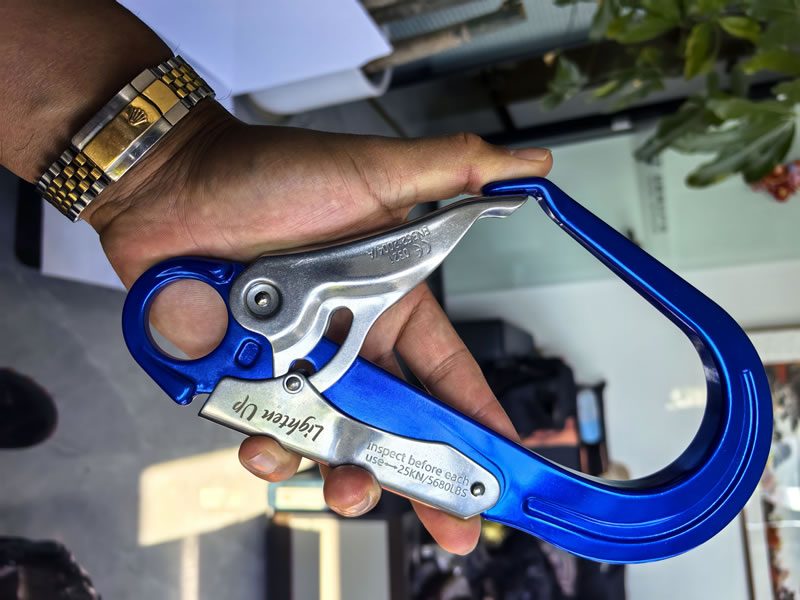
Distinguishing Industrial Shackles from Climbing Carabiners
The primary differences are foundational:
- Closure Mechanism: They lack a spring-loaded gate. Instead, they use a removable screw pin or bolt that threads directly into the body, creating a solid, closed circle under load. This eliminates the "open gate" weakness entirely.
- Material and Strength: Made from heat-treated, forged alloy steel (Grades 6, 8, or 10). Their strength is measured in tons, not kilonewtons.
- Standard and Purpose: Governed by ASME B30.26 (Rigging Hardware) and other industrial standards. They are marked with a Working Load Limit (WLL), not just a breaking strength, which includes a built-in safety factor (typically 4:1 or 5:1).
Defining "Largest": Sizing and Capacity
Size in this category refers to material diameter and WLL.
- Common Large Sizes: For truly heavy equipment, shackle diameters often start at 1 inch (25mm) and scale up to 1.5 inches (38mm) and beyond.
- Working Load Limits: Correspondingly, the WLL for these sizes ranges from approximately 8.5 tons (1" Grade 6) to over 30 tons (1.5"+ Grade 8). The Minimum Breaking Load (MBL) is 4-5 times higher.
- Physical Dimensions: These shackles are substantial, often weighing several pounds each, with inside widths and lengths measured in inches to accommodate thick slings, master links, and other hardware.
Primary Types for Heavy-Duty Applications
- Anchor Shackles (Bow Shackles):Shape: Characterized by a large, rounded "bow" shape.Advantage: The wider bow allows it to accept multiple connection points (e.g., several sling legs) without pinching.Use: The most versatile and common choice for general heavy lifting, crane rigging, and securing equipment.
- Chain Shackles (Dee Shackles):Shape: Resemble a "D," with a narrower, straighter-sided bow.Advantage: Stronger in-line with the load than a similarly sized anchor shackle, as the load is more directly aligned with the pin.Use: Ideal for direct, in-line connections to chain or where a narrower profile is needed.
Critical Selection Factors for Heavy Equipment
Choosing the correct shackle is a calculated safety decision:
- Grade of Steel: Determines strength-to-weight ratio.Grade 6: General purpose.Grade 8: High strength, more common in demanding applications.Alloy (e.g., G-2130): Even higher strength for specialized uses.
- Working Load Limit (WLL): The maximum allowed load in service. The total load on the shackle must never exceed its WLL. This includes calculating loads from angles in multi-leg slings.
- Pin Type:Screw Pin: Most common, for general use. Must be fully threaded and tight.Bolt-Type / Safety Pin: Uses a nut and cotter pin. Used where vibration could loosen a screw pin or in permanent/pendant applications.
- Certification and Marking: Every legitimate shackle must be permanently marked with its WLL, grade, manufacturer, and a unique ID. Look for certification from bodies like NA (National Association of Chain Manufacturers) in the US.
Top Industrial Manufacturers
The market is dominated by brands built for engineering, not recreation:
- The Crosby Group: The global industry benchmark. Their Crosby 320S (Screw Pin Anchor) and 321S (Bolt-Type) shackles are ubiquitous on job sites worldwide.
- CM (Columbus McKinnon): Another leading manufacturer with a comprehensive line of high-quality, certified shackles.
- WLL (Wheeling Lock/Lug): Known for durable rigging hardware.
- Rigging and Marine Brands: Companies like Wichard and Kong offer high-grade stainless steel shackles for marine and corrosive environments.
Safety Protocols and Inspection: Non-Negotiable Practices
- Pre-Use Inspection: Check for deformation (bending, stretching), cracks, corrosion, and thread damage. The shackle must open and close smoothly.
- Proper Loading: Load must be applied in-plane (through the center of the bow) and never side-loaded on the pin. The pin must be fully engaged and seated.
- Avoid "Shackle Prying": Never use a shackle if the connected slings or hardware are forcing the bow apart sideways.
- Immediate Retirement: Any shackle that is dropped from significant height, shows visible deformation, or has been overloaded must be taken out of service immediately. The crystalline structure of the steel can be compromised invisibly.
Conclusion: The Engineered Link in the Industrial Chain
The "largest carabiner for heavy equipment" is, in truth, a high-grade, certified industrial shackle—a precision-engineered, forged steel link upon which the safety of personnel and the security of colossal assets depend. Its selection is a technical discipline, requiring an understanding of load ratings, angles, and material science. By insisting on properly marked, grade-rated shackles from manufacturers like Crosby or CM, and enforcing a rigorous culture of inspection and correct use, industries ensure that these massive connectors perform their Herculean task reliably. In the world of heavy equipment, where failures are catastrophic, the right shackle is not just hardware; it is the definitive, calculable link between a planned lift and a safe outcome.




